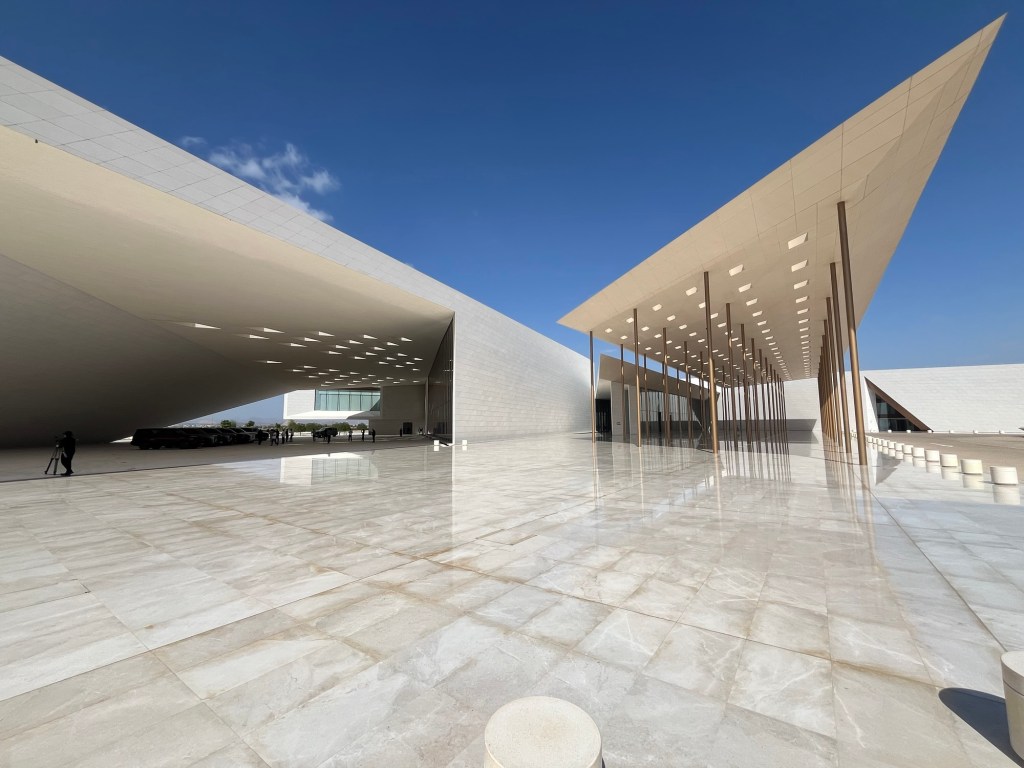
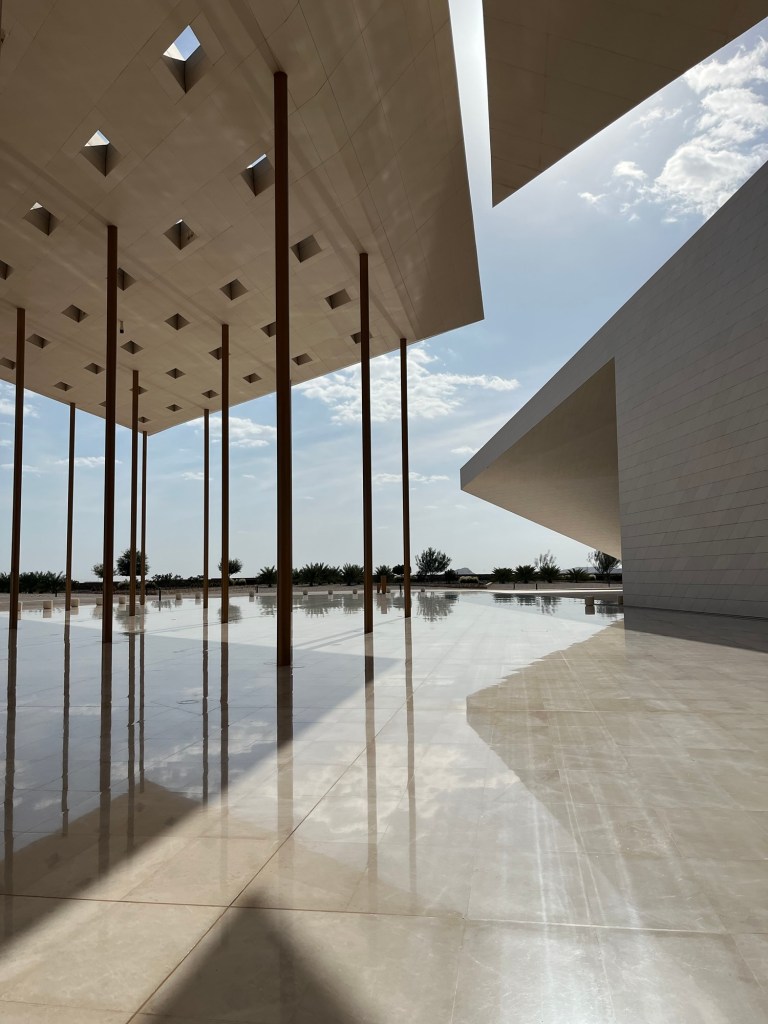
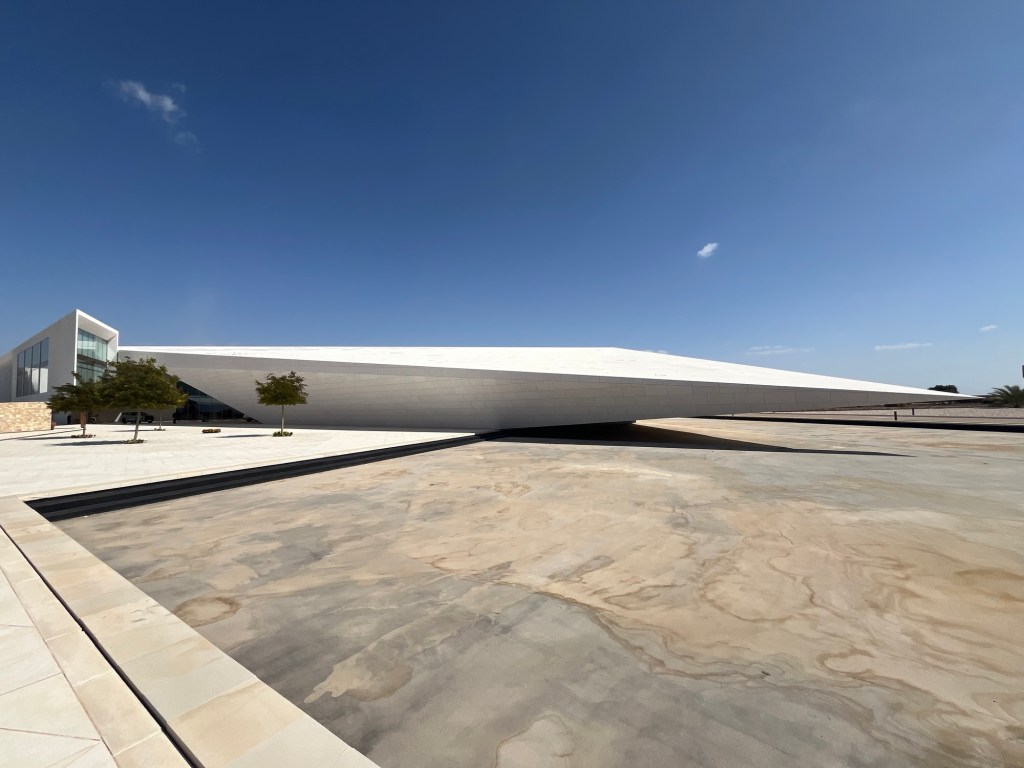
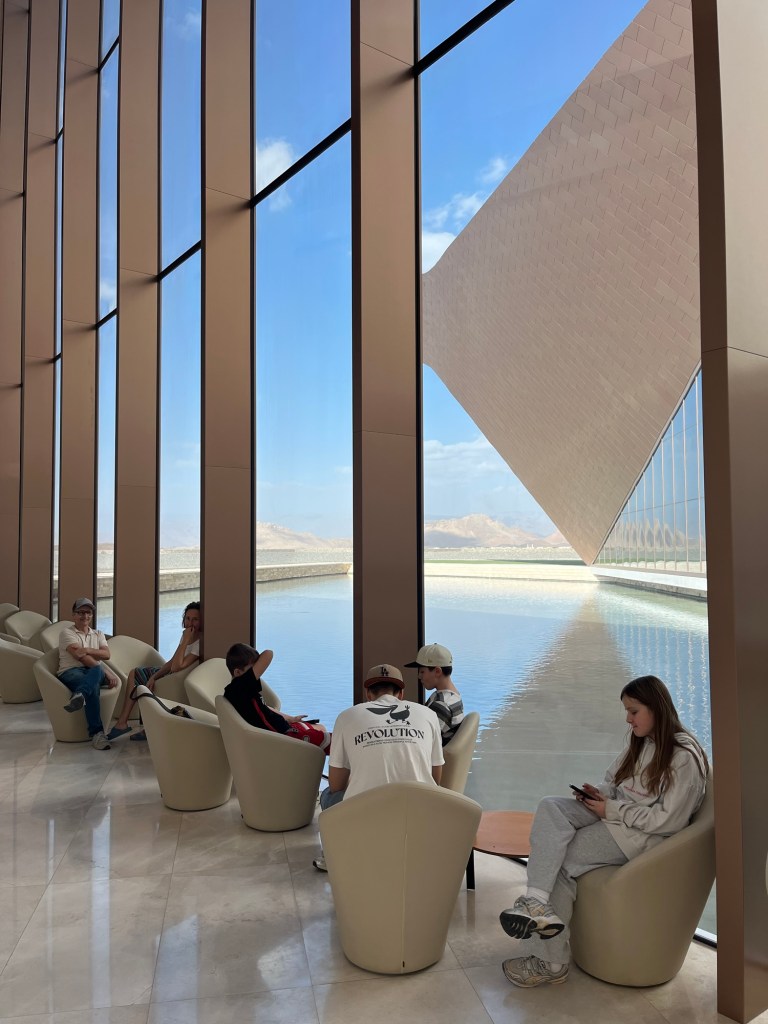
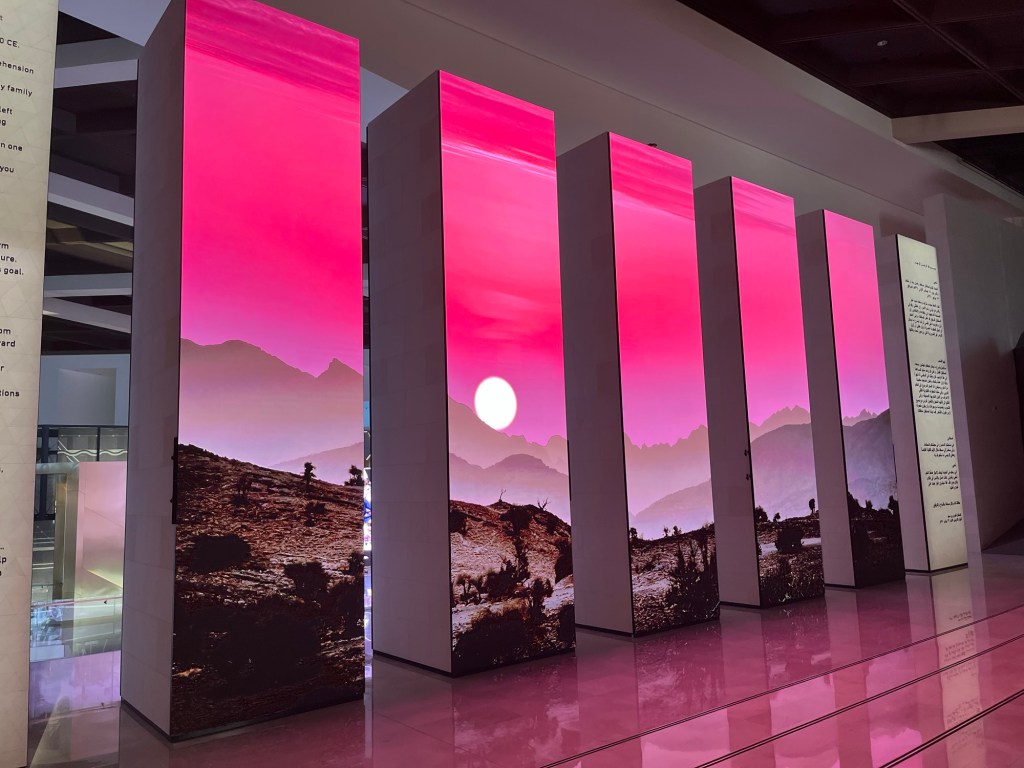
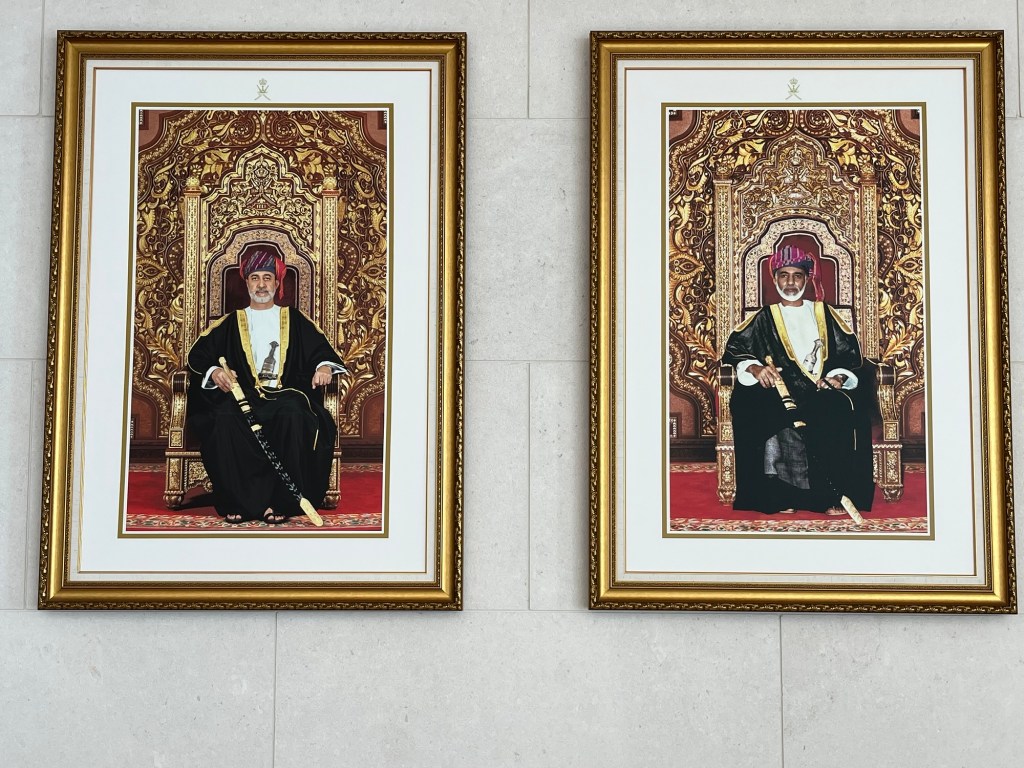
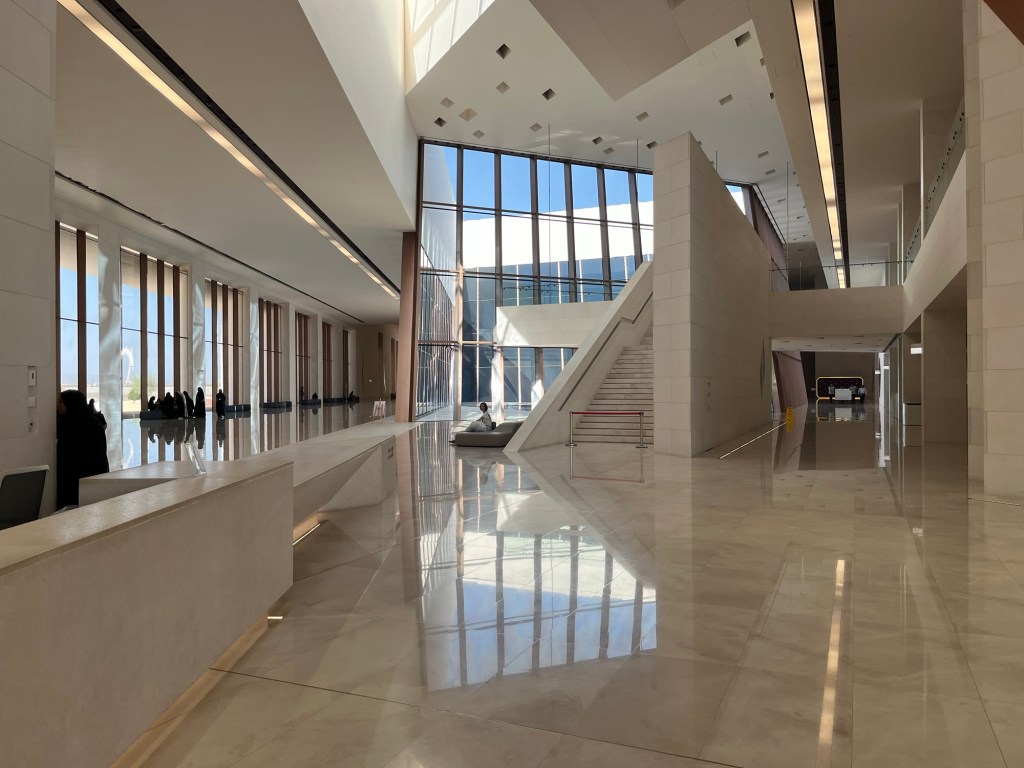
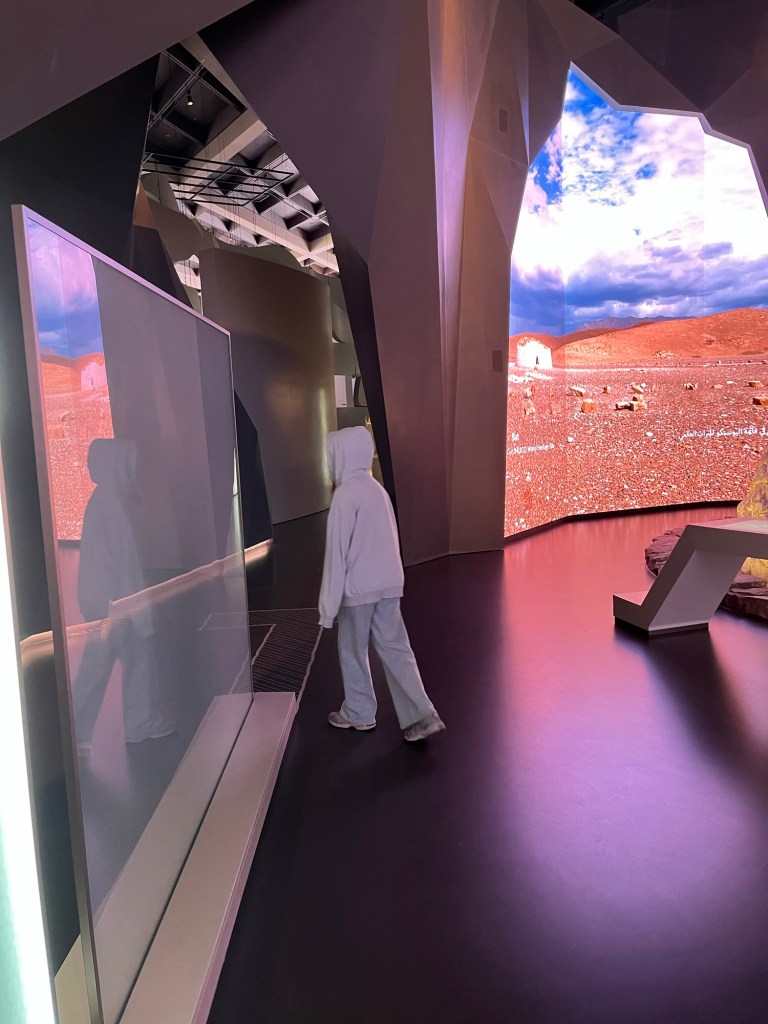
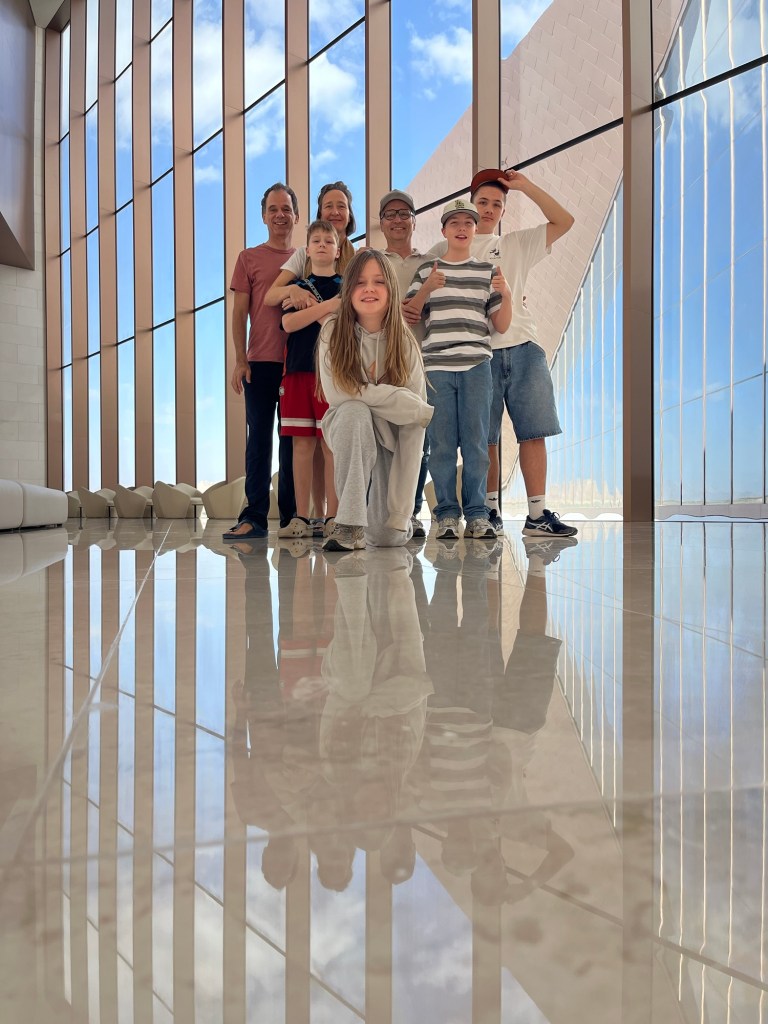
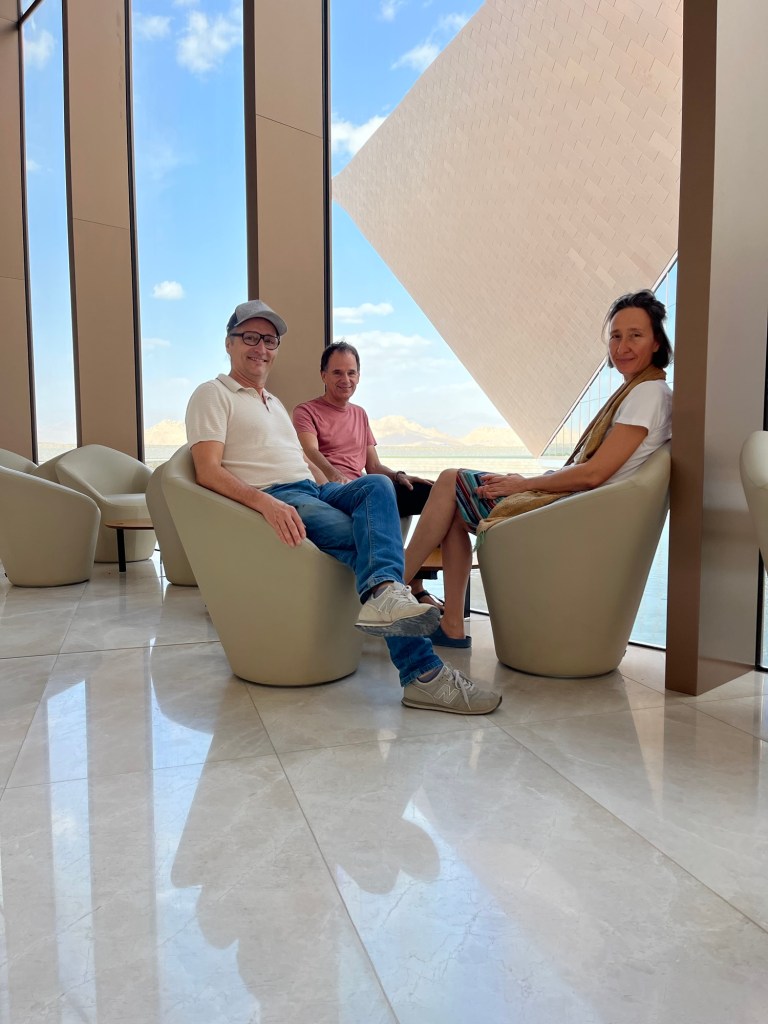
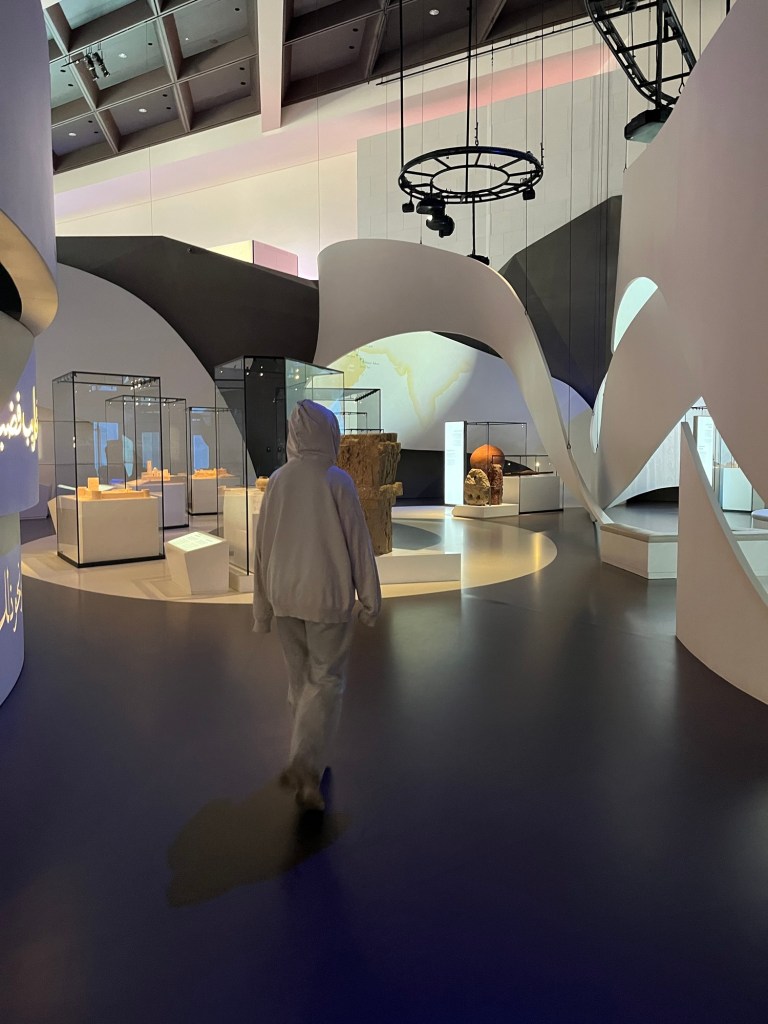
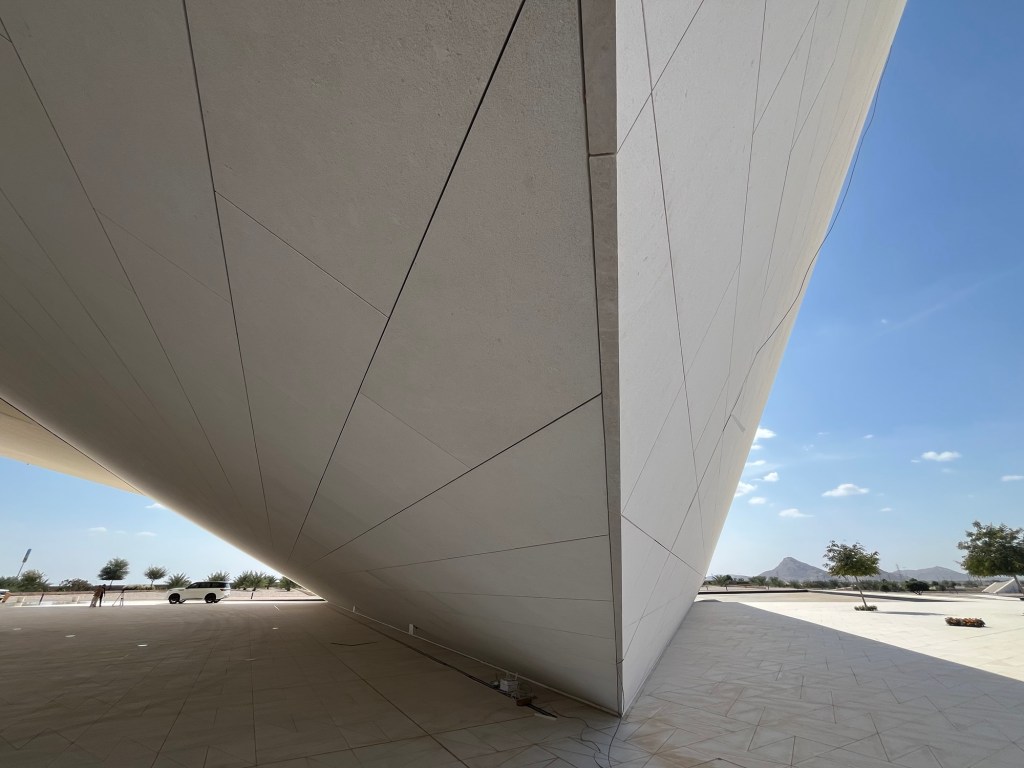
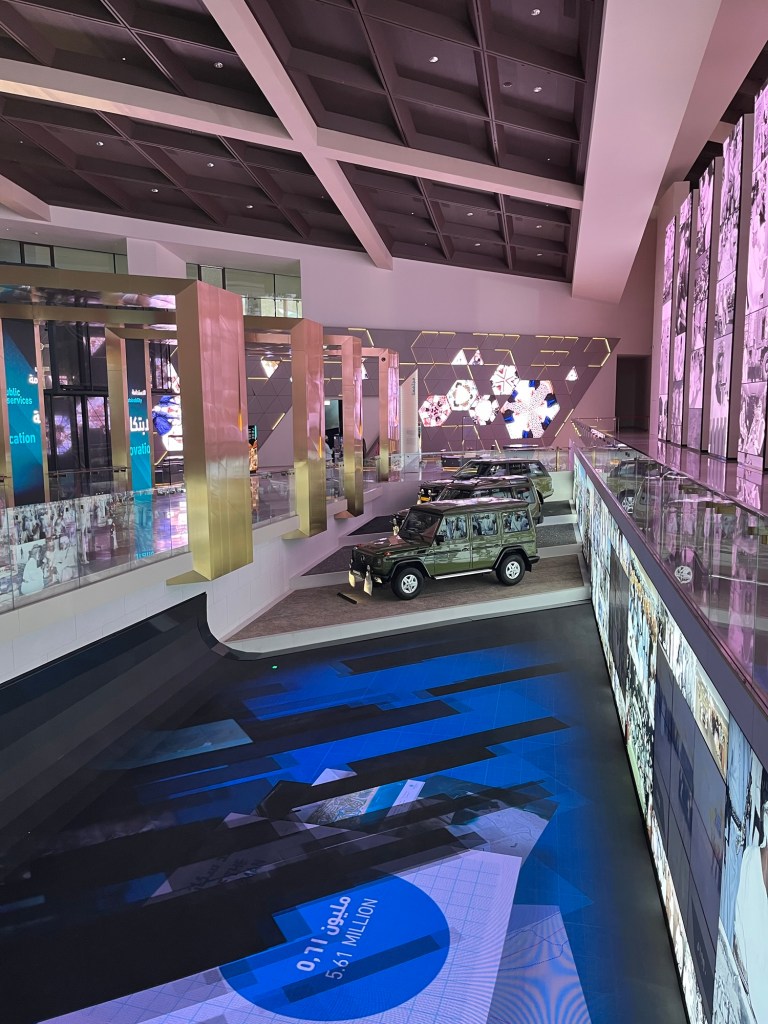
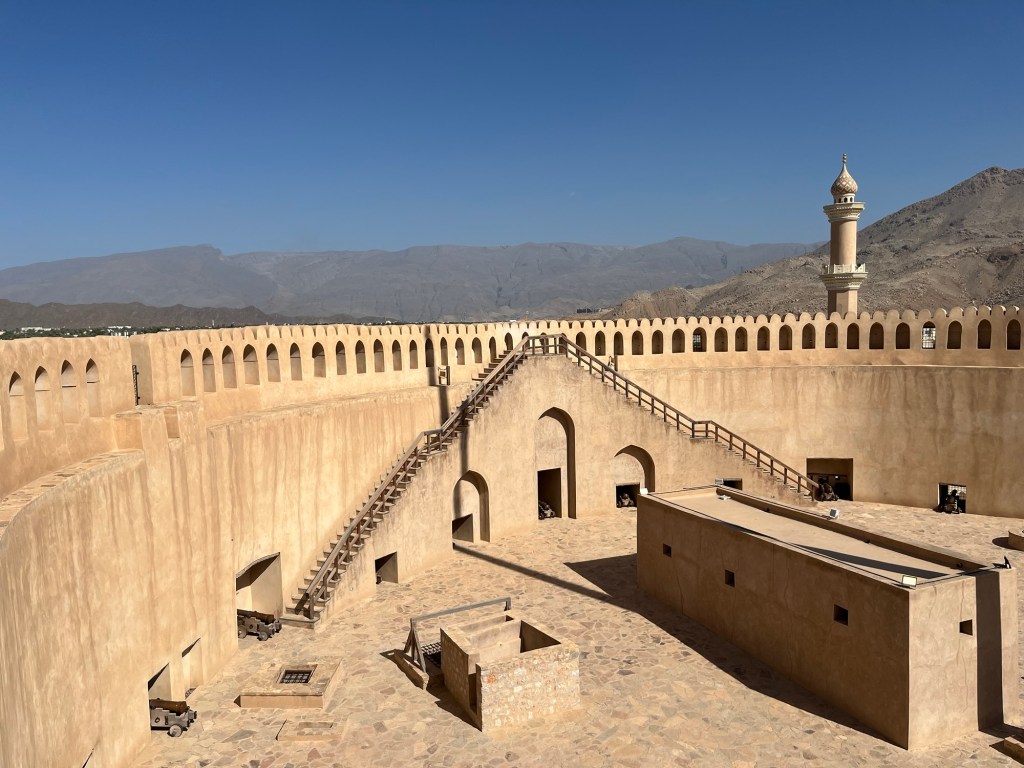
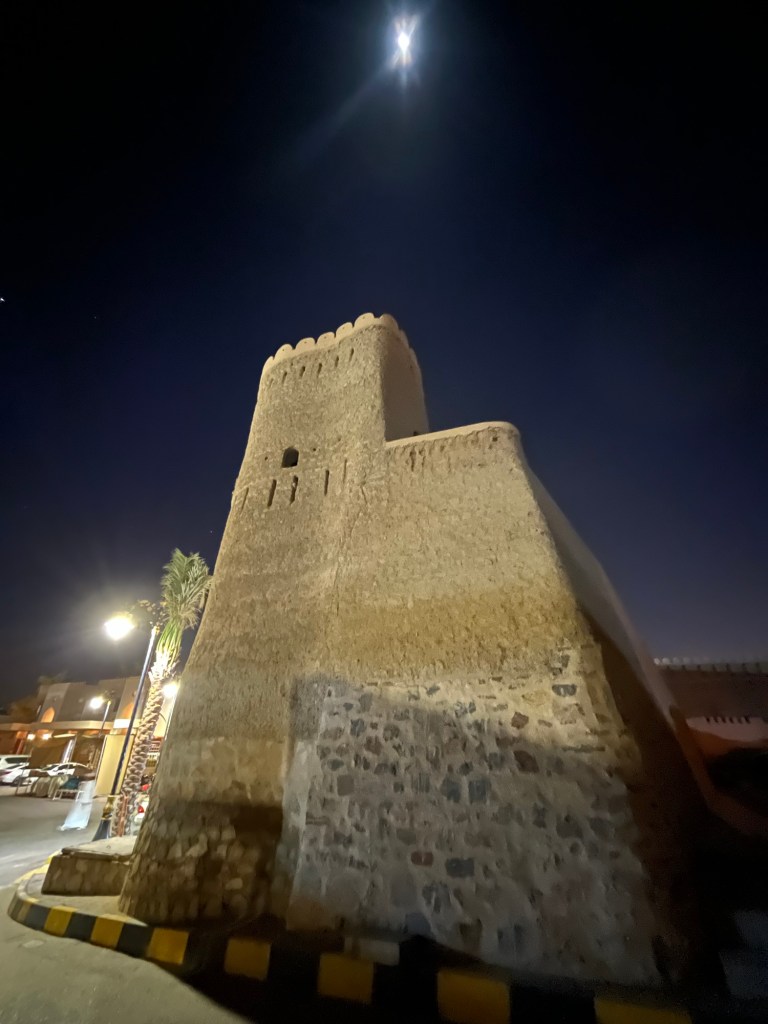
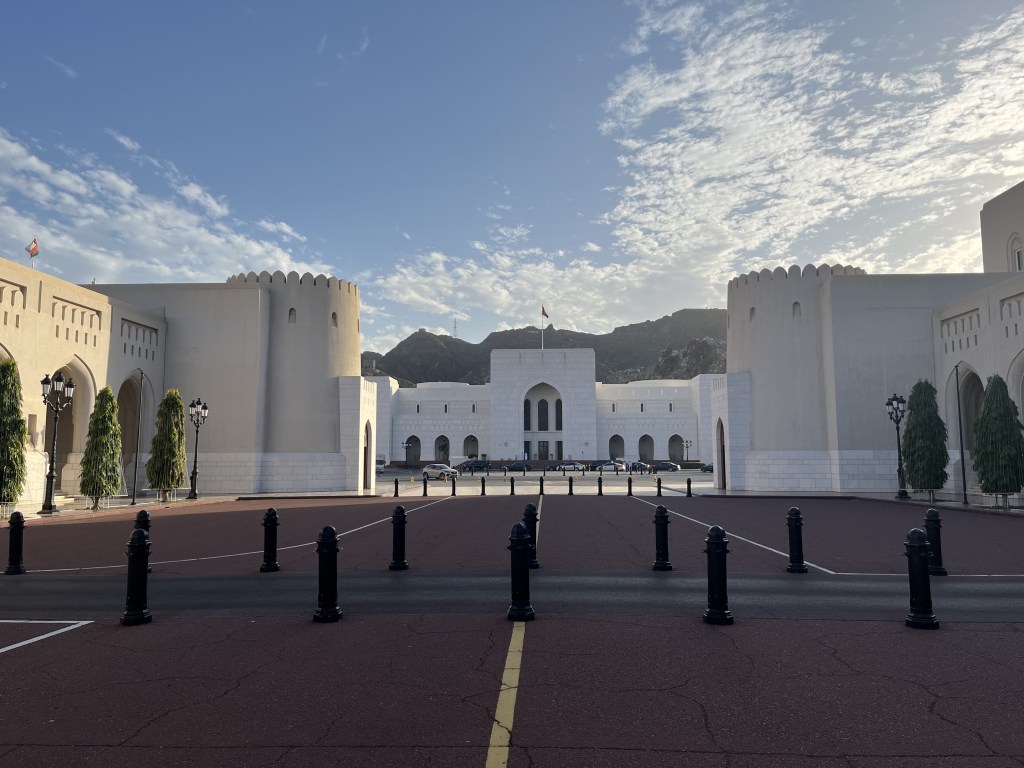
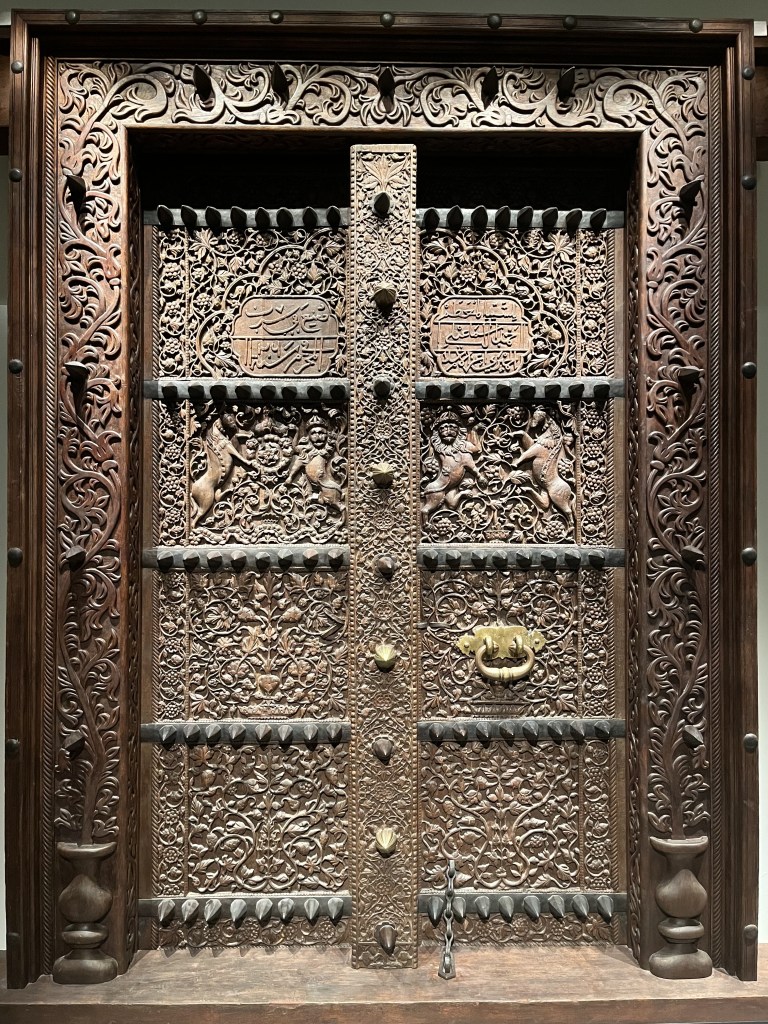
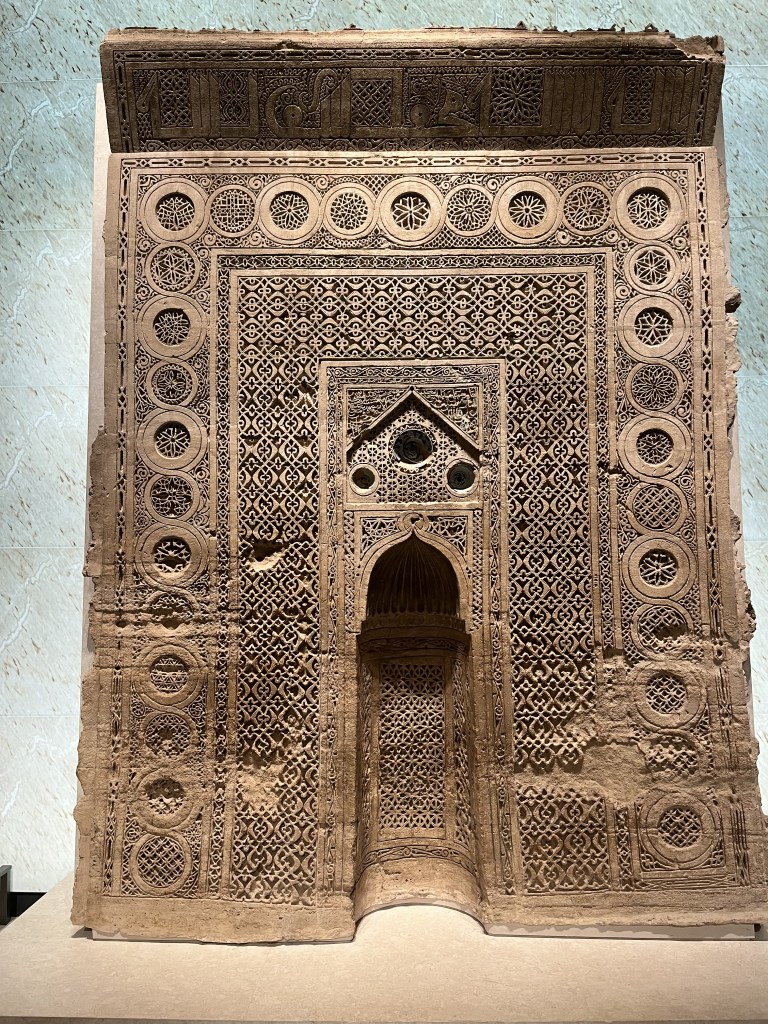
Eigentlich wollte ich ja über das Fort vom Nizwa berichten. Eindrucksvoll restauriert, der meist besuchte Ort des Landes. Den Jungs gefiel am meisten die drei Todesfallen am Eingang. „The King of Germany was there, last year“- meinte der Eisverkäufer zu Andreas und zeigte auf das Bild von Steinmeier. Doch irgendwie verblasste das alles angesichts des Museums, das wir danach sahen. Mit 300.000 m2 50% größer als der Louvre. 3 Milliarden Euro wäre eine konservative Schätzung für die Kosten. 2023 eröffnet, haut es einen in allen Dimensionen einfach um. Von außen wie innen, die Technologie, die interaktiven Objekte. Es sieht wie aus einer science Fiction Szene auf einem fremden Planeten aus.
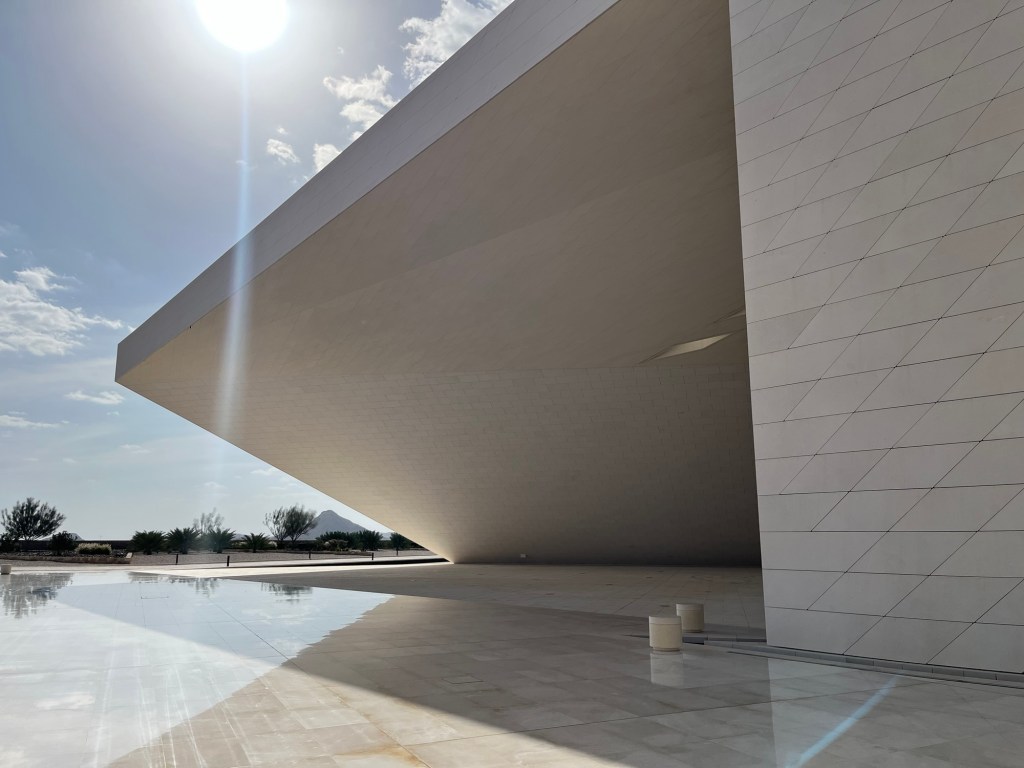
Ich fand es wirklich beeindruckend- es gewann den Preis als schönstes Museum der Welt 2024. Die australischen Architekten Cox durften sich hier offenbar austoben- Budget und Gestaltung ohne Limit.
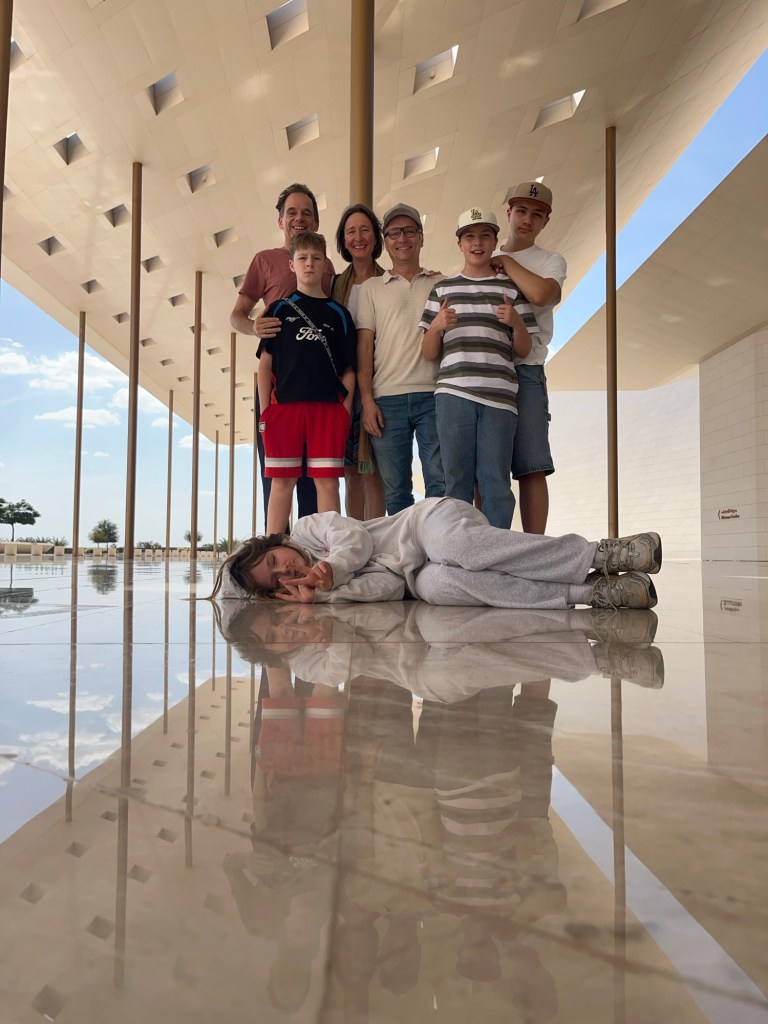
Das Dreieck als das geometrische Motiv, in Extremform genutzt. Hier möchte man Influencer sein, um mal ein paar wirksame Selfies zu drehen. Oder den Tesla Cybertruck in Szene setzen. Aber noch wird hier mit Benzin gefahren- Spritpreis 60 Cent der Liter.
Doch der Oman setzt auf Wasserstoff und Tourismus als die Zukunft. Investition von 70 Milliarden US$ sind für grünen Wasserstoff geplant.
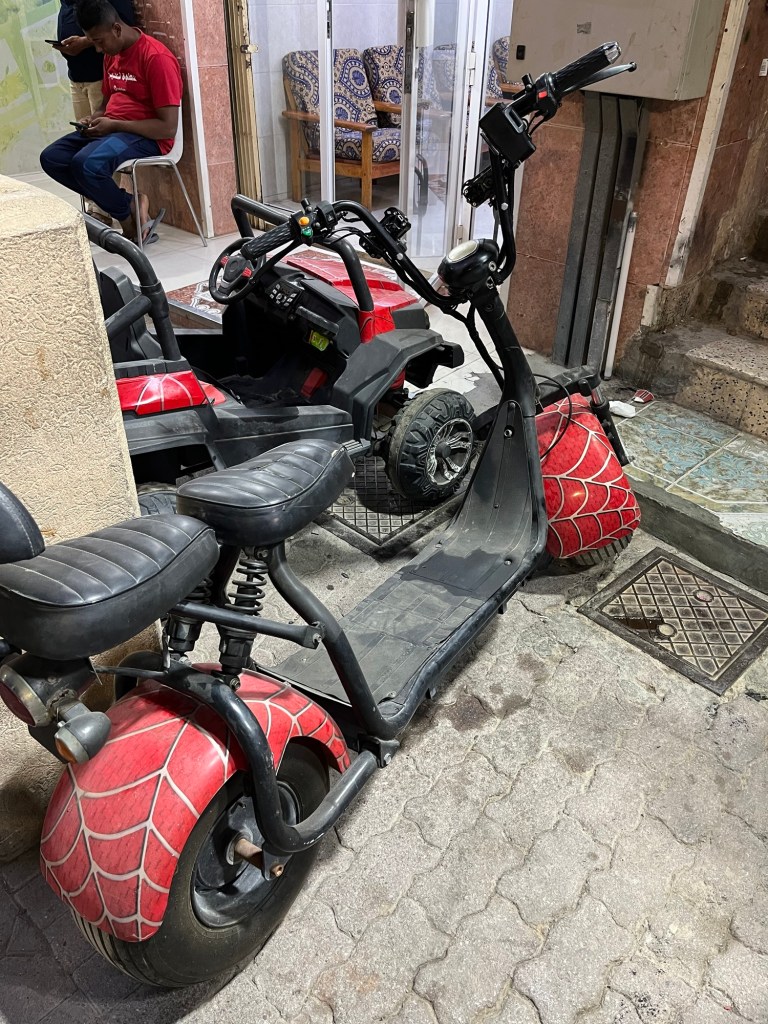
Schon heute begeistert die leisen Elektro-Mopeds, mit denen die Locals abends durch die kleinen Gassen der Altstadt cruisen.
Day 8
I actually wanted to report on the fort in Nizwa. Impressively restored, the most visited place in the country. The boys liked the three deaths at the entrance the most. „The King of Germany was there last year“ – said the ice cream seller to Andreas, pointing to the picture of Steinmeier. But somehow it all paled in the face of the museum we saw afterwards. At 300,000 m2, it is 50% larger than the Louvre. 3 billion euros would be an honorably conservative estimate for the cost. Opened in 2023, it simply blows you away in all dimensions. From the outside as well as the inside, the technology, the interactive objects. It looks like something out of a science fiction scene on an alien planet.
I found it really impressive – it won the prize for the most beautiful museum in the world in 2024. The Australian architects Cox were obviously allowed to let off steam here – budget and design without limits.
The triangle as a geometric motif, used in extreme form. Here you want to be an influencer to take a few effective selfies. Or to showcase the Tesla Cybertruck. But people are still driving on petrol here – the price is 60 cents a liter.
But Oman is banking on hydrogen and tourism as the future. An investment of US$ 70 billion is planned for green hydrogen.
The quiet electric mopeds on which the locals cruise through the narrow streets of the old town in the evenings are already a hit.
Beim Aufbruch gab es unterschiedliche Geschwindigkeiten. Andreas, der erst gegen Mitternacht einschlief wurde um 2 Uhr morgens vom Betonmischer geweckt, der die Baustelle nebenan belieferte, gegen 5 waren dann auch Yuki und Inyan vom Krach wach. Nadine wiederum wollte früh aufbrechen und den Tag nutzen. 9.00 ist Abfahrt- um 9.30 wurde sie unruhig. Auf der Autobahn versuchte Andreas dann die verlorene Zeit wieder reinzuholen- ich hatte Mühe mein 2,5 Tonnen SUV zu beschleunigen um ihn nicht aus den Augen zu verlieren.
Als wir dann nach zwei Stunden Fahrt im Wadi Tanuf ankamen, fehlte Nadine die Snacks für die Wanderung, wir hatten keinen Laden gesehen.
Nach einem kurzen Gespräch waren dann die Wogen wieder geglättet. Ich spielte wie üblich den Oberlehrer und hatte Morpheus und Tara die Fahrt über mit dem Quadratzahlen bis 20 genervt. Was ist 17 mal 17? Irgendwann saß es und wir schwenken auf Harry Potter als Audible Hörbuch, gelesen von Rufus Beck um. So viel mehr Inhalt als im Film, und wie er all die Stimmen variiert!
Nadine übernahm auf halber Strecke das Steuer, und ich konnte etwas relaxen. Draußen Felsen und Berge, wenig grün und die Autobahn akkurat durch die Anhöhen gefräst. Etwas erinnerte es mich an Colorado oder Nevada.
Der Anfang des Tals sah vielversprechend aus- ich hatte ja Baden versprochen und erläutert- hinter der Staumauer kommt das Wasser.
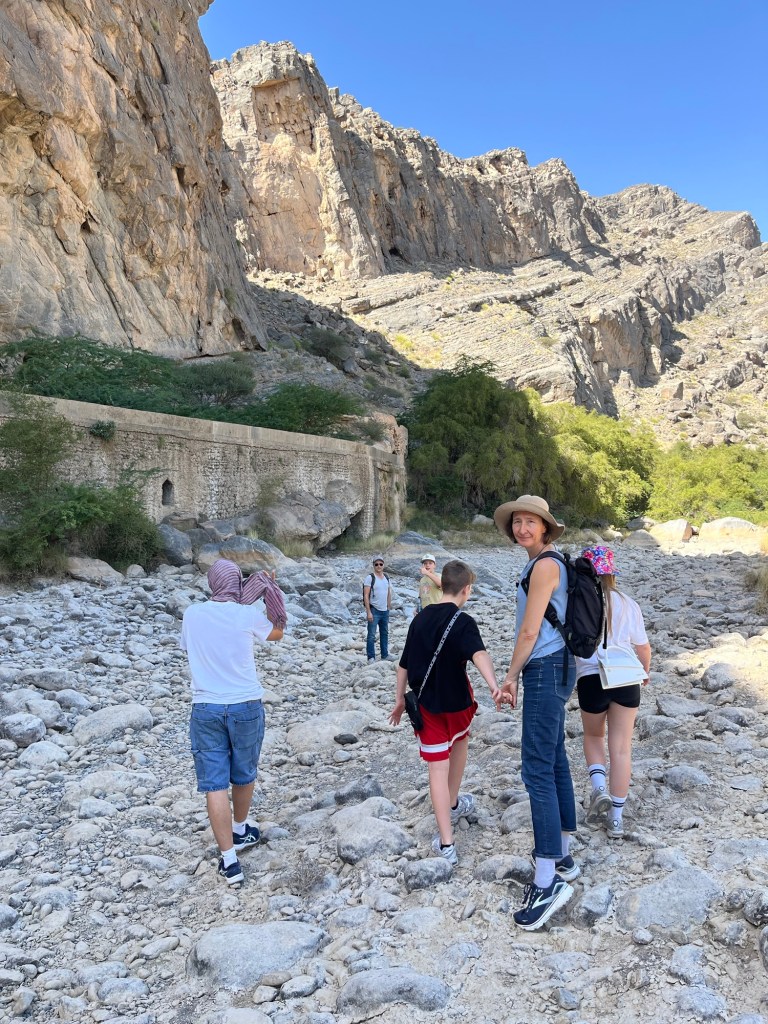
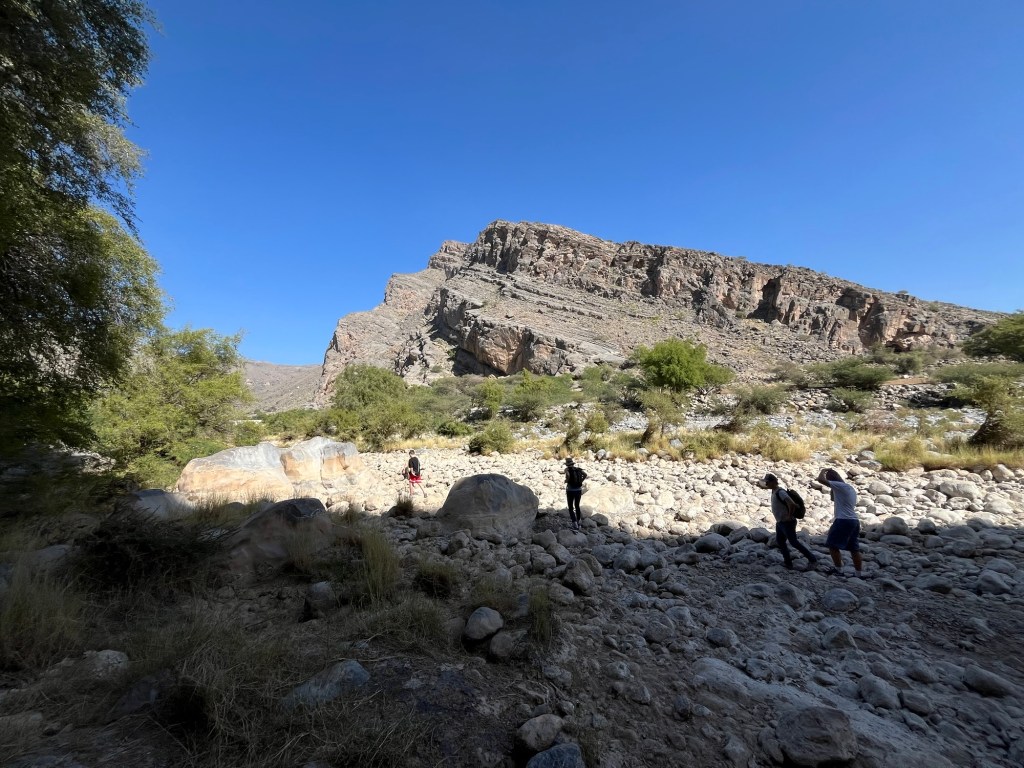
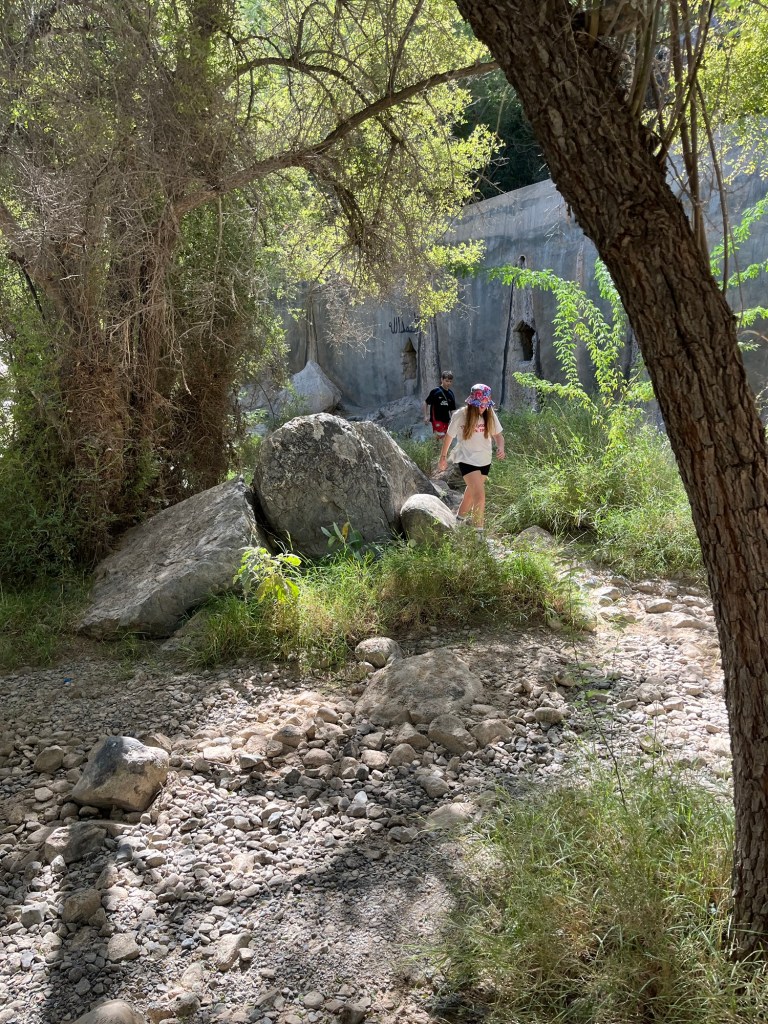
Wir stiegen das trockene Flussbett hinauf und kletterten über glattgeschliffene Felsen gutgelaunt durch die Mittagshitze.
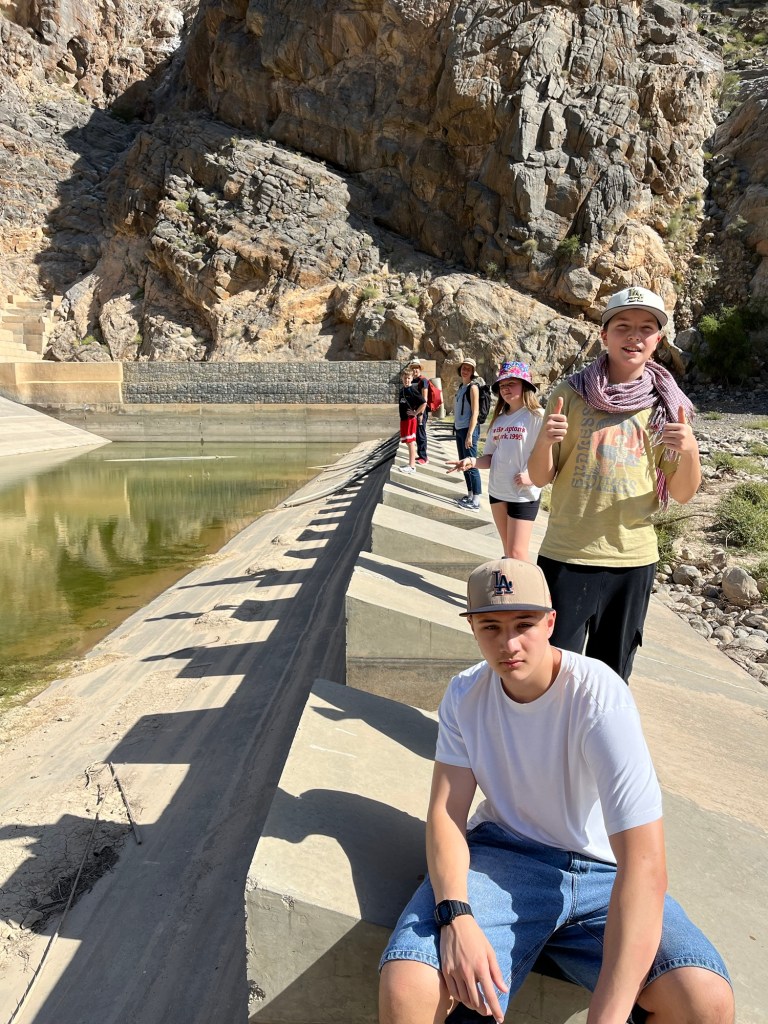
Doch es kam anders. Alles ausgetrocknet, der Rest vor der Staumauer verlockte die Kinder nicht- und es war auch noch klar erklärt- Baden verboten.
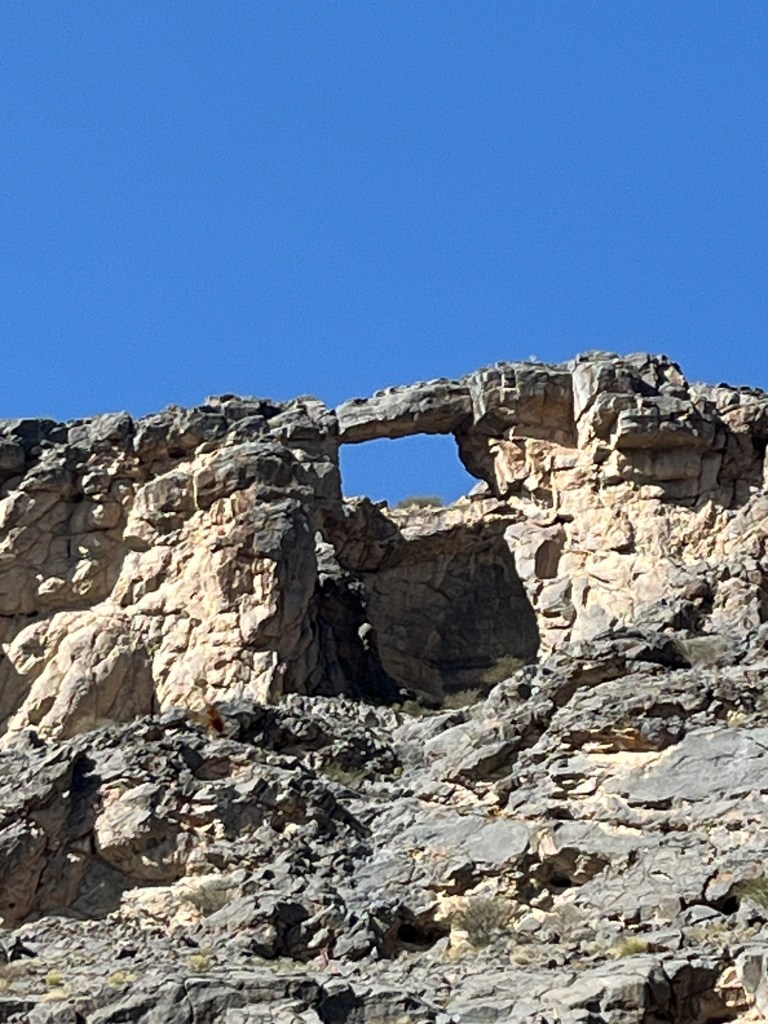
Aber so schnell waren wir nicht aus der Fassung zu bringen. Dann machen wir eben eine Exkursion, das Tal hinauf bis zum Aussichtspunkt, an dem Google Maps einen Steinbogen eingetragen hatte..
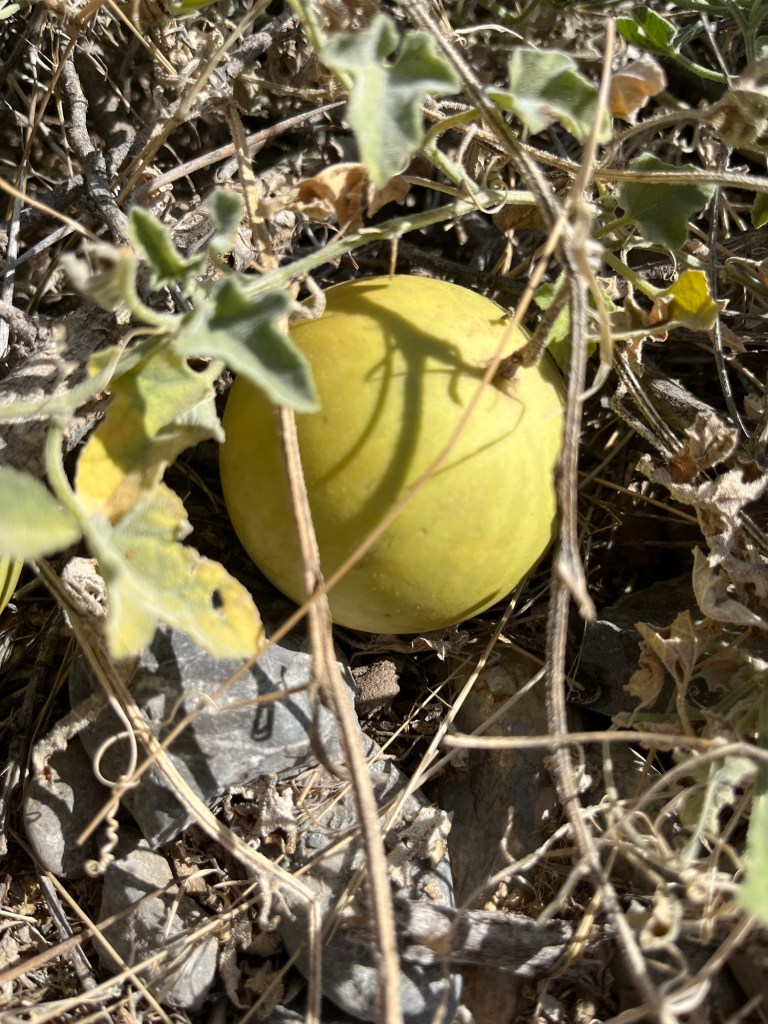
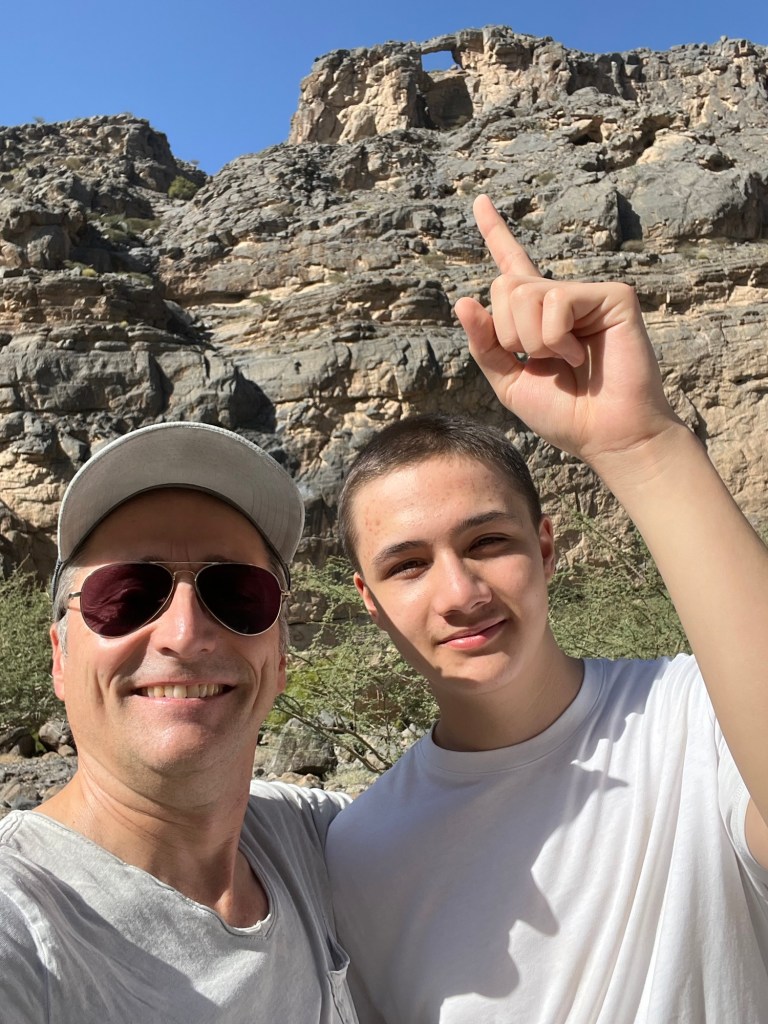
Dort dann ein verdientes Picknick im Schatten, die halb angefaulte Wassermelone von vorgestern und die Nüsse mit Wasser schmeckten allen erstaunlich gut . Yuki hatte noch Energie übrig, wollte noch einmal um den Fels herum steigen, um in das aufsteigende Tal zu schauen – hier könnte man längere Trekking Touren machen.
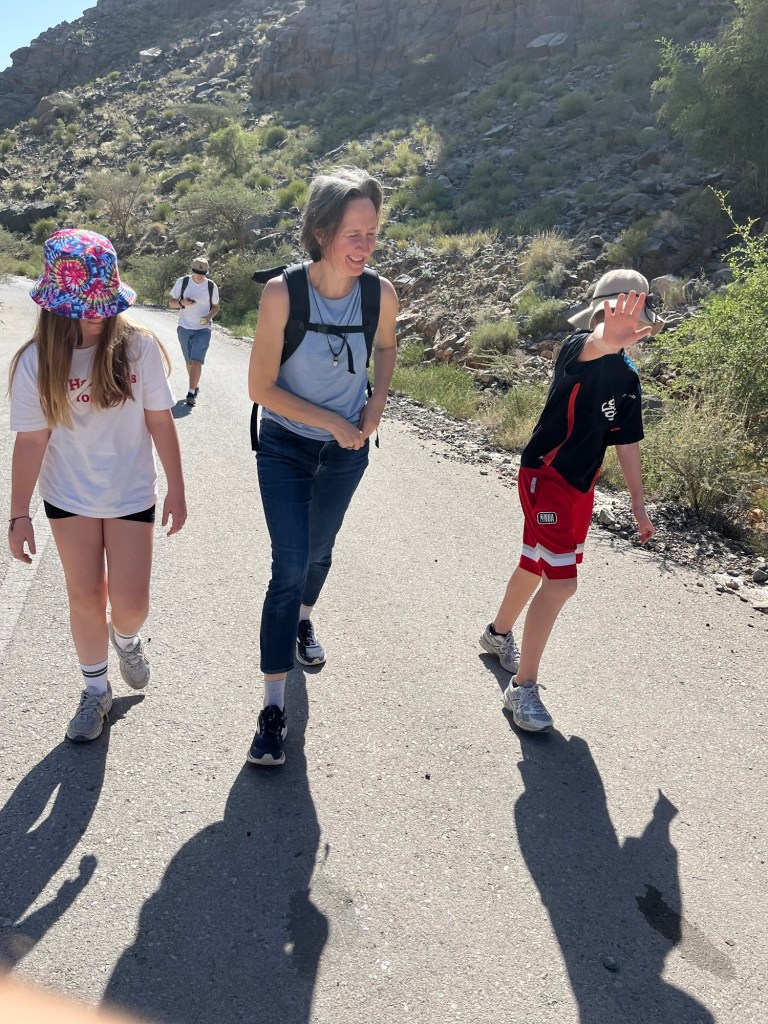
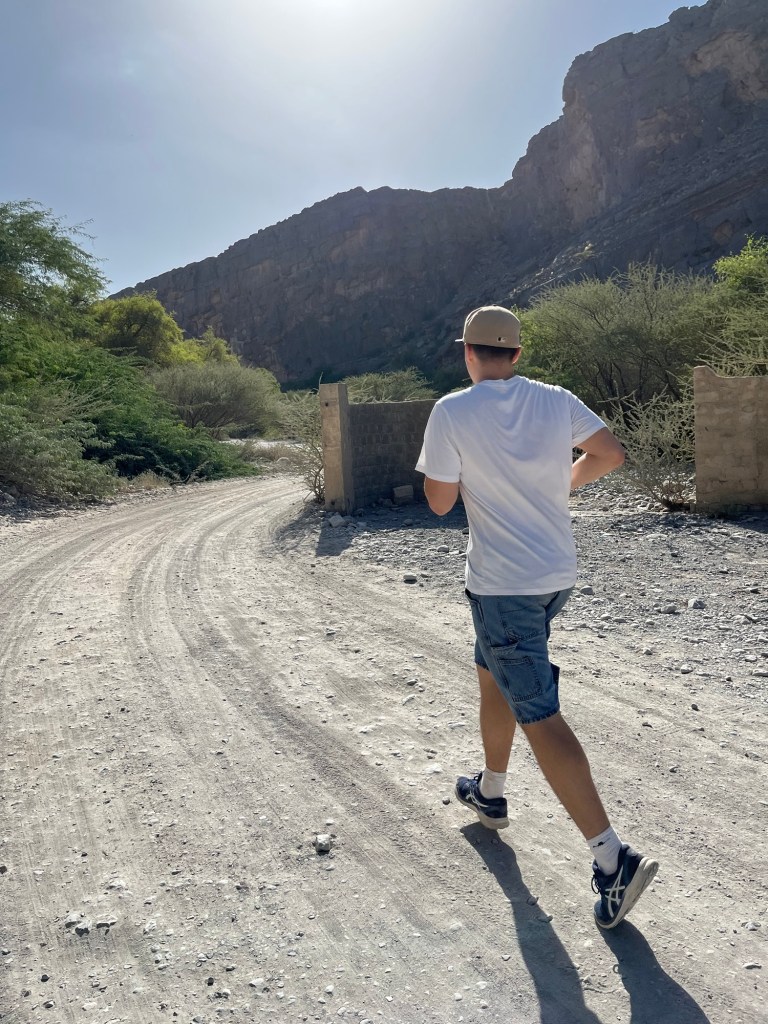
Und er schlug vor, die Strecke zurück zu joggen. Das ließ ich mir nicht nehmen, und wir rannten durch die Hitze zurück, kamen erschöpft, aber Happy wieder am Parkplatz an. Jetzt galt es unser Hotel in der Altstadt von Nizwa zu finden. Mit dem Auto gestaltete sich das schwierig, so dass wir es außerhalb der Mauer auf dem Parkplatz im trockenen Flussbett parkten.
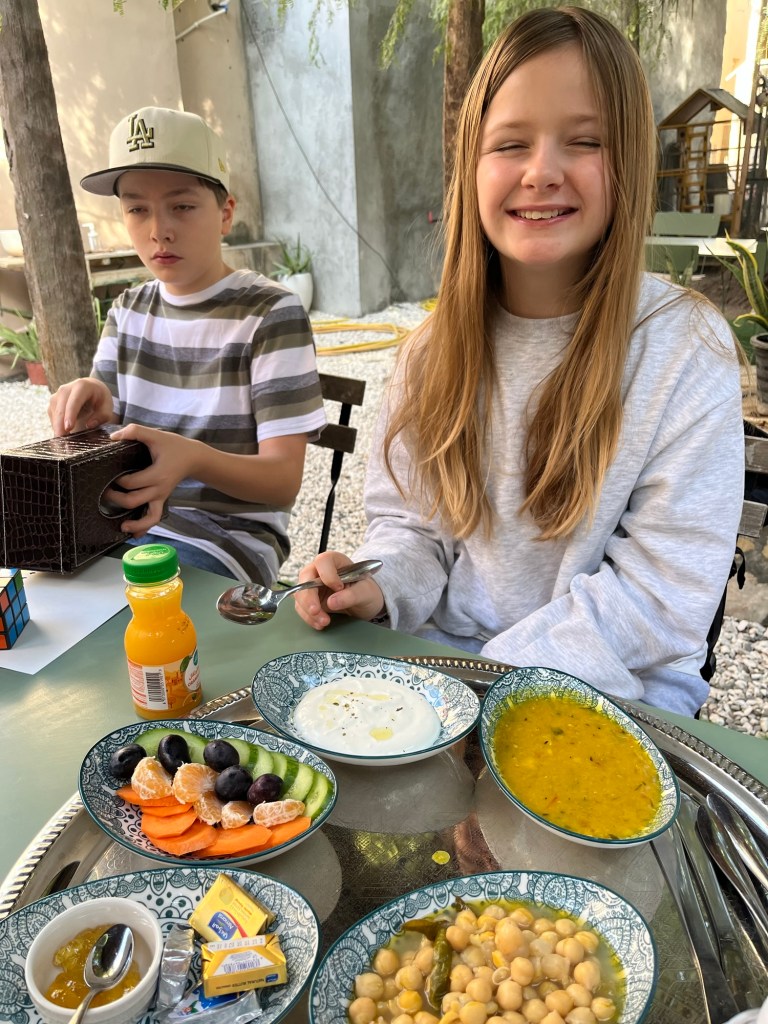
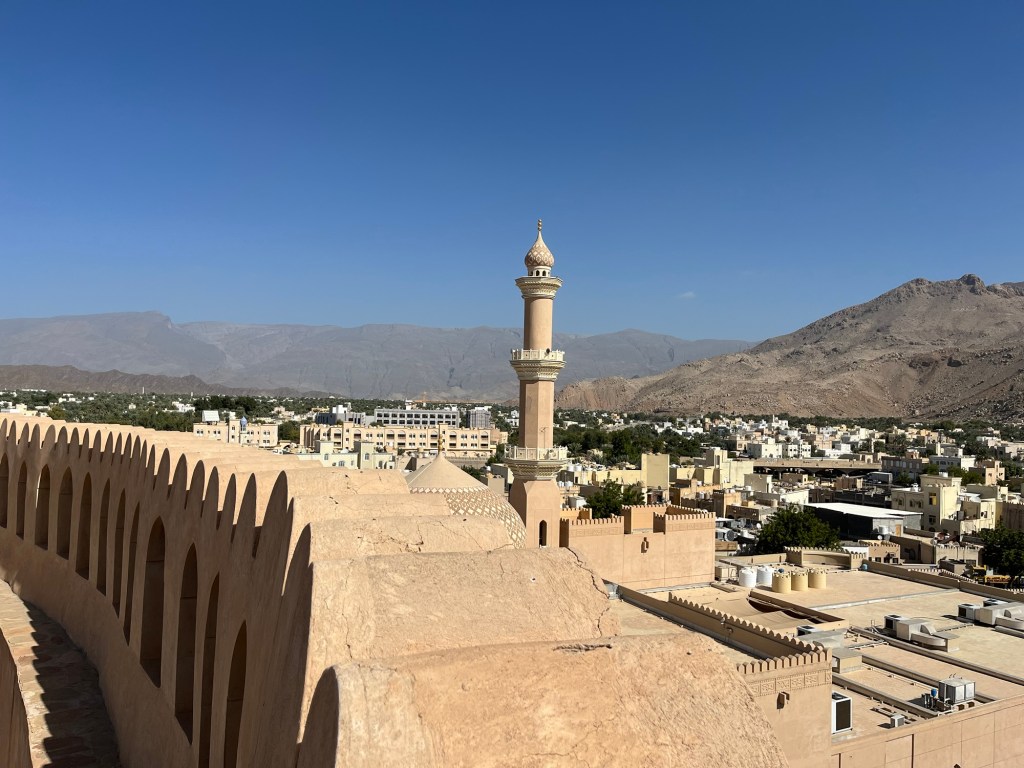
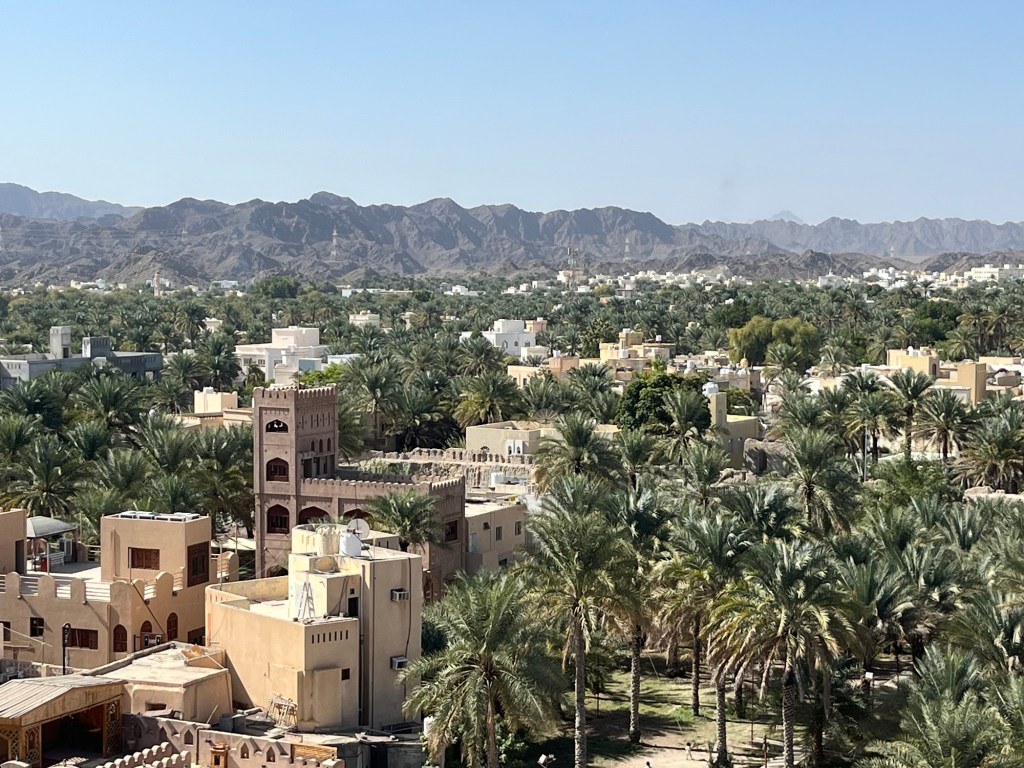
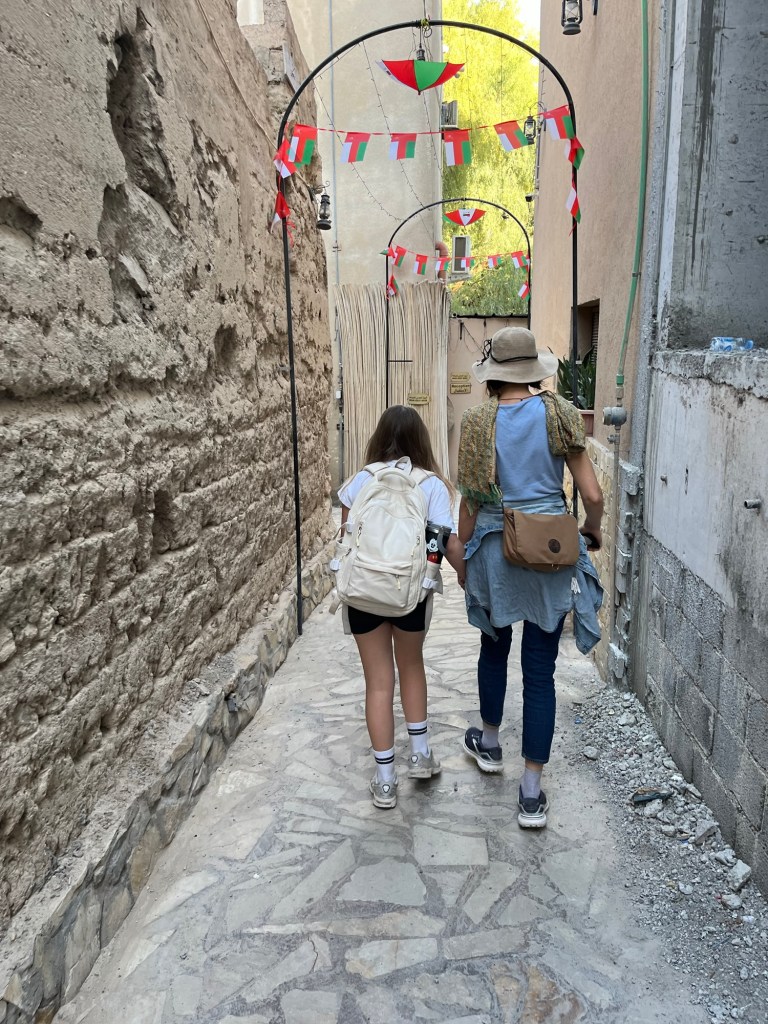
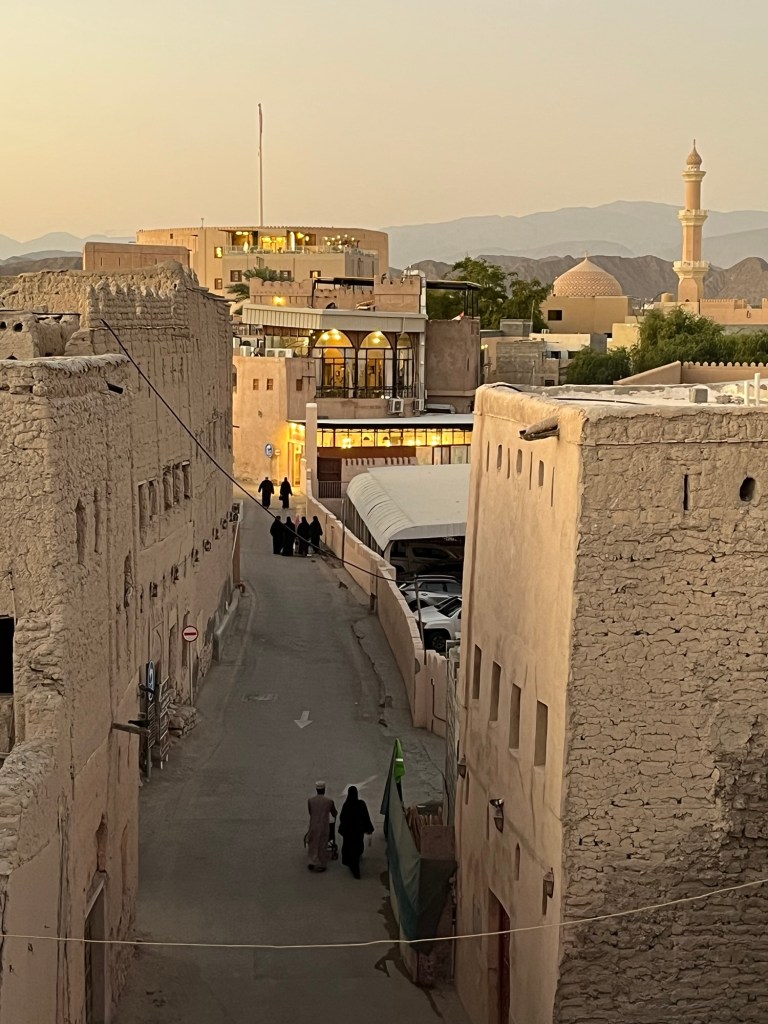
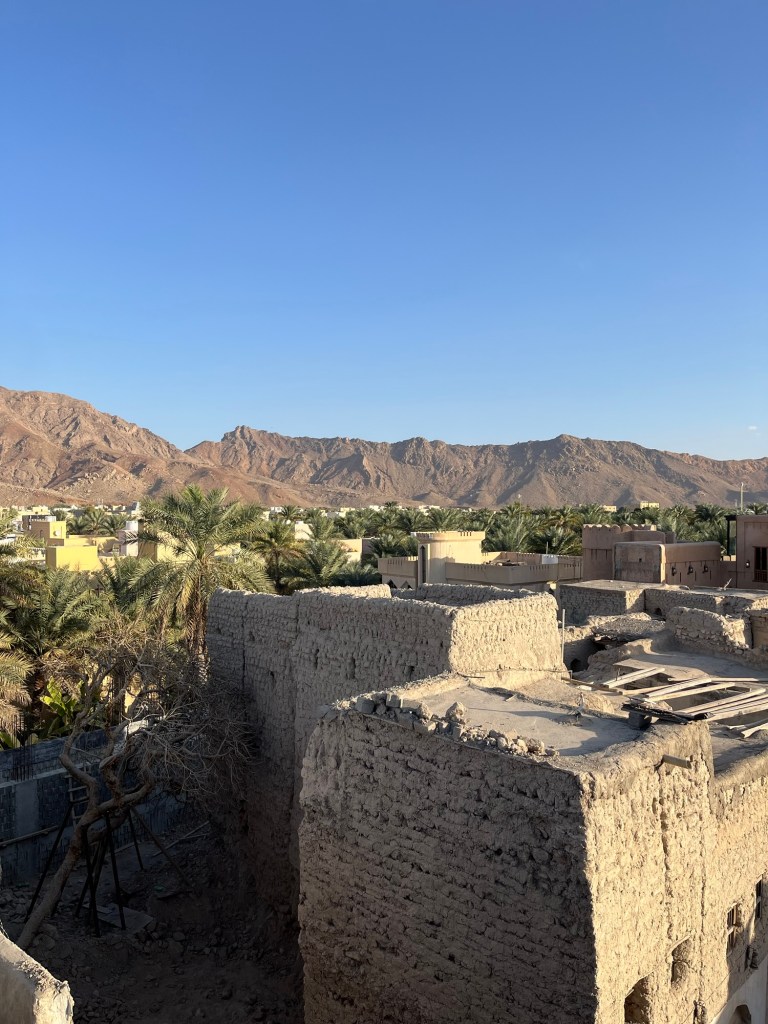
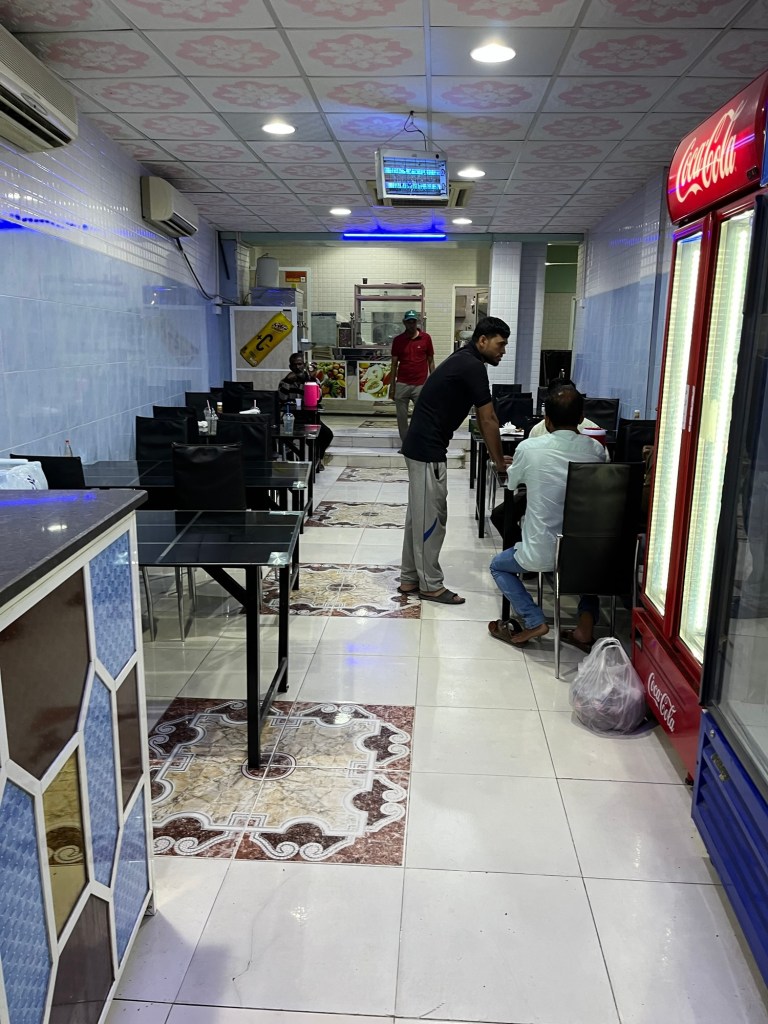
Nach etwas Sucherei mit hungrigen Kindern, die erstaunlich gut die Stimmung hielten, erreichten wir unser super schönes Haus und wurden freundlich mit Datteln und Kaffee empfangen – und zum Sonnenuntergang der Blick über die Stadt mit Blick auf die Berge, über Palmen und historische Gebäude hinweg, einfach traumhaft. Ein Schluck Rum aus der duty free Flasche half beim relaxen, bevor wir uns durch die Altstadt zu einem Original indischen Restaurant aufmachten. Dieses hätte exakt so auch in Goa ausgesehen, und bei Dahl Chicken Masala und vegetable Kuruma, mit Fladenbrot und dazu Lemon, Mint Juice kam schon Vorfreude auf Indien auf. Aber man muss sagen dieses Land hat wirklich etwas zu bieten und Oman hat zurecht erkannt, dass Tourismus Zukunft ist.
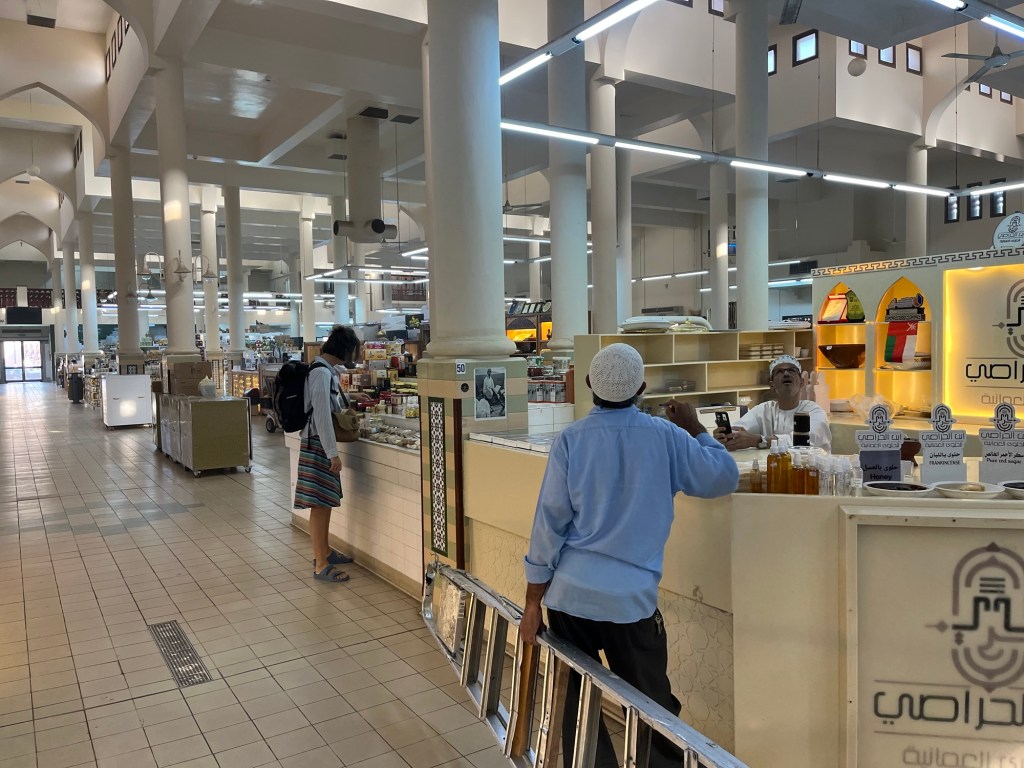
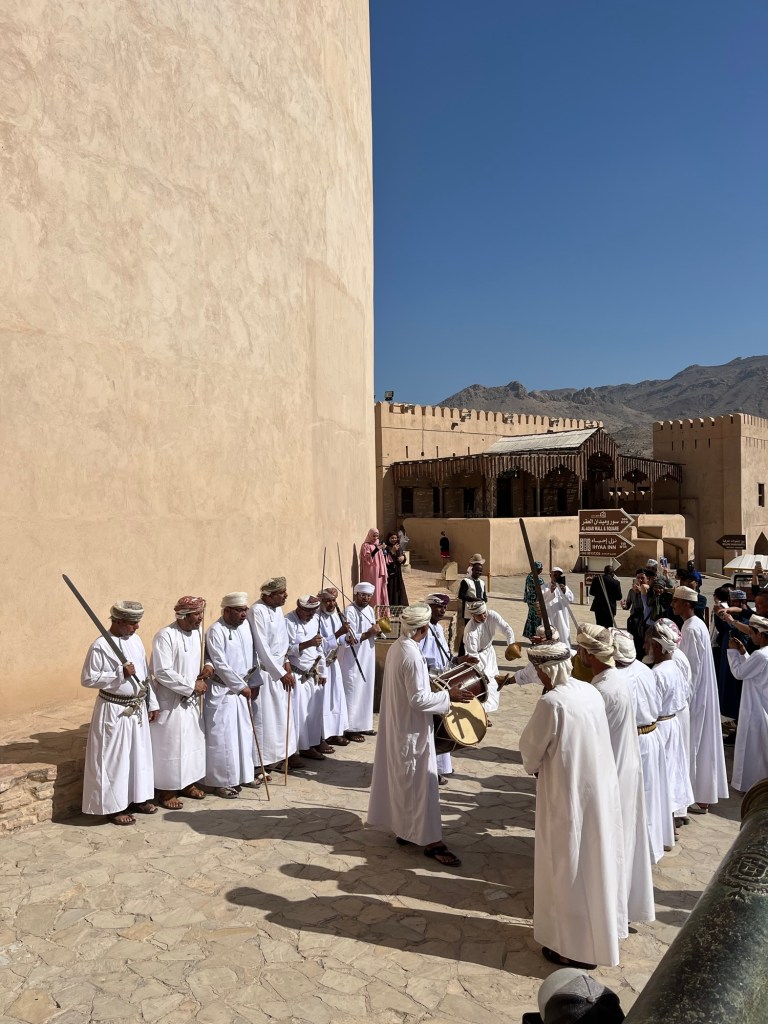
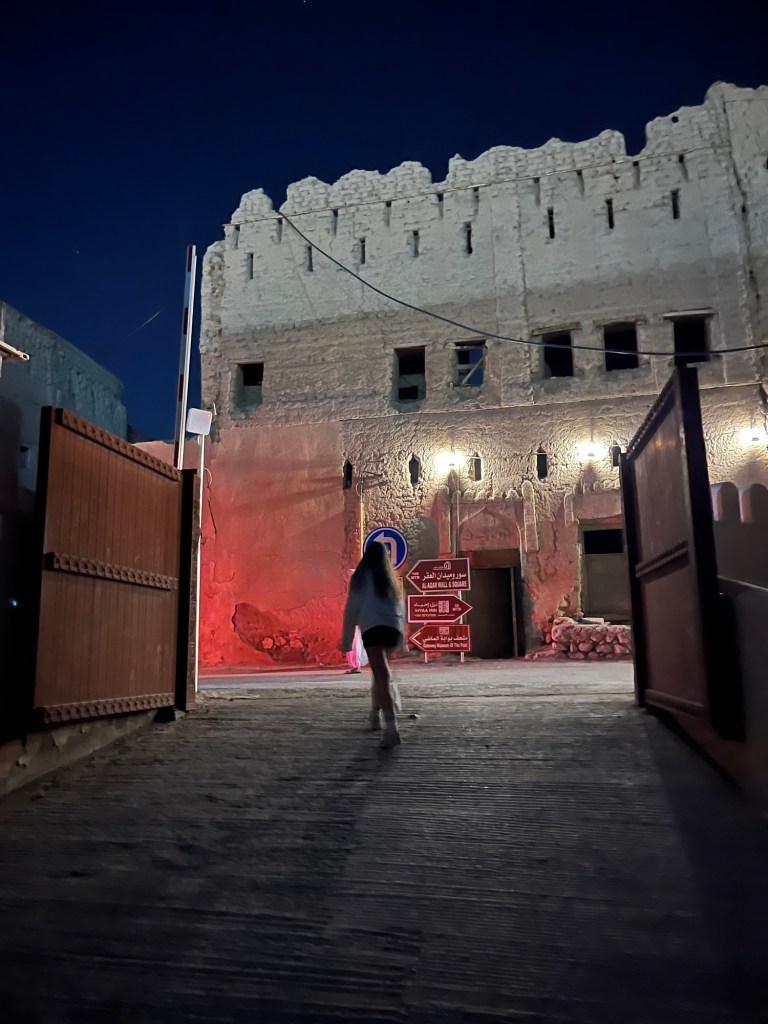
Der nette Hotelangestellte erzählte mir auf dem Dach, er sei vor sechs Monaten aus Nepal gekommen mit einem zwei Jahres Arbeitsvisum. Hier treffen wirklich verschiedene Kulturen aufeinander, die voll verschleierten Frauen in schwarz, die Männer in ihren weißen Umhängen, die Gruppen an indischen, nepalesischen oder pakistanischen Arbeitern auf den Straßen und dazwischen die Touristen aus Europa. Und überall duftet es nach Weihrauch.
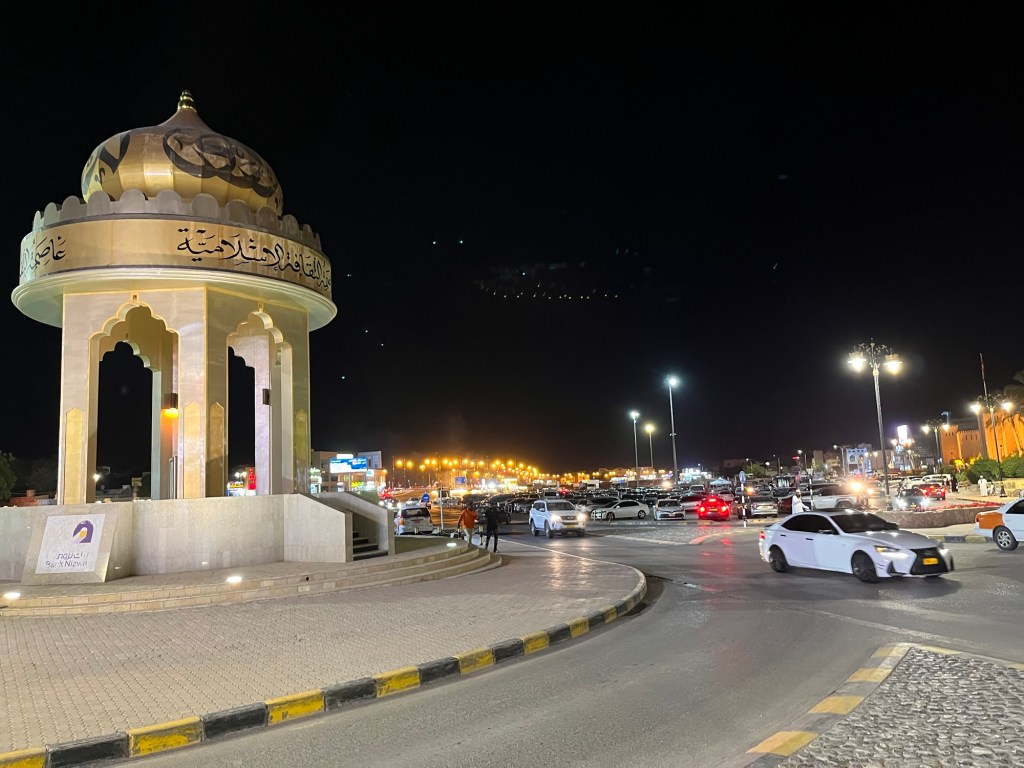
Sogar die Straßenlaternen sind schwarz golden bemalt und sehen aus wie historische Gaslichter, die es an die Autobahn verschlagen hat. Schick auch die vielen Elektroroller und Mopeds
Wir lassen uns Zeit und werden morgen noch den Tag hier verbringen, das Fort und das super moderne Museum anschauen, bevor es in die Berge geht.
Wadi Tanuf and Nizwa
Day 7
There were different speeds when we set off. Andreas, who only fell asleep around midnight, was woken up at 2 a.m. by the concrete mixer delivering concrete to the construction site next door, and Yuki and Inyan were also awake by 5 a.m. from the noise. Nadine, on the other hand, wanted to get up early and make the most of the day. 9.00 is departure time – at 9.30 she became restless. On the highway, Andreas tried to make up for lost time – I had trouble accelerating my 2.5-ton SUV so as not to lose sight of him.
When we arrived in Wadi Tanuf after a two-hour drive, Nadine didn’t have any snacks for the hike – we hadn’t seen a store.
After a brief conversation, the dust had settled. As usual, I played the head teacher and annoyed Morpheus and Tara with squares up to 20. What is 17 times 17? At some point it sunk in and we switched to Harry Potter as an Audible audiobook, read by Rufus Beck. So much more content than in the movie, and how he varies all the voices!
Nadine took over the wheel halfway along the route and I was able to relax a little. Outside, there were rocks and mountains, little greenery and the highway carved accurately through the hills. It reminded me a little of Colorado or Nevada.
We climbed up the dry riverbed and scrambled over smooth rocks in good spirits through the midday heat. But things turned out differently. Everything was dry, the rest in front of the dam wall didn’t tempt the children and it was also clearly stated – no swimming. But we were not to be put off so easily. So we went on an excursion up the valley to the viewpoint where Google Maps had marked a stone arch.
We then had a well-earned picnic in the shade, the half-rotten watermelon from the day before and the nuts with water tasted surprisingly good. Yuki still had energy left and wanted to climb around the rock again to look into the rising valley – you could do longer trekking tours here.
And he suggested jogging the route back. I didn’t miss it and we ran back through the heat, arriving back at the parking lot exhausted but happy. Now we had to find our hotel in the old town of Nizwa. This proved difficult by car, so we parked outside the wall in the parking lot on the dry riverbed.
After a bit of searching with hungry children, who kept their spirits up surprisingly well, we reached our super nice house and were warmly welcomed with dates and coffee – and at sunset the view over the city with a view of the mountains, over palm trees and historic buildings was simply fantastic. A sip of rum from the duty-free bottle helped us relax before we set off through the old town to an original Indian restaurant. It would have looked exactly the same in Goa, and with dahl chicken masala and vegetable kuruma, with flatbread and lemon and mint juice, we were already looking forward to India. But it has to be said that this country really has something to offer and Oman has rightly recognized that tourism is the future.
The nice hotel employee told me on the roof that he had come from Nepal six months ago with a two-year work visa. Different cultures really do come together here, the fully veiled women in black, the men in their white cloaks, the groups of Indian, Nepalese or Pakistani workers on the streets and the tourists from Europe in between. And the smell of frankincense is everywhere.
Even the street lamps are painted black and gold and look like historic gas lights that have been moved to the highway. The many electric scooters and mopeds are also stylish.
We are taking our time and will spend the day here tomorrow, visiting the fort and the super modern museum before heading into the mountains.
Tag 6 – Morgens beim Spaziergang zum Strand wurde es uns klar: so warm wird es jetzt die nächsten 4 Monate bleiben. Und vermutlich scheint auch meistens die Sonne. Früh aufstehen ist angesagt, wo doch die Sonne gegen 6 aufgeht und abends um die gleiche Zeit untergeht. Als um 7:45 Uhr der Wecker klingelt, fühlt es sich aber immer noch sehr früh an, obwohl es draußen schon strahlend hell ist.
Nach unserem morgendlichen Sportprogramm gibt es Frühstück. Tara liest die fünf Grundregeln des Islam vor – und danach wird Mathe gemacht. Wir versuchen neue Routinen einzuführen. Gegen 13:00 Uhr dann Reste von Gestern Essen und einen Salat, den wir in unserer kleinen Küche im Apartment bereiten, danach geht es los zum National Museum of Oman. Wir sind erstaunt, dass es 20 km weg ist, und ich verfahre mich in dem Labyrinth der Schnellstraßen gleich mehrfach.
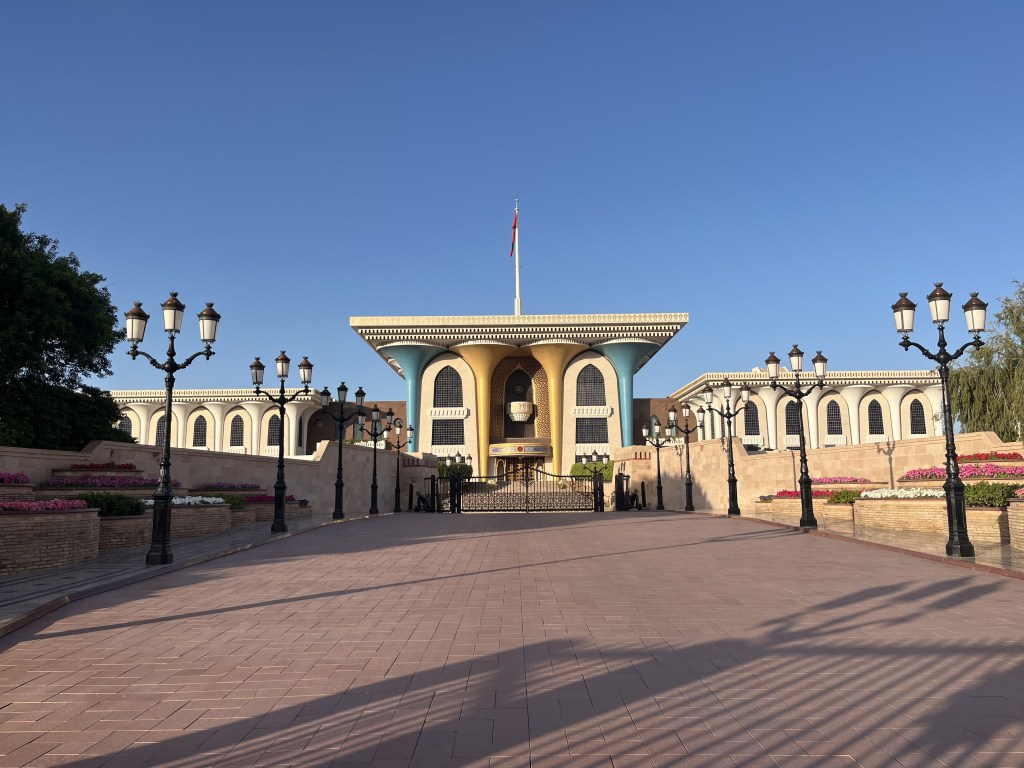
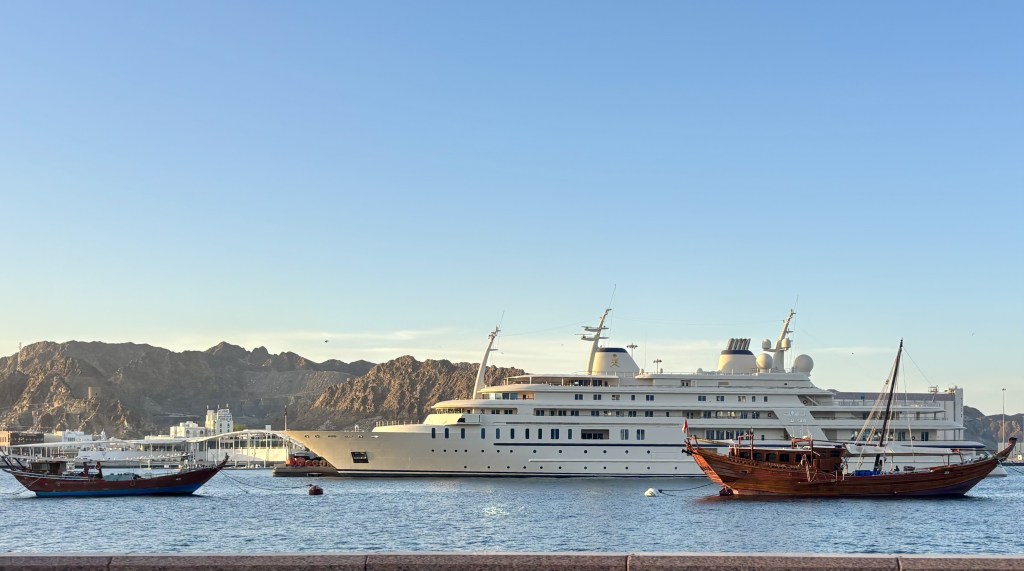
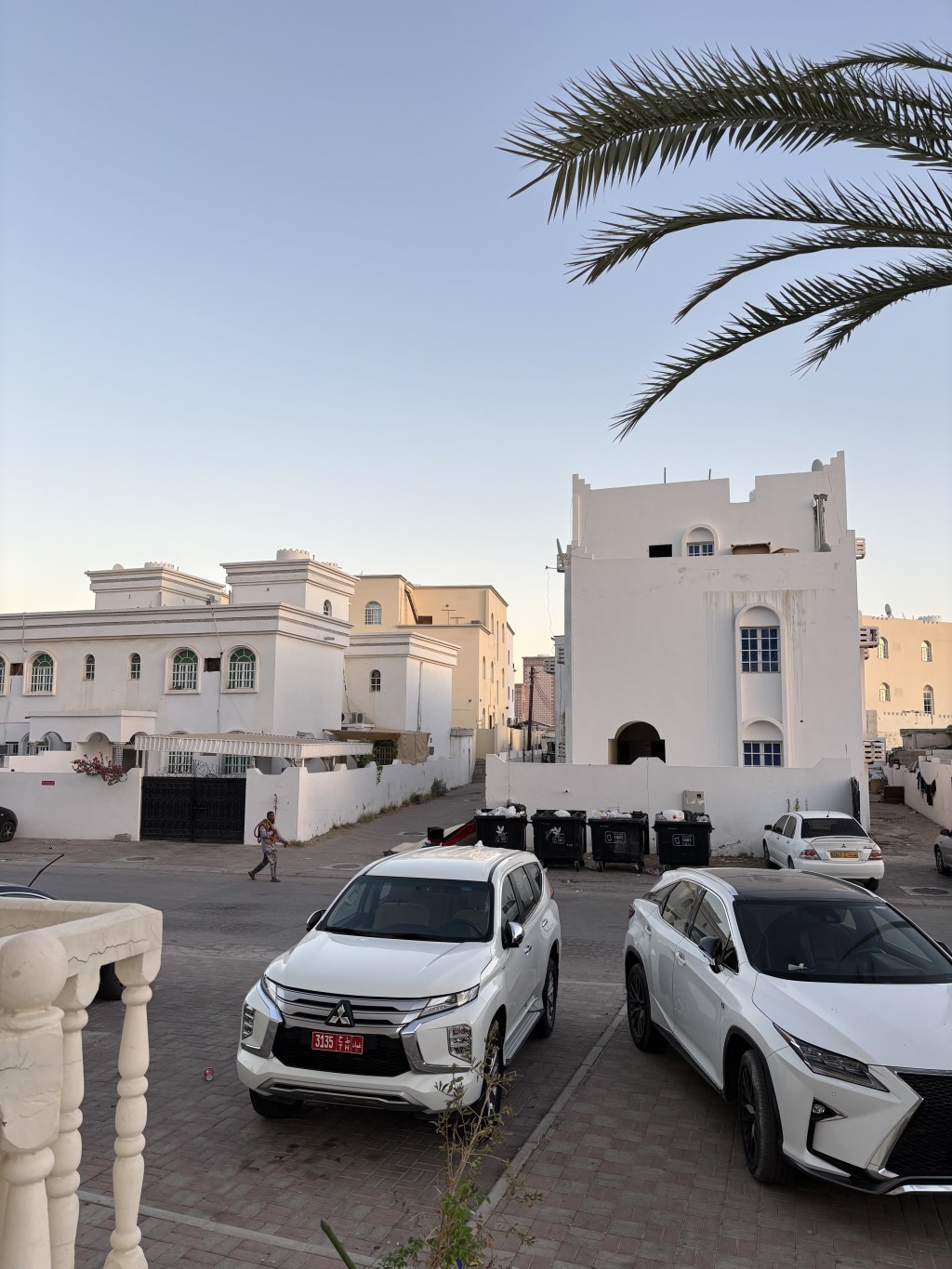
Oman ist ein Auto-Land, das wird uns schnell klar. Vieles erinnert an die USA; an Los Angeles oder Las Vegas. Draußen die heiße Wüste, ewig viel Platz und riesige Parkplätze, dahinter Shopping-Malls, Hotels oder Hafenanlagen. Wir passieren einen Kreuzfahrt-Riesen und die Yacht des Sultans, die Al Said. Nummer 7 in der Welt der Mega-Yachten, mit 155 Meter Länge, ein Prachtexemplar der Lürssen-Werft aus Bremen.
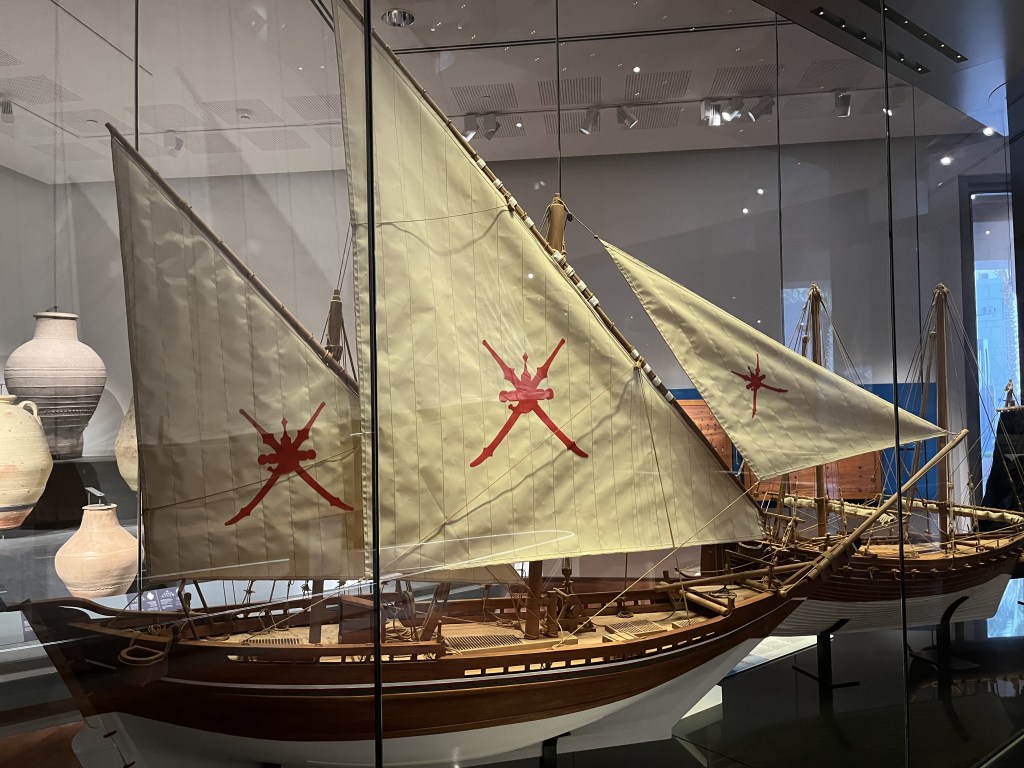
Im National Museum sehen wir – Schiffe spielen eine zentrale Rolle in der Geschichte des Omans. Als Zwischenstop auf dem Weg nach Indien war der Oman eine wichtige Anlaufstation, und über die Jahrhunderte waren Schiffe aus aller Welt hier mit Gütern aus China, Indien, Afrika und Europa unterwegs.
Das Museum beeindruckt die Kinder mit einem eigenen Kinosaal, in dem die ersten menschlichen Funde 2 Millionen Jahren zurücklagen, mit einem Faustkeil des Australopithecus, der damals von Afrika sich nach Europa und Asien ausbreitete.
Die größte Veränderung fand durch kriegerische Araber aus dem Süden statt, als sich die Botschaft des Propheten verbreitete. Mohammed (Friede sei mit ihm) lobte die Stämme des Oman, sie hätten den neuen Glauben ohne Kampf und mit viel Verständnis angenommen.
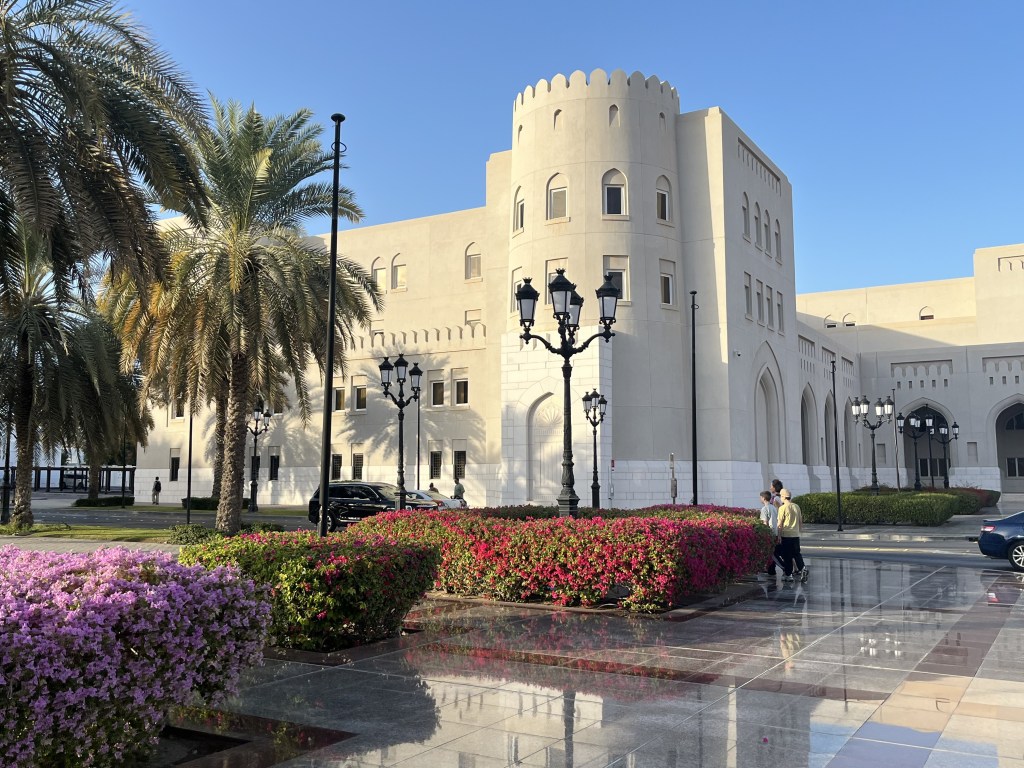
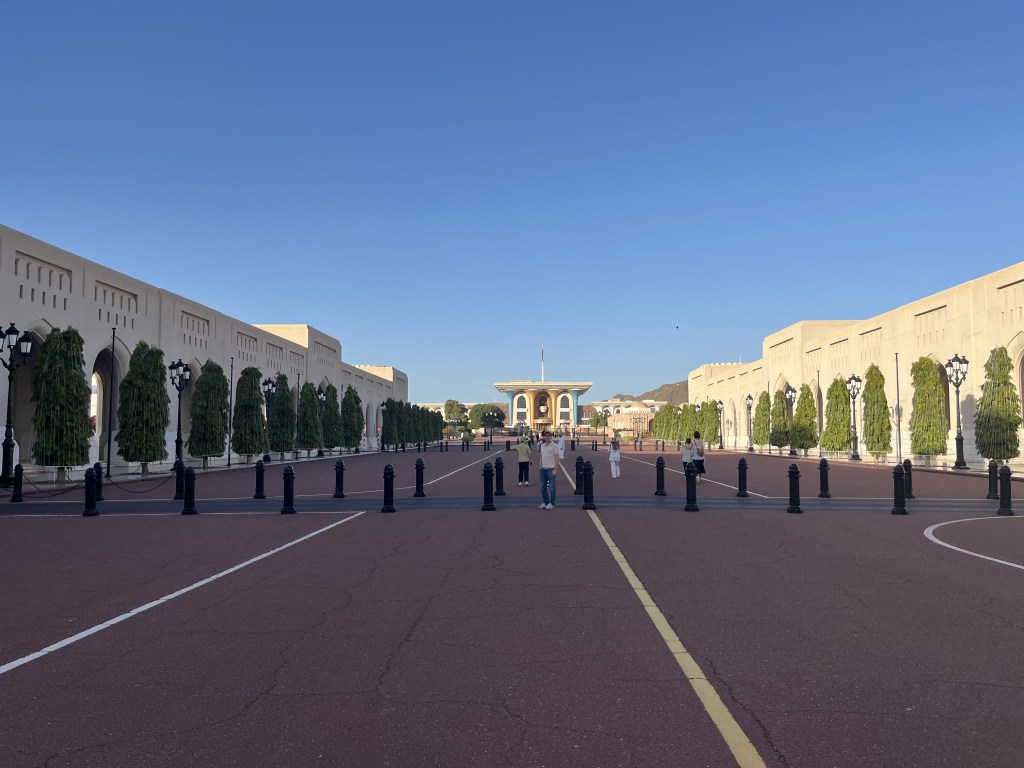
Doch alles anders wurde 1970. Die ersten Ölvorkommen wurden entdeckt, und die folgen dieses Booms kann man besonders deutlich rund um das Nationalmuseum beobachten. Teilweise sieht die Architektur aus wie bei Star Wars, auf einem fremden Planeten. Alles glänzt und scheint und sieht nagelneu aus, unwirklich groß und repräsentativ, so dass die wenigen Touristen darin völlig untergehen.
Den Kindern gefällt es, vor allem das Kino und dass es eine Malecke gibt, wo man Krummdolche und andere Waffen zeichnen kann. Das Museum ist eindrucksvoll und imposant gebaut, bis 25 Jahre ist der Eintritt frei und man hat viel Platz – bis eine Diplomaten-Mission mit 10 Mercedes S-Klasse ankommen und durch die Hallen geführt werden. Dann und wann haben die Kinder Erschöpfungszustände, die mit Keksen und Cola bekämpft werden.
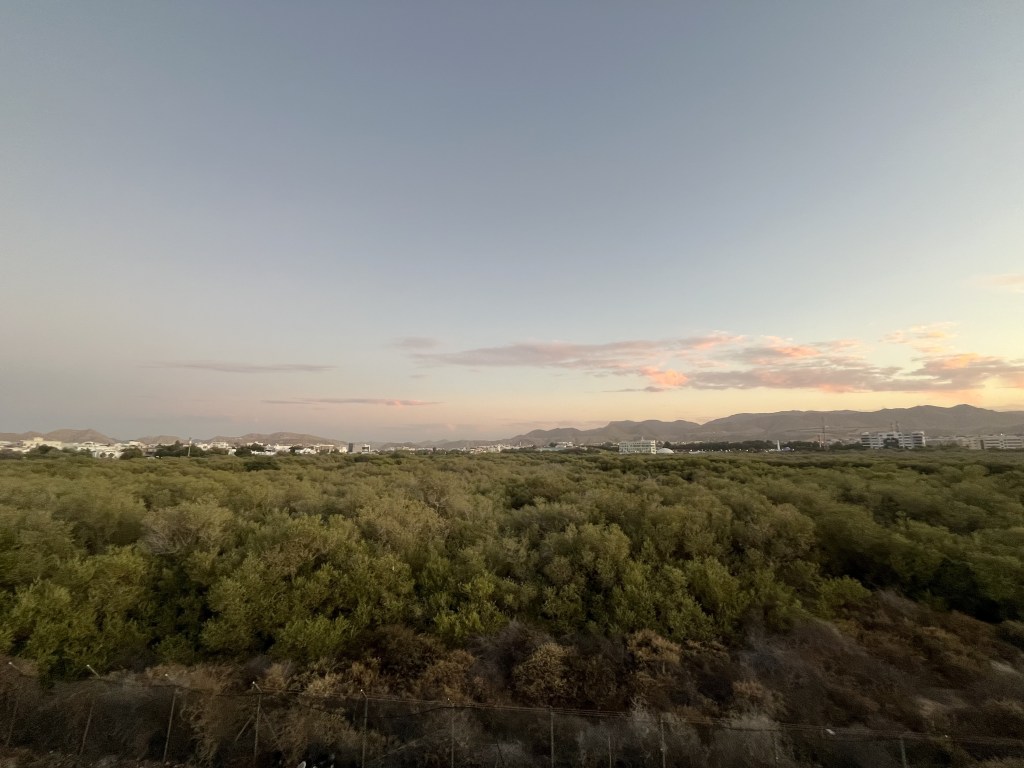
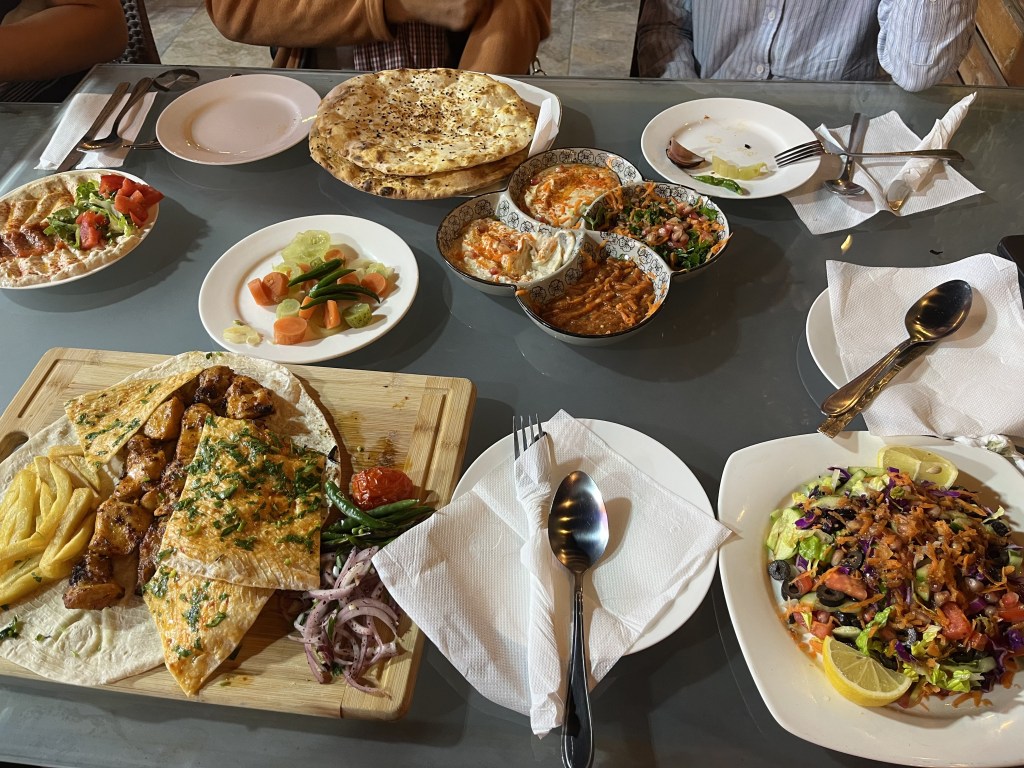
Auf der Fahrt zurück an der Küste überrascht uns eine grüne Sumpflandschaft, die einen starken Kontrast zu den felsigen Bergen des Hintergrunds bildet. Dort wollen wir morgen hinfahren. Und um die Badesachen auszupacken ist es schon zu spät, so begnügen wir uns mit einem Spaziergang zum Sonnenuntergang. Als wir eine Street-Food-Ecke bei Google Maps ausfindig gemacht haben, stellen wir fest, dass dies eher amerikanische Größenordnungen mit Parkplätzen und Restaurants sind, die Essen aus allen Ländern kredenzen – wir sind bei einem türkischen Restaurant gelandet und erstaunt, was wir für 40 Euro zu siebt alles geboten bekommen, von den frisch gepressten Fruchtsäften in XL über die Salate, Vorspeisen und Grillgerichte. Alle sind begeistert, es ist günstiger und mindestens so lecker wie in Istanbul.
Morgen geht es in die Berge, zur zweigrößten Stadt des Landes nach Nizwa und in ein Gebirgstal. Wir sind gespannt.
The palace of the sultan
Day 6 – On our morning walk to the beach, we realised: it’s going to stay this warm for the next 4 months. And the sun will probably be shining most of the time. We have to get up early, as the sun rises around 6 a.m. and sets at the same time in the evening. When the alarm clock rings at 7.45, it still feels very early, even though it is already bright outside.
After our morning sports programme, we have breakfast. Tara reads out the five basic rules of Islam. And then comes school, mathematics. We try to introduce new routines. Around 1 p.m., we have leftovers from yesterday’s meal and a salad, which we prepare in our small kitchen in the flat, before heading off to the National Museum of Oman. We are amazed that it is 20 kilometres away and I get lost several times in the labyrinth of motorways.
We quickly realise that Oman is a car country. Much reminds us of the USA; of Los Angeles or Las Vegas. Outside, the hot desert, endless space and huge car parks, with shopping malls, hotels and harbours behind them. We pass a cruise giant and the Sultan’s yacht, the Al Said. Number 7 in the world of mega yachts, at 155 metres long, a magnificent specimen from the Lürssen shipyard in Bremen.
In the National Museum we see that ships play a central role in the history of Oman. As a stopover on the way to India, Oman was an important port of call, and over the centuries ships from all over the world travelled here with goods from China, India, Africa and Europe.
The museum impresses the children with its own cinema room, where the first human finds date back 2 million years, with a hand axe from the Australopithecus, which spread from Africa to Europe and Asia at that time.
The greatest change was brought about by warlike Arabs from the south, when the message of the Prophet spread. Muhammad (peace be upon him) praised the tribes of Oman for accepting the new faith without fighting and with much understanding.
But everything changed in 1970, when the first oil reserves were discovered and the consequences of this boom can be seen particularly clearly around the National Museum. Some of the architecture looks like something out of Star Wars, on an alien planet. Everything is shiny and shiny and looks brand new, unreal in size and prestigious, so that the few tourists are completely lost in it.
The children like it, especially the cinema and the fact that there is a drawing corner where you can draw scimitars and other weapons. The museum is impressive and imposingly built, admission is free up to the age of 25 and there is plenty of space – until a diplomatic mission arrives with 10 Mercedes S-Class cars and is guided through the halls. Every now and then the children are exhausted, which is combated with biscuits and cola.
As we drive back along the coast, we are surprised by a green marshland landscape that forms a stark contrast to the rocky mountains in the background. We want to go there tomorrow. And it’s already too late to unpack our swimming gear, so we make do with a walk to watch the sunset. When we find a street food corner on Google Maps, we realise that these are more American-sized places with car parks and restaurants serving food from all over the world – we end up at a Turkish restaurant and are amazed at what the seven of us can get for 40 euros, from the freshly squeezed XL fruit juices to the salads, starters and grilled dishes. Everyone is delighted, it’s cheaper and at least as tasty as in Istanbul.
Tomorrow we are travelling to the mountains, to Nizwa, the second largest city in the country, and to a mountain valley. We are excited.
Tag 5 Es ist zwei Uhr morgens auf meiner Uhr, als der Airbus A321 zur Landung ansetzt. Aus dem Fenster sah man schon lange zuvor gelbe Lichter, in Straßen und Siedlungen aufgereiht. Ich bin nicht ganz unfroh, denn unsere Reihe 39 hatte wie die klassischen Billigflieger feste Rückenlehnen, und so richtig gelungen ist mir das Schlafen nicht. Anders als Tara, die sich über den leeren Platz neben ihr ausgestreckt hat und mit dem Kopf auf meinem Schoß schlief. Kurz nach 3 Uhr Ortszeit dann die super sanfte Landung. Morpheus war noch schwindelig, während Tara sich mit Nadine schon munter sich auf den Weg zur Gepäckausgabe machte und strahlend mit meinem roten Koffer ankam.
Der Flughafen gefiel beiden, hochmodern, sehr elegant. Die verschleierte junge Grenzbeamtin war sehr freundlich und verzichtete darauf, bei uns die Fingerabdrücke abzunehmen, anders als bei Andreas und seinen Kindern. Wir kauften uns Telefonkarten von einem netten Inder, der für die staatliche Telefongesellschaft arbeitete. Den Mietwagen hatten wir erst um 6 bestellt, also gab es noch etwas Wartezeit in der entspannten Stille des frühen Morgens. Ich teilte mir ausnahmsweise einen halben Cappuccino mit Nadine, der außerordentlich lecker schmeckte. Koffein wirkt eben doch Wunder, besonders wenn man es nicht mehr gewohnt ist. Morpheus ging es nach einer Cola auch schon viel besser.
Auf dem Tisch lag ein Hochglanz-Bildband zum 47. Jahrestag der Nation 2017. Auf schätzungsweise 100 Seiten wurde die Weisheit und Güte von Sultan Quabus gelobt, immer mit weißem Bart, gütigem Lächeln und einem Schwert abgebildet. Der 2020 verstorbene Herrscher war schließlich 50 Jahre für die Geschicke des Landes verantwortlich, das in dieser Zeit von einer der ärmsten Länder der Welt zu einem wohlhabenden Land aufstieg, dem Erdöl sei dank.
Ich war noch nie in einem der Golf-Staaten, und Tara meinte zurecht: „Ich dachte das wäre wie Jordanien oder Marokko. Das ist aber wie Spanien!“
Im Sonnenaufgang fuhren wir mit einem standesgemäßen SUV der Größe eines Kleinbusses über gut ausgebaute Schnellstraßen entlang an Prachtbauten wie der Moschee zu unserm Hotel. Wie am Flughafen das vertraute Englisch und Kopfnicken der Inder zum Empfang, alle superfreundlich.
Bei der Währung muss man sich umstellen. 1 OmanRial (OMR) entspricht 2.45 Euro. So viel kostete aber auch das Frühstück bei uns im Hotel, nach einem kurzen Power-Nap trafen sich dort wieder alle. Danach schliefen alle für zwei Stunden. Danach war das helle Licht draußen noch beeindruckender.
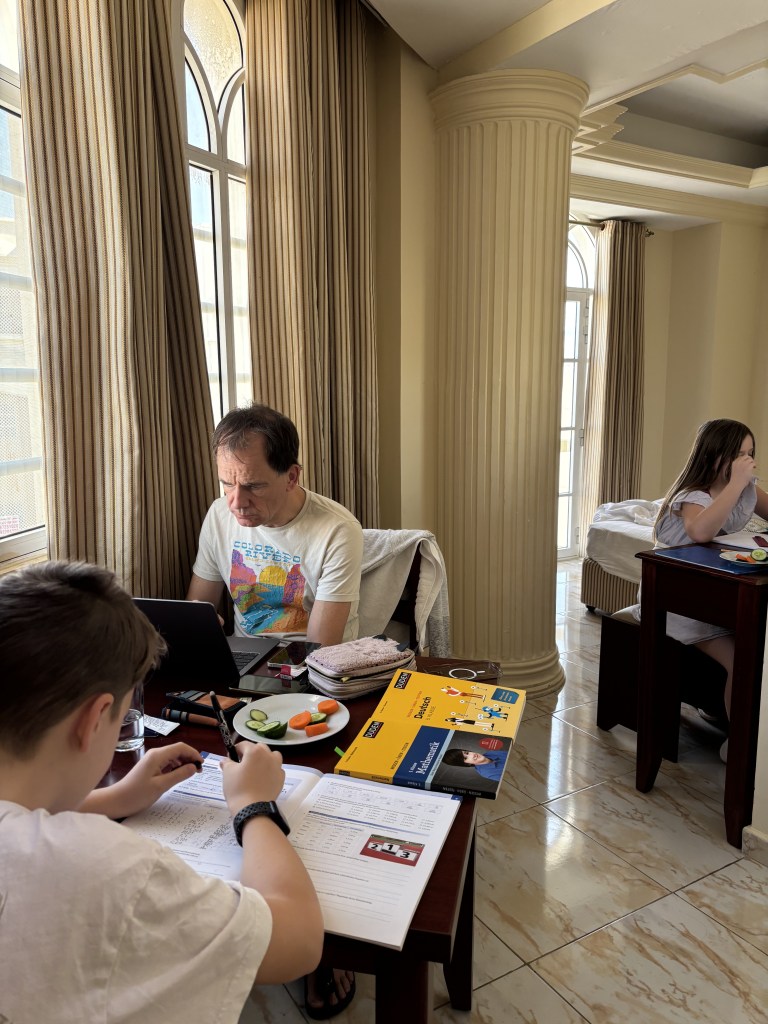
Aber wir sind ja nicht zum Spaß hier. Deshalb begann danach die Weltreiseschule. Morpheus suchte sich das Matheübungsbuch heraus, Tara erstellte sich einen Ländervergleich von Oman, Türkei und Indien und lachte laut auf, als sie bei der Einwohnerzahl von Indien war. Ich holte auch den Rechner heraus. Um 14:00 Uhr waren wir alle wie besprochen aufbruchsbereit zum Strandausflug.
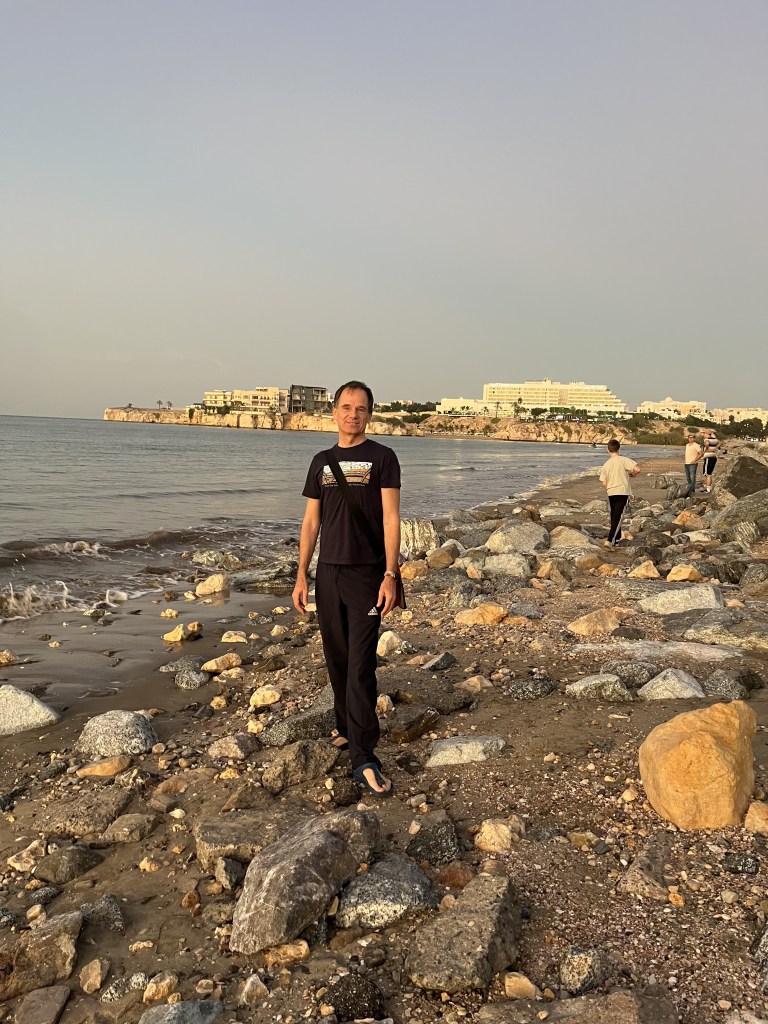
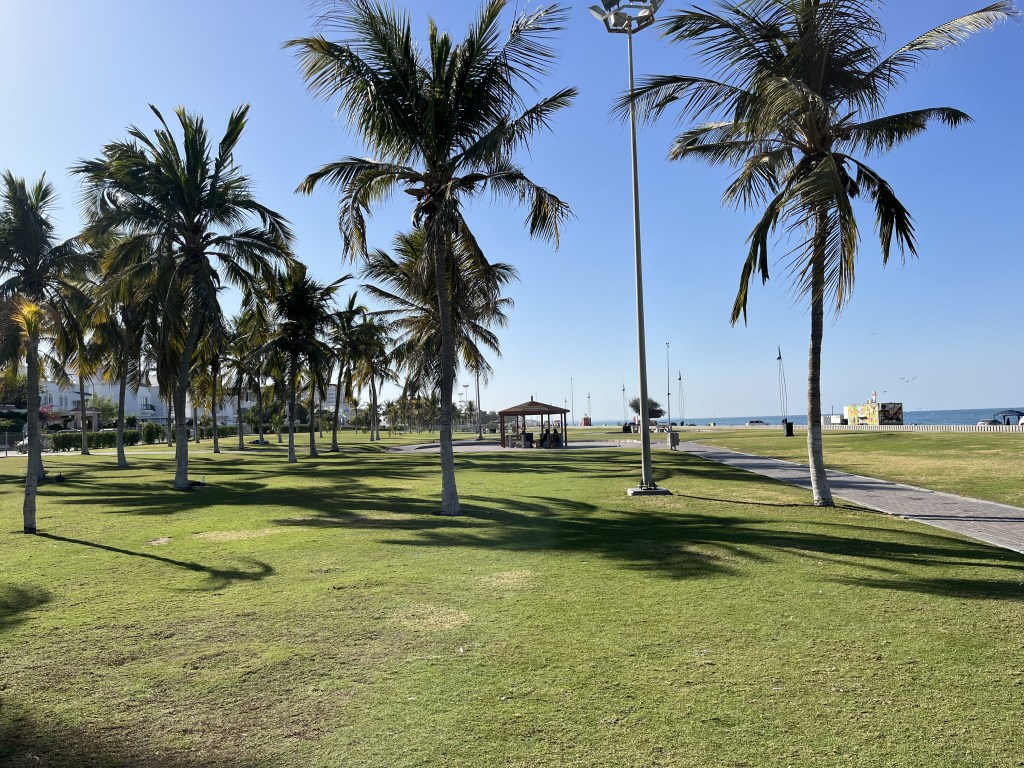
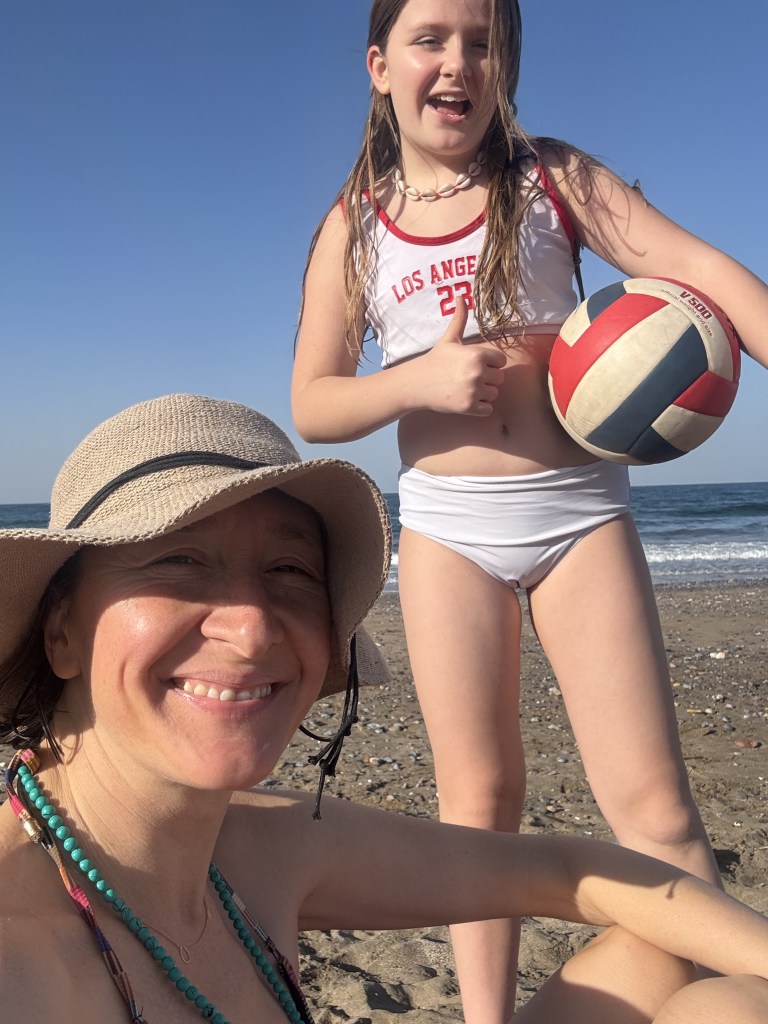
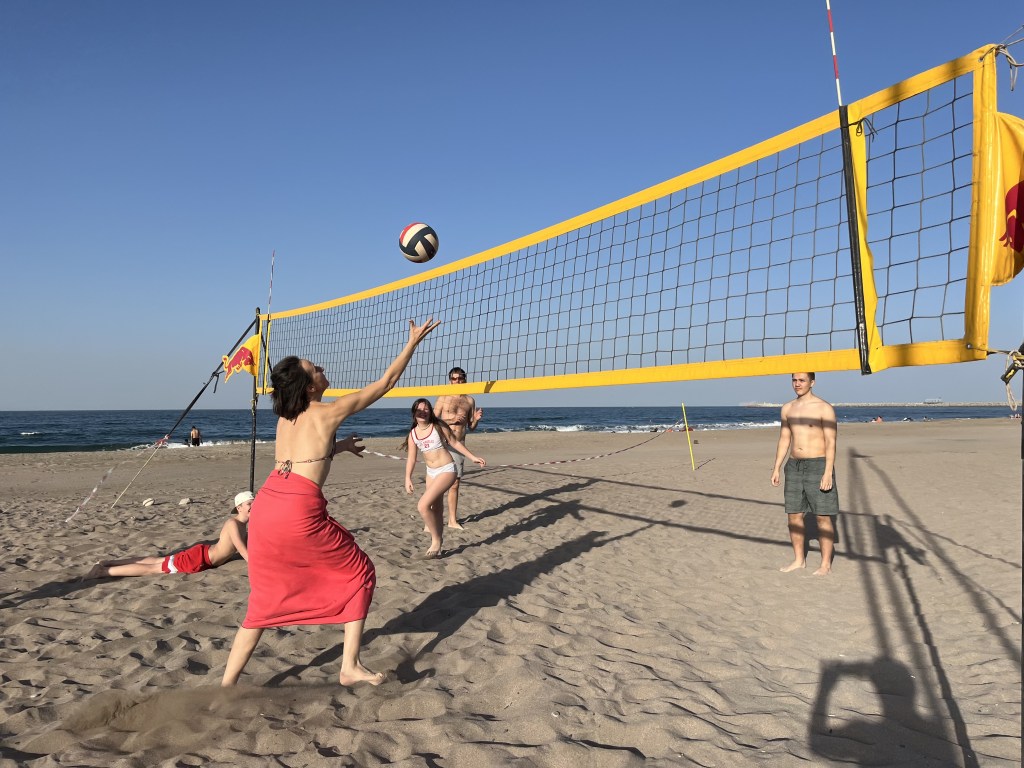
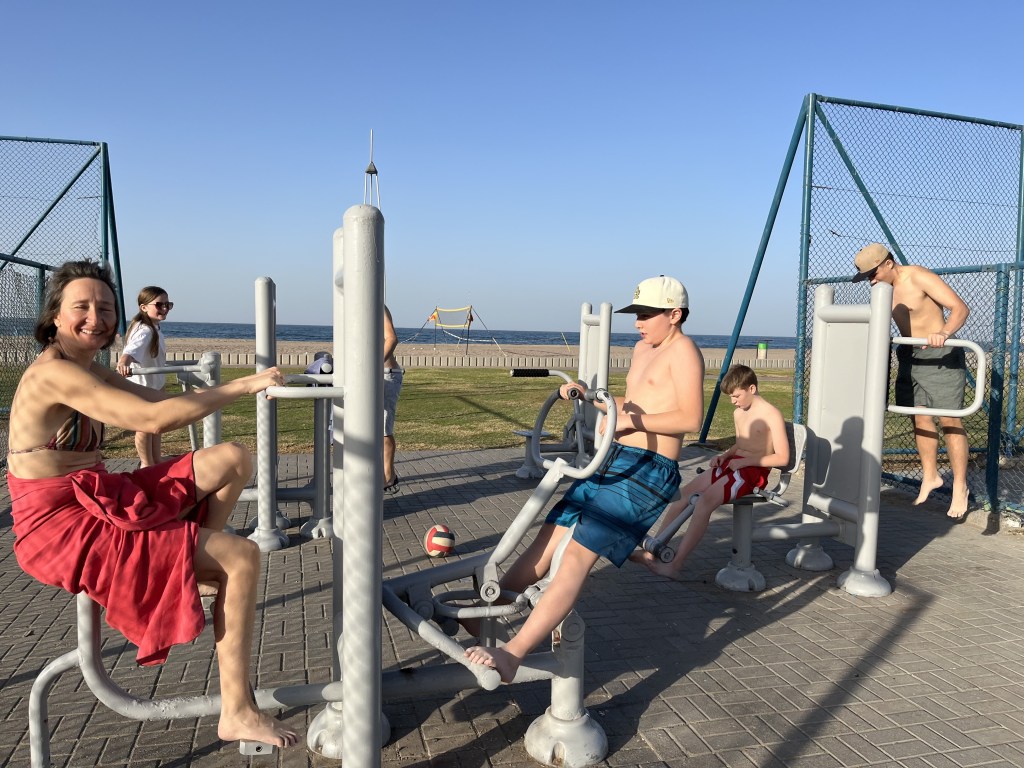
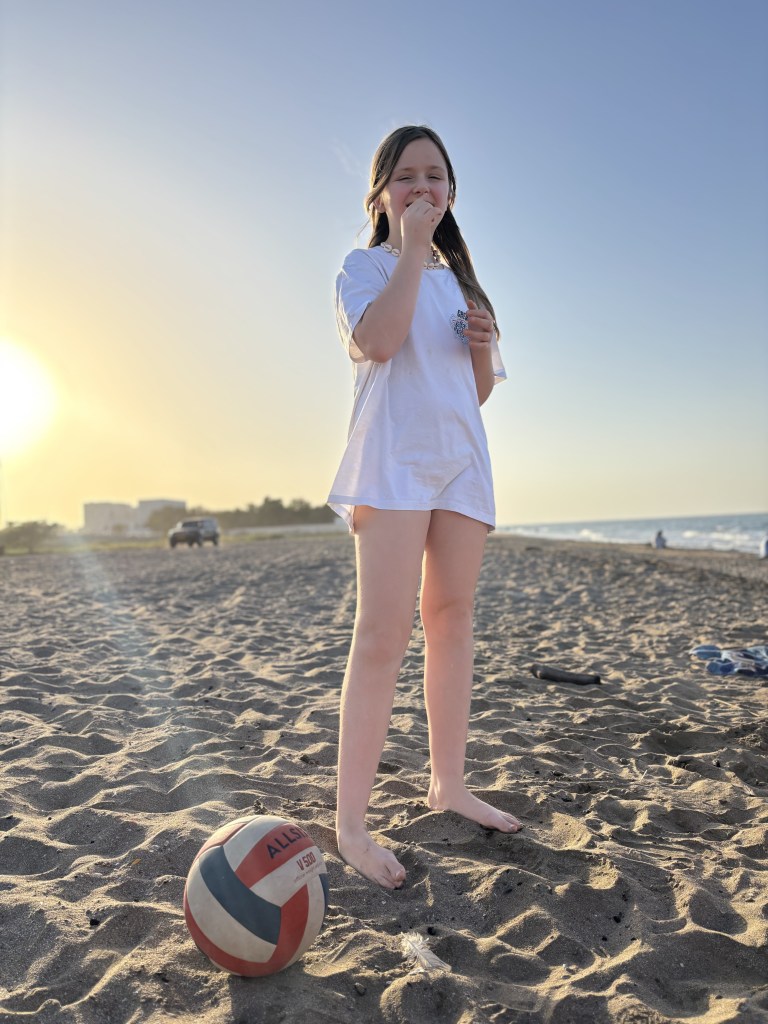
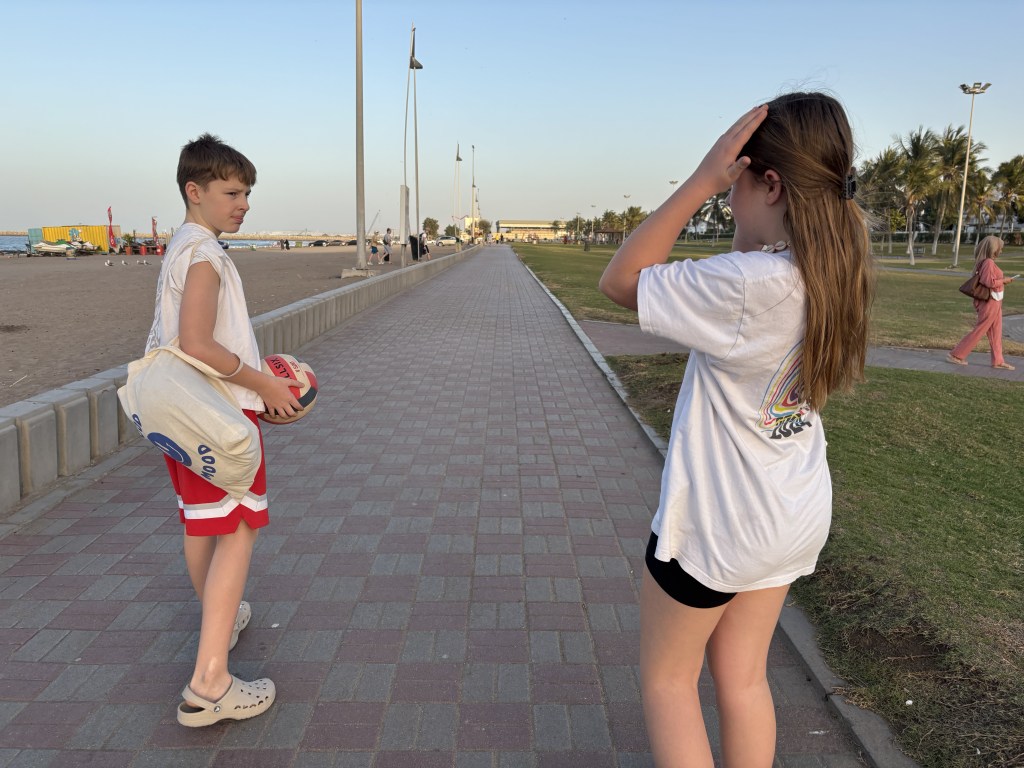
Im Oman fährt man mit dem Auto an den Strand, das haben wir gleich verstanden. Wir parkten dennoch brav auf dem Parkplatz, staunten über die hochmoderne Toilette und die Parkanlage mit Fitnessbereich, Fußballfeld und Beachvolleyball, alles frei zugänglich und fast menschenleer.
Tara war gleich im Meer, aber an der falschen Stelle – scharfkantige Felsen verursachten erste Kratzer am Fuß. Hier also nicht ins Wasser. Wir liefen 500 Meter weiter und fanden eine besser Stelle mit mehr Kies und Sand.
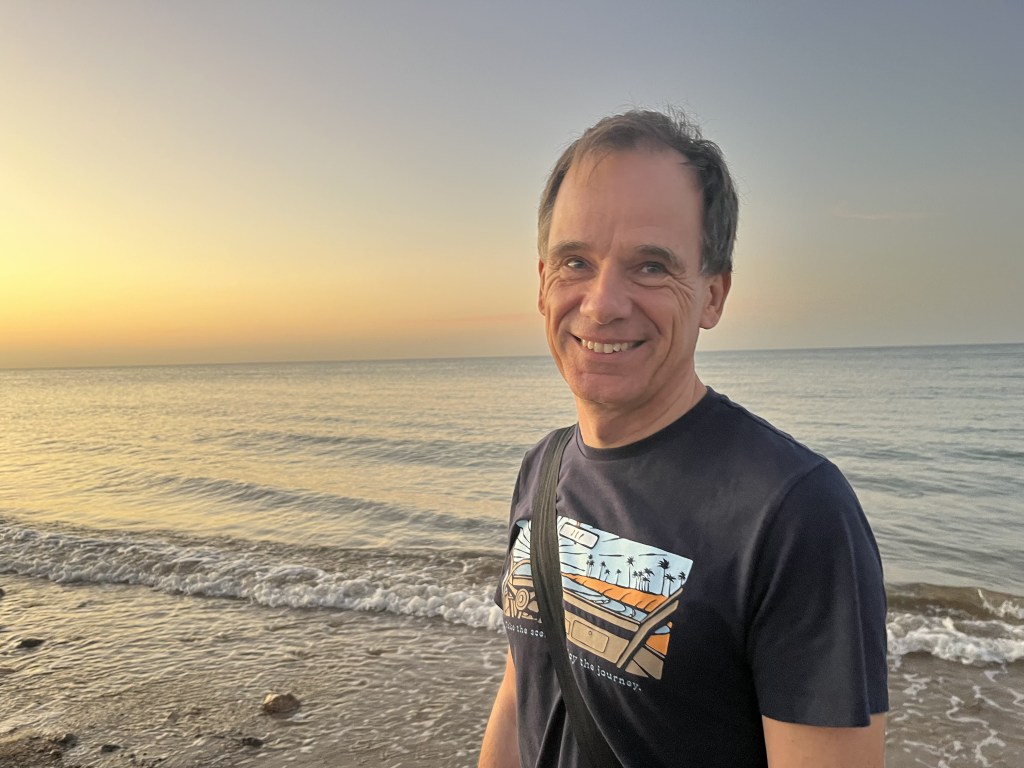
Wann war ich zuletzt bei 25 Grad Wassertemperatur im Meer? Das muss zuletzt auf der Weltreise vor 7 Jahren gewesen sein. Traumhaft. Alle waren im Wasser und strahlten.
Danach das Sportprogramm: Beachvolleyball und Training an den Geräten. Wir hatten großen Spaß. Inyan begann das Geburtstagsgeschenk Zauberwürfel auszuprobieren.
Wir tranken ein aus der Türkei eingeschmuggeltes Bier heimlich zu dritt und aßen Pistazien. Entspannung. Morpheus freute sich, endlich wieder in der Natur zu sein.
Zurück ging es zum Supermarkt (schnell die Knie bedecken, jeder suchte sich ein Tuch oder eine Hose), wir fanden alles für Spaghetti mit Tomatensoße und Salat. Daheim kochen, etwas Normalität wie zuhause. Es hat allen geschmeckt. Man kann also Nachtflüge nutzen und dennoch den Tag etwas erleben – aber jetzt sind die Kinder müde ins Bett gefallen und wir bald auch.
Arrival in Oman
Day 5
It’s two o’clock in the morning on my watch as the Airbus A321 is about to land. Out of the window you could see yellow lights lined up in streets and neighbourhoods long before. I’m not entirely unhappy, because our row 39 had fixed backrests like the classic low-cost planes, and I didn’t really manage to sleep. Unlike Tara, who stretched out across the empty seat next to her and slept with her head on my lap. Shortly after 3 a.m. local time, we made a super soft landing. Morpheus was still dizzy, while Tara was already cheerfully making her way to baggage reclaim with Nadine and arrived beaming with my red suitcase.
They both liked the airport, ultra-modern and very elegant. The veiled young border official was very friendly and refrained from taking our fingerprints, unlike from Andreas and his children. We bought telephone cards from a nice Indian who worked for the state telephone company. We hadn’t ordered the hire car until 6 a.m., so there was still some waiting time in the relaxed silence of the early morning. For once, I shared half a cappuccino with Nadine, which tasted exceptionally delicious. Caffeine works wonders, especially when you’re not used to it. Morpheus felt much better after a coke.
On the table was a glossy illustrated book commemorating the nation’s 47th anniversary in 2017, with an estimated 100 pages praising the wisdom and goodness of Sultan Quabus, always depicted with a white beard, a benevolent smile and a sword. The ruler, who died in 2020, was ultimately responsible for the fate of the country for 50 years, during which time it rose from one of the poorest countries in the world to a prosperous country, thanks to oil.
I’ve never been to one of the Gulf states, and Tara rightly said: ‘I thought it was like Jordan or Morocco. But it’s like Spain!’
At sunrise, we drove to our hotel in a SUV the size of a minibus on well-developed motorways past magnificent buildings such as the mosque. As at the airport, the familiar English and nodding heads of the Indians at the reception, all super friendly.
You have to get used to the currency. 1 Oman Rial (OMR) is equivalent to 2.45 euros. But that’s also how much breakfast at our hotel cost, and after a short power nap everyone met up there again. Then everyone slept for two hours. Afterwards, the bright light outside was even more impressive.
But we are not here for fun. That’s why the world travelling school started afterwards. Morpheus picked out the maths exercise book, Tara drew up a country comparison of Oman, Turkey and India and laughed out loud when she got to the population of India. I also got out the calculator. At 2.00 p.m. we were all ready to set off for the beach excursion as discussed.
In Oman, you go to the beach by car, we realised that straight away. Nevertheless, we parked dutifully in the car park, marvelling at the ultra-modern toilets and the park with fitness area, football pitch and beach volleyball, all freely accessible and almost deserted.
Tara was in the sea straight away, but in the wrong place – sharp-edged rocks caused the first scratches on her feet. So don’t go into the water here. We walked 500 metres further and found a better spot with more gravel and sand.
How warm was the water then? When was the last time I was in the sea with a water temperature of 25 degrees? It must have been 7 years ago on our trip around the world. Fantastic. Everyone was in the water and beaming.
Then the sports programme: beach volleyball and training on the equipment. We had great fun. Inyan started to try out the birthday present of Rubik’s cubes.
The three of us secretly drank a beer smuggled in from Turkey and ate pistachios. Relaxation. Morpheus was delighted to finally be out in nature again.
Back we went to the supermarket (quickly covering our knees, everyone looked for a scarf or a pair of trousers), we found everything we needed for spaghetti with tomato sauce and salad. Cooking at home, some normality like at home. Everyone enjoyed it. So you can use night flights and still enjoy the day – but now the children have fallen into bed tired and soon we will too.
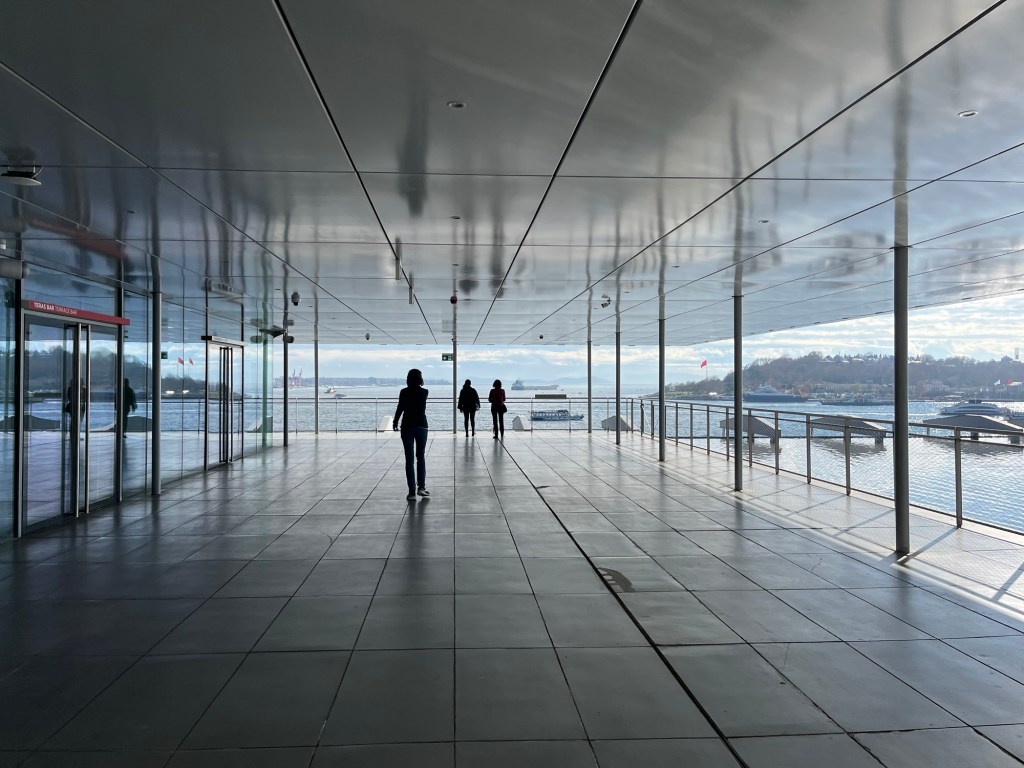
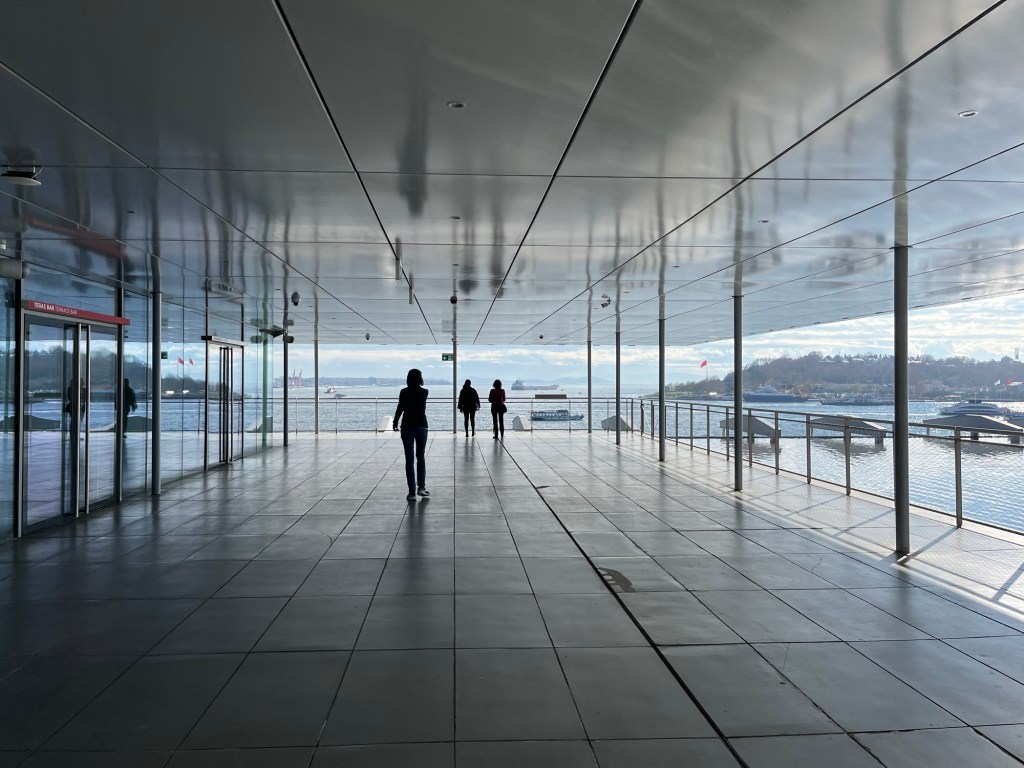
Heute ist Inyans zwölfter Geburtstag, und er wünscht sich mit seinen Freunden in das Aquarium zu gehen. Andreas nimmt unsere Kinder mit, und so haben wir einen freien Tag zu zweit, um ein paar der Tipps unserer Freundin Inci auszuprobieren. Als erstes geht es mit der Straßenbahn zum Istanbul Modern, ein eleganter Neubau von Renzo Piano mit einer Promenadenfront am Bosporus, wo es sich entspannt flaniert und in der Sonne sitzen lässt., während vor einem die Ausflugsboote und Frachtschiffe, Fähren und Tanker über die Meeresöffnung zwischen Mittelmeer und schwarzen Meer fahren.
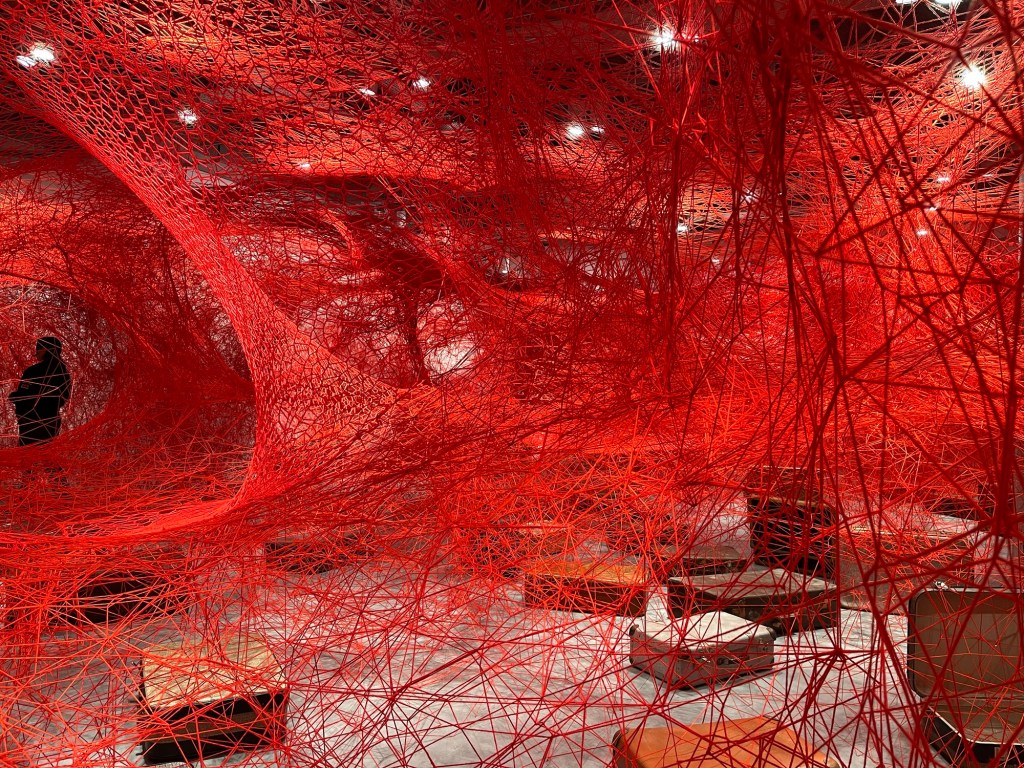
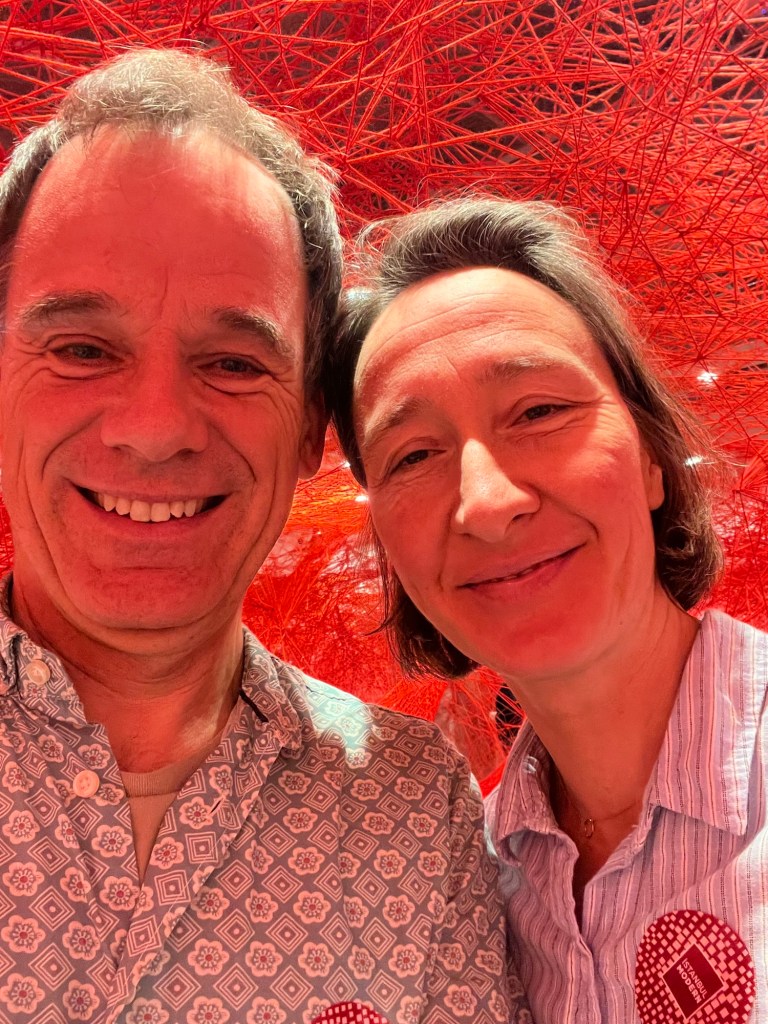
Es ist ein Genuss, einmal in Ruhe gemeinsam moderne Kunst zu genießen, besonders beeindruckt mich eine Installation aus Fäden der japanischen Künstlerin Chiaru Chiota, die in Berlin lebt. Morgens haben wir das erste Mal alle unser Hab und Gut wieder in die Koffer gepackt, die Lichterkette aus dem Schlafzimmer der Kinder wieder aufgerollt und das Gepäck die kleine Wendeltreppe herunter getragen. Dort lassen wir es an der Rezeption stehen.
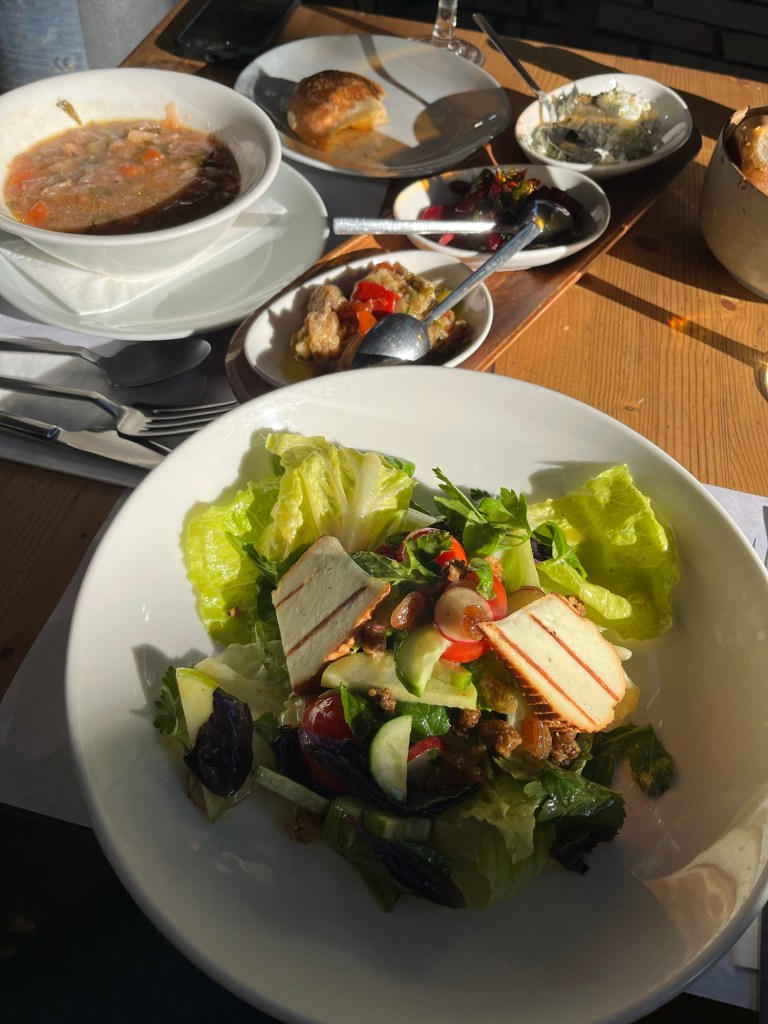
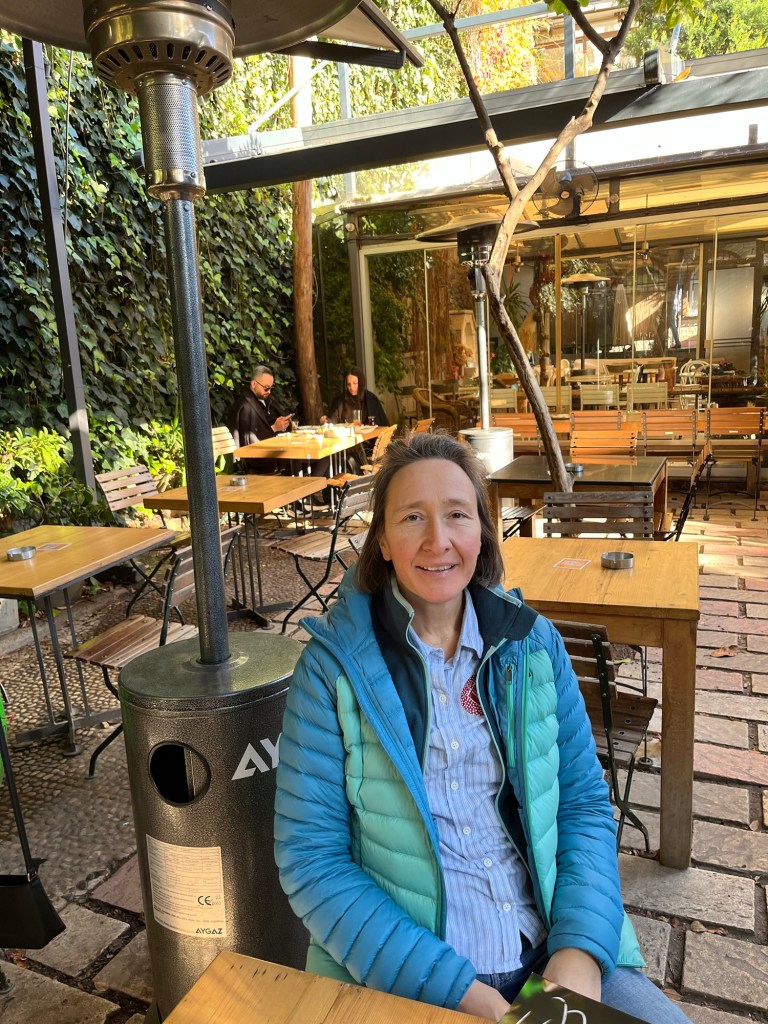
Während die Kinder uns Videos von Haien schicken, schlendern wir den Berg durch kleine Gassen hinauf zu einem Geheimtipp von Inci unauffällig in einer Straße verborgen befindet sich der Eingang zum Limonlu bahce, über eine enge Treppe hinab und durch einen langen Ganggang zu einem schattigen begründen Innenhof mit einem angesagten Studentencafe und Restaurant. Der Salat mit warmen Ziegenkäse, die Gemüsesuppe und die Auberginenpaste schmecken hervorragend!
Hier ist ein moderner Flair zu spüren, und wir sehen wieder einmal, wie facettenreich Istanbul ist .
An unserem Treffpunkt im Gülhane-Park finden wir alle wieder zusammen, holen das Gepäck ab und machen uns auf dem Weg mit der Metro Richtung Flughafen. Das klappt erstaunlich gut, man kann meistens die Fahrkarte einfach mit der Kreditkarte am Drehkreuz lösen, und wir sind nach einmal umsteigen und einer Stunde Fahrt wieder am Flughafen Sabiha Gökçen angekommen, der praktisch angelegt ist, und voller Passagiere. 3 Stunden bis zum Abflug brauchen wir auch und sind nun mit einer letzten Nudelsuppe für die Kinder und Spekulatius meiner Mama, zwei Avocados und Sesamkringel gestärkt beim Boarding für unseren vom Nachtflug von knapp 5 Stunden mit Pegasus nach Maskat– no Frills. Der Oman kann kommen- Istanbul war ein großartiger Auftakt – es geht weiter!
Today is Inyan’s twelfth birthday and he wants to go to the aquarium with his friends. Andreas takes our children with him, so we have a day off together to try out a few of our friend Inci’s tips. First we take the streetcar to the modern Istanbul Museum of Art, an elegant new building by Renzo Piano with a promenade front on the Bosphorus, where we can stroll and sit in the sun while the excursion boats and cargo ships, ferries and tankers sail across the sea opening between the Mediterranean and the Black Sea.
It’s a pleasure to enjoy modern art together in peace for once, and I’m particularly impressed by an installation made of threads by a Japanese artist who lives in Berlin. In the morning, we packed all our belongings back into our suitcases for the first time, rolled up the fairy lights from the children’s bedroom and carried our luggage down the small spiral staircase. We leave it there at reception.
While the children send us videos of sharks, we stroll up the hill through small alleyways to one of Inci’s insider tips: the entrance to Limonlu bahce is hidden away in a street, down a narrow staircase and through a long corridor to a shady, green courtyard with a trendy student café and restaurant. The salad with warm goat’s cheese, the vegetable soup and the eggplant paste are delicious!
There is a modern flair here, and once again we see how multifaceted Istanbul is.
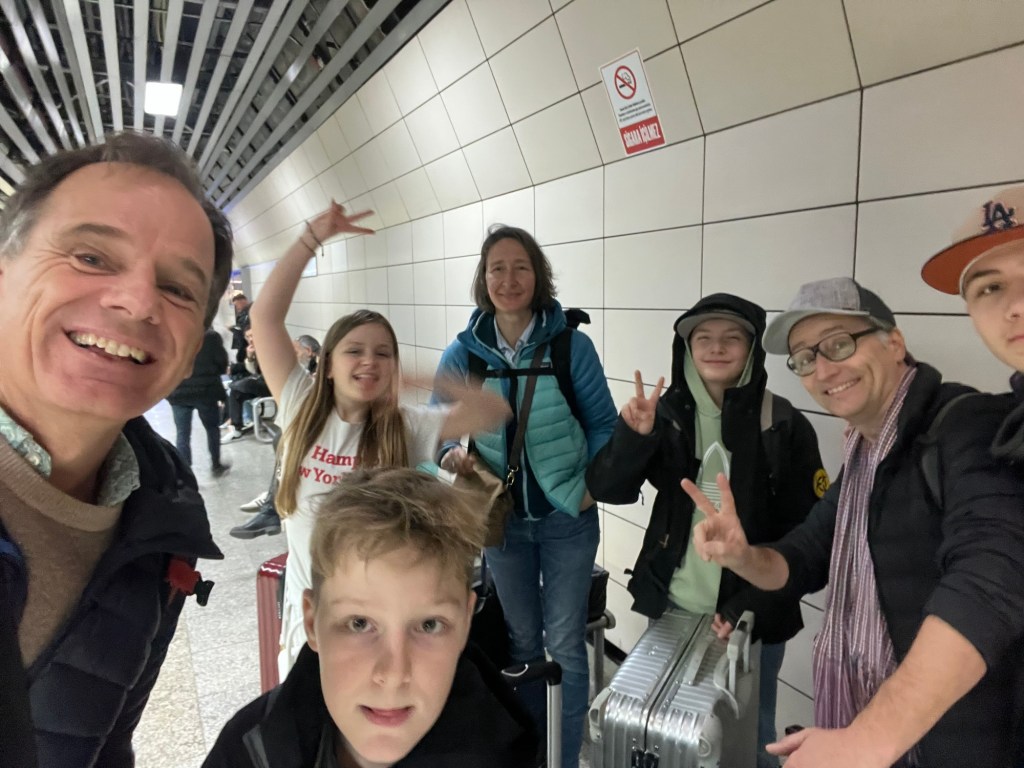
At our meeting point in Gül Ahnepark, we all get together again, collect our luggage and make our way to the airport by metro. It works surprisingly well, you can usually just buy the ticket with your credit card at the turnstile, and we change again and arrive back at Sabina Göttingen Airport after a one-hour journey, as it is practically laid out and full of passengers. We also need 3 hours until departure and are now with a last noodle soup for the kids and speculoos from my mom. An avocado and sesame. Ringle strengthened at boarding for our night flight of just under 5 hours with Pegasus to Muscat – no frills. Oman can come – Istanbul was a great start – it goes on!
Am dritten Tag der Reise wird so langsam klar, dass wir unterwegs sind. Das Zuhause, die Schule, Arbeit etc. rücken in die Ferne. Und ein erstaunliches Gefühl macht sich breit. Es liegt an uns, wann wir aufstehen, was wir machen wollen. Die Routinen des Alltags weichen einer Mischung aus Freiheit und Unsicherheit. Klar bleibt – wir wollen den Kindern die Welt zeigen. Wir müssen uns uns auch etwas einfallen lassen. Erschöpfung und Neugierde sind beides dabei, denn die 15-Millionen- Metropole Istanbul ist überwältigend.
Wir stehen spät auf, und nach dem Frühstück mit Oliven und Schafskäse, Sesamkringel und Ei wollen sich alle erst mal wieder auf dem Zimmer ausruhen. Ich gehe ein paar Schritte und setze mich auf eine Steinmauer, gegenüber einer kleinen alten heruntergekommenen Moschee aus dem 18. Jahrhundert. Die Sonne wärmt mich wieder bei 15 Grad, und ich zücke das Handy, um ChatGPT zu Rate zu ziehen. Welche Museen sind für Kinder in Istanbul interessant, frage ich per Spracheingabe. Das Robotermuseum klingt spannend, ist aber eine Stunde weg. Aber nur 5 min von hier liegt das Museum für Geschichte der Wissenschaft und Technik im Islam. Ich lasse mir, altersgerecht, eine kurze Übersicht der Errungenschaften für 12 jährige zusammenstellen. Auf der roten Wendeltreppe unsrer Pension sitzend bitte ich sie, kurz zuzuhören und lasse die KI vorlesen: Vom Astrolabium, dem Sternencomputer, über die Erfindung der Algebra, die Erfindung der Krankenhäuser und der Grundlagenwerke der Medizin, Pumpen und Wasseruhr gibt es eine erste Einführung. Das funktioniert. Es ist auch viel besser, als wenn ich immer rede.
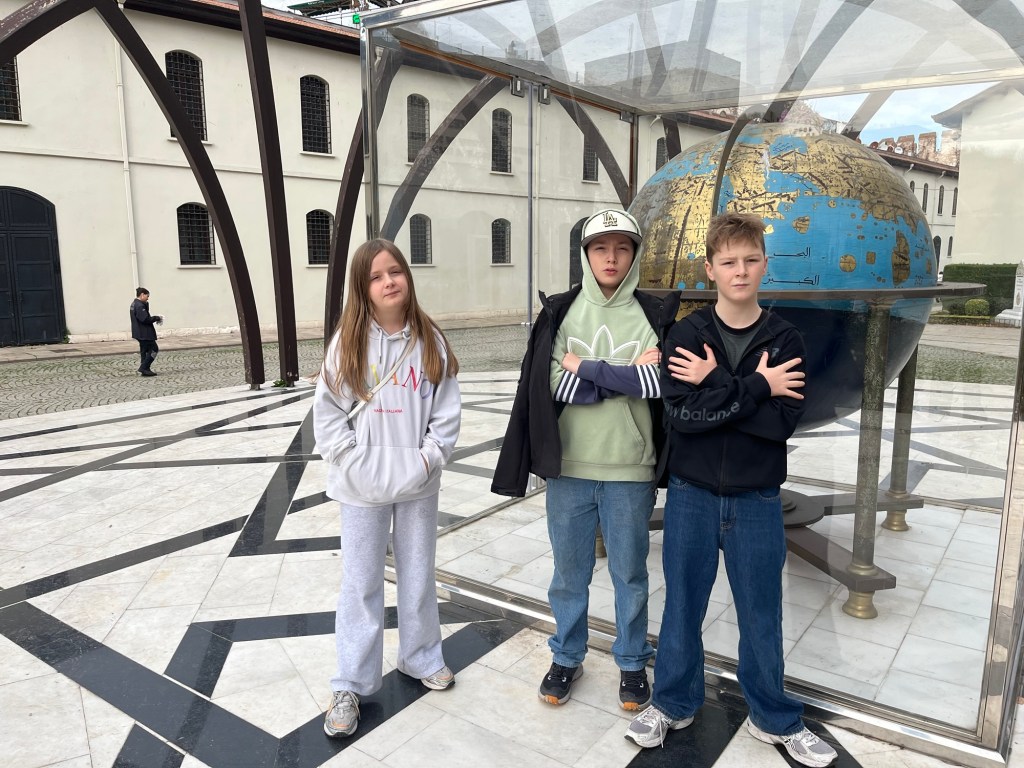
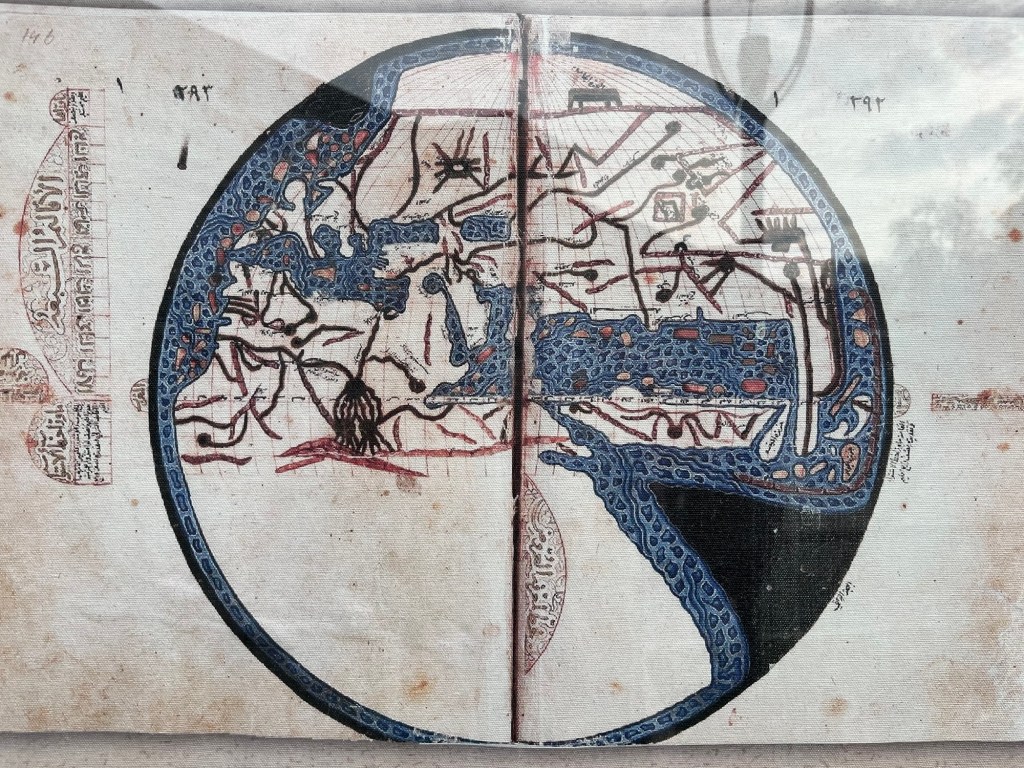
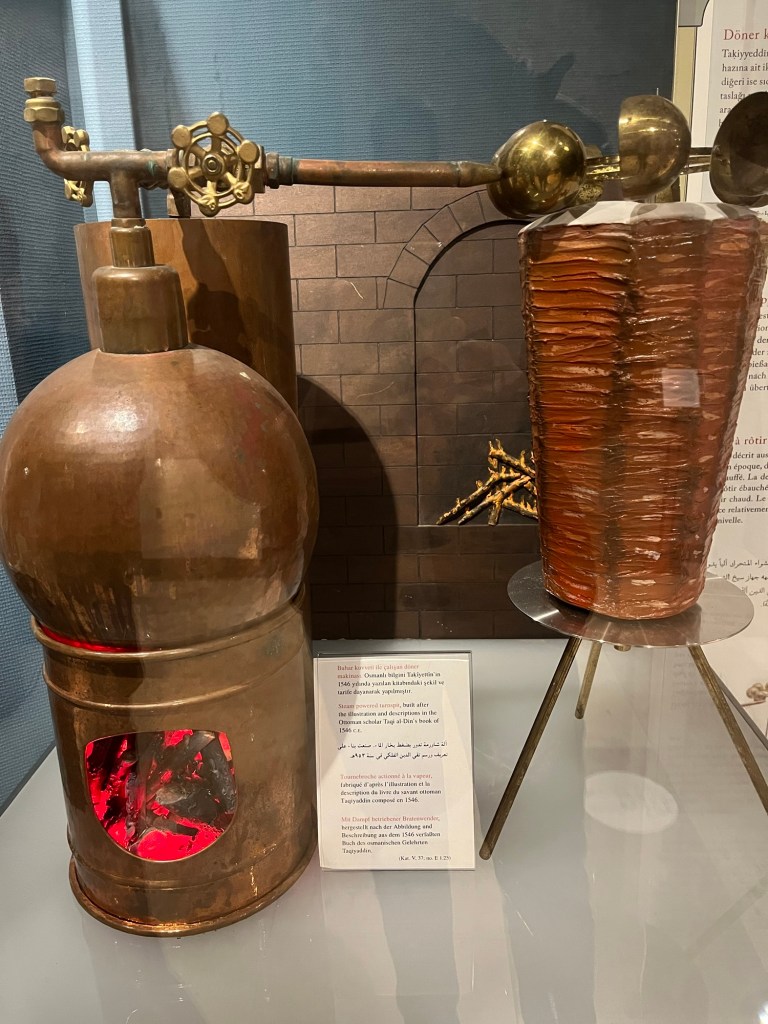
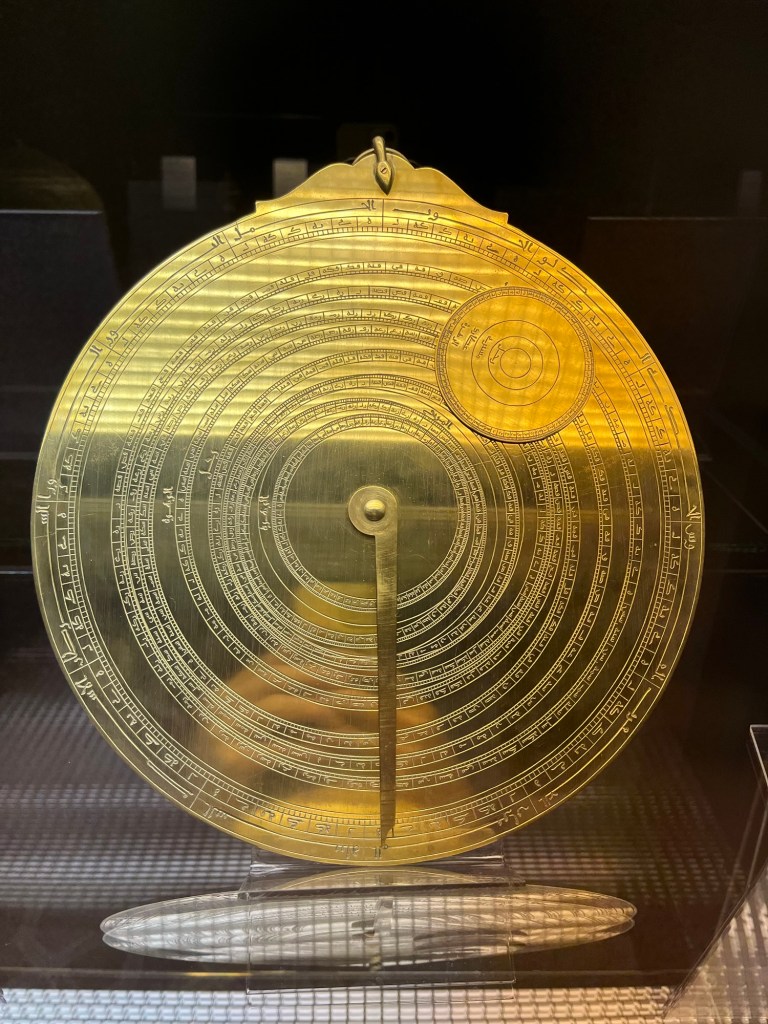
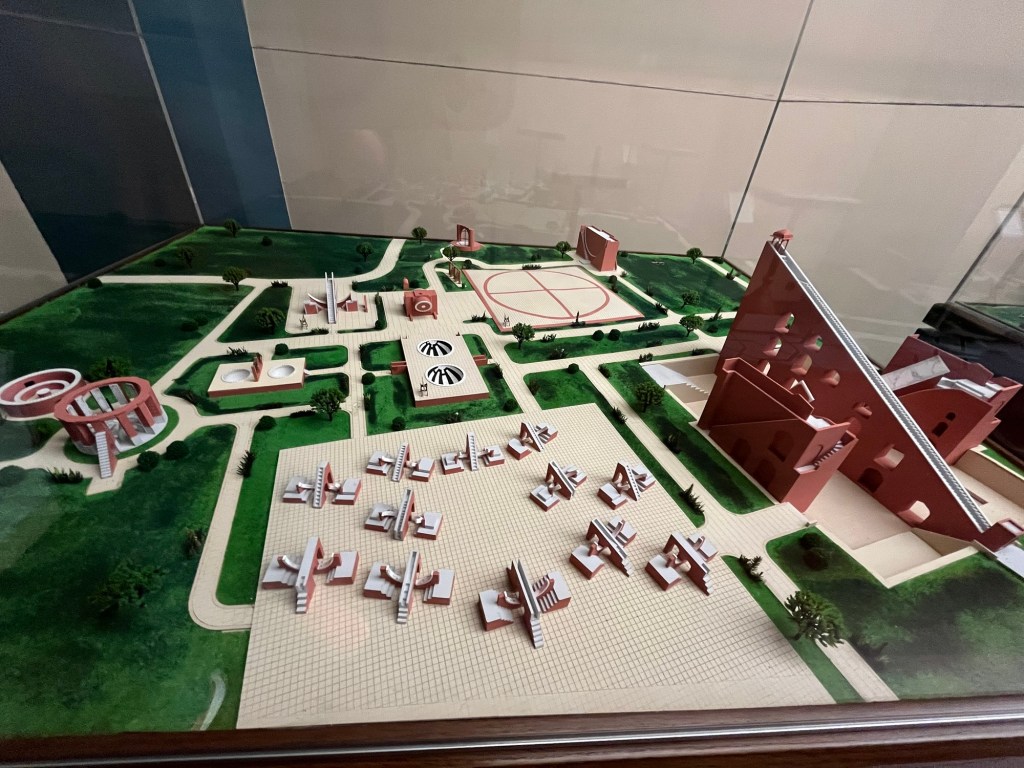
Das Museum ist dann erstaunlich schön gemacht, mit hunderten von Modellen aller Arten von Geräten und Technik – bis hin zum Prototyp des Döner-Spießes mit Dampf betrieben aus dem Jahr 1450. Das bereits im 9. Jahrhundert ein persischer Gelehrter die Psychosomatik begründet, hat mich erstaunt. Immer wieder lasse ich mir selbst die astronomischen oder mathematischen Errungenschaften von ChatGPT erklären, was gut funktioniert. Dass aus Samarkand in Turkmenistan sich eine Schule der Astronomie mit riesigen Sternwarten bis nach Jaipur in Indien ausbreitete, fand ich faszinierend.
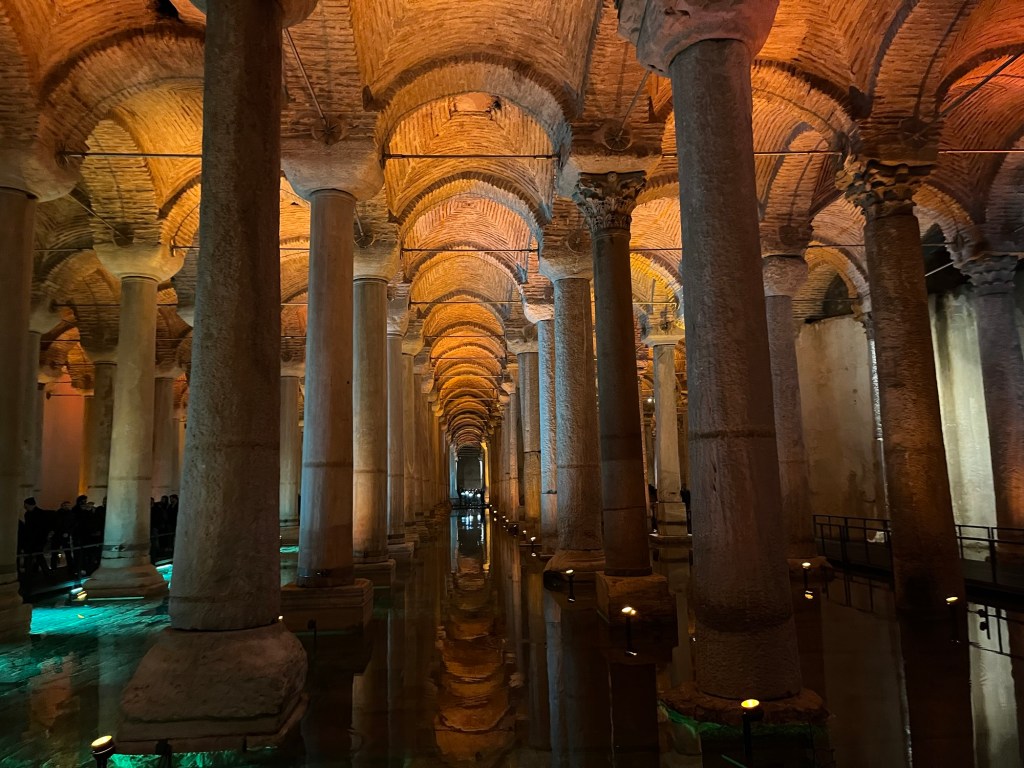
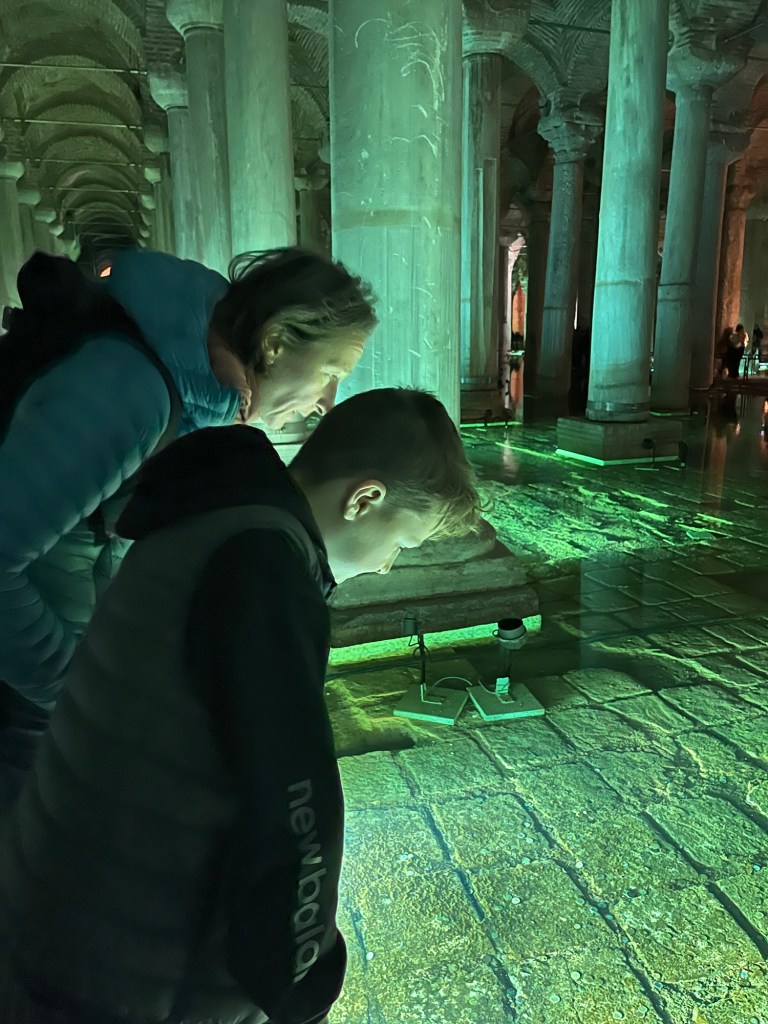
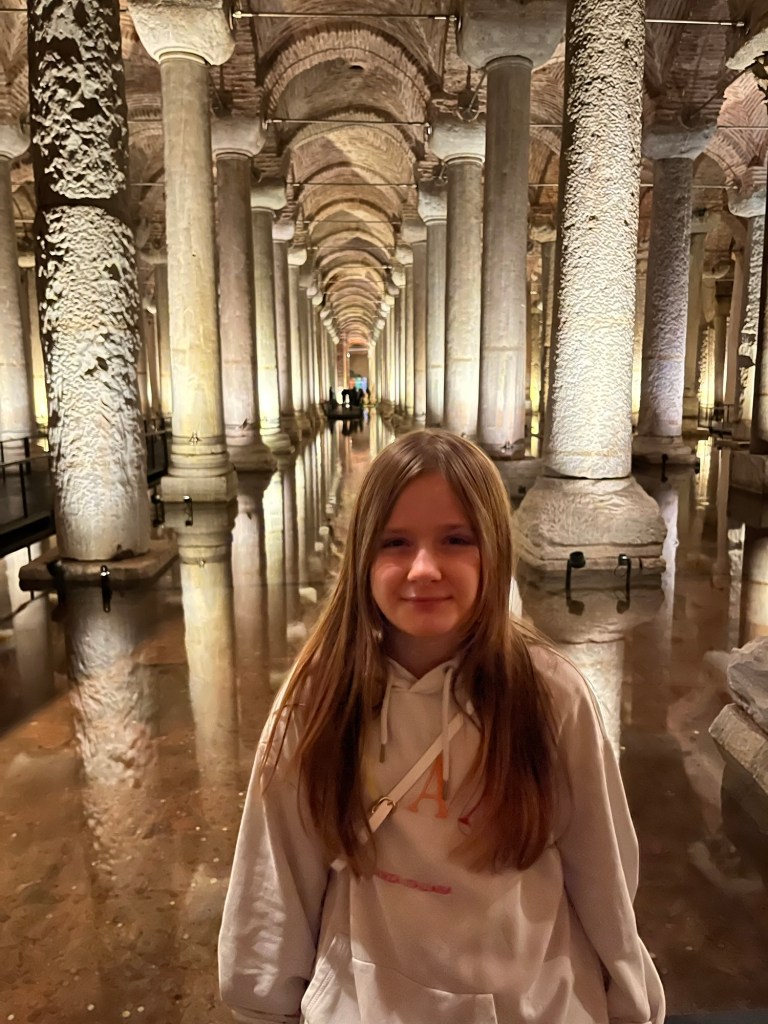
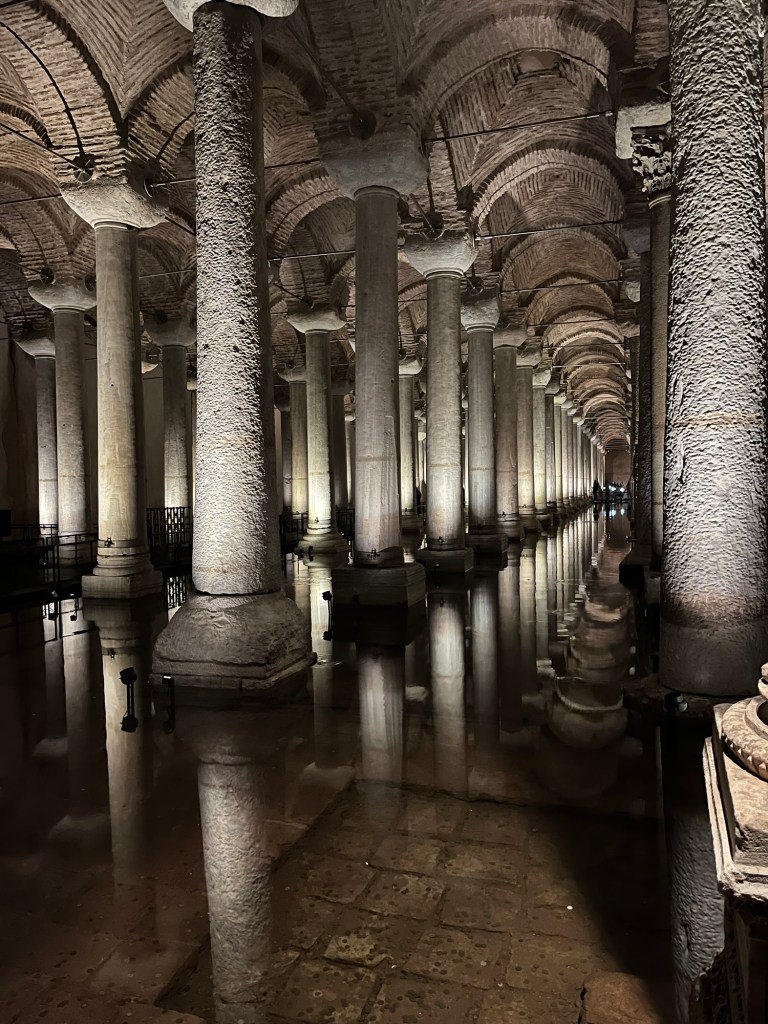
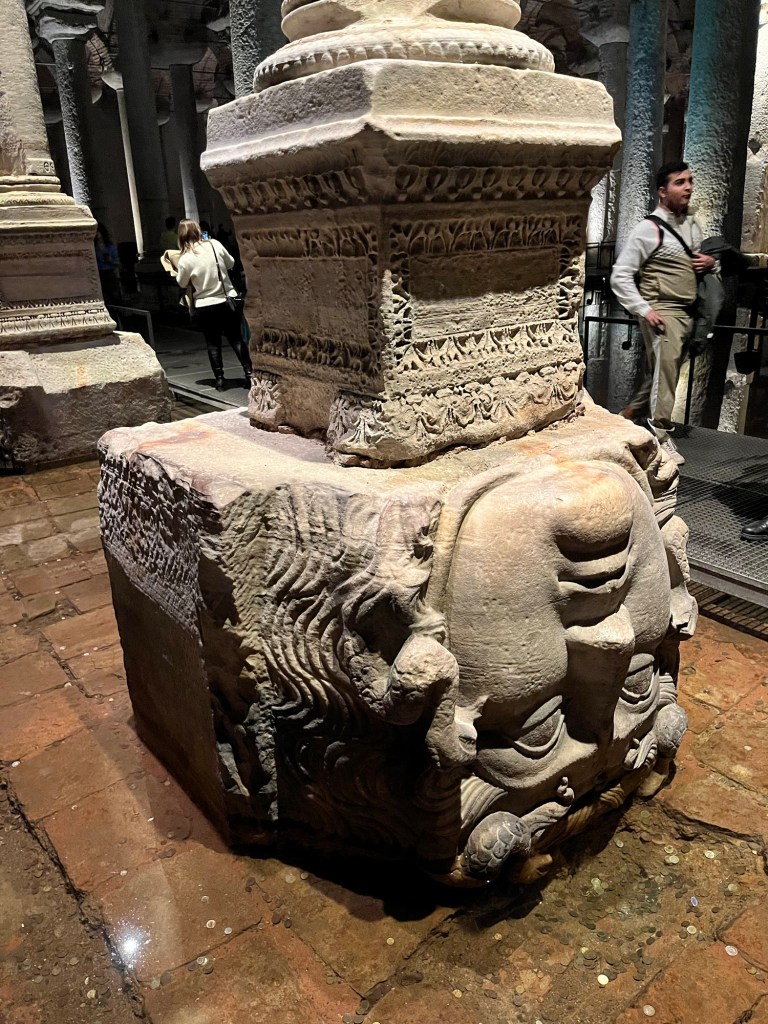
Nachmittags geht es dann zum „versunkenen Palast“ genannten historischen Wasserspeicher neben der Hagia Sophia und der blauen Moschee, der Basilika-Zisterne. Schon die Ausmaße der unterirdischen Anlage sind beeindruckend: Das Wasser wurde aus 19 km Entfernung über Aquädukte in die im 6. Jahrhundert gebaute Anlage transportiert – 140 Meter lang und 70 Meter breit. Ein magischer Ort, der die 25 Euro Eintritt pro Person wert war.
Auf noch mal 100 Euro Eintritt für die Hagia Sophia haben wir dann aber alle keine Lust mehr und essen lieber gegrillten Mais und Sesamringle mit Frischkäse und hängen noch etwas auf dem großen Platz ab, bevor sich jeder daheim ausruhen darf. Die Kinder bekommen Nudelsuppen, entspannen sich an den Geräten, wir üben Skat auf dem Balkon und gönnen uns ein Feierabendbier mit Blick auf die Stadt. Die batteriebetriebene Lichterkette macht Tara und Morpheus glücklich zum Einschlafen und erinnert an daheim.
Morgen ist Inyans Geburtstag, wir müssen mittags auschecken, und abends gegen 21:35 fliegen wir weiter knapp 5 Stunden in den Oman.
Museum of Islamic science and sunken palace
On the third day of the journey, it slowly becomes clear that we are on the road. Home, school, work, etc. are receding into the distance. And an amazing feeling spreads. It’s up to us when we get up, what we want to do. The routines of everyday life give way to a mixture of freedom and uncertainty. One thing remains clear – we want to show the children the world. We also have to come up with something. Exhaustion and curiosity are both present, because the metropolis of Istanbul with its 15 million inhabitants is overwhelming.
We get up late and after breakfast with olives and sheep’s cheese, sesame curls and eggs, everyone wants to relax in the room. I take a few steps and sit down on a stone wall opposite a small, old, run-down mosque from the 18th century. The sun warms me again at 15 degrees and I pull out my mobile phone to consult ChatGPT. Which museums are interesting for children in Istanbul, I ask by voice command. The Robot Museum sounds exciting, but it’s an hour away. But the Museum of the History of Science and Technology in Islam is only 5 minutes away. I ask for a brief, age-appropriate overview of the achievements for 12-year-olds. Sitting on the red spiral staircase of our guesthouse, I ask them to listen for a moment and have the AI read out: From the astrolabe, the star computer, to the invention of algebra, the invention of hospitals and the basic works of medicine, pumps and water clocks, there is a first introduction. It works. It’s also much better than when I’m always talking.
The museum is amazingly beautiful, with hundreds of models of all kinds of devices and technology – right up to the prototype of the steam-powered kebab spit from 1450. I was amazed that a Persian scholar founded psychosomatics back in the 9th century. Time and again I have ChatGPT explain astronomical or mathematical achievements to me, which works well. I found it fascinating that a school of astronomy with huge observatories spread from Samarkand in Turkmenistan to Jaipur in India.
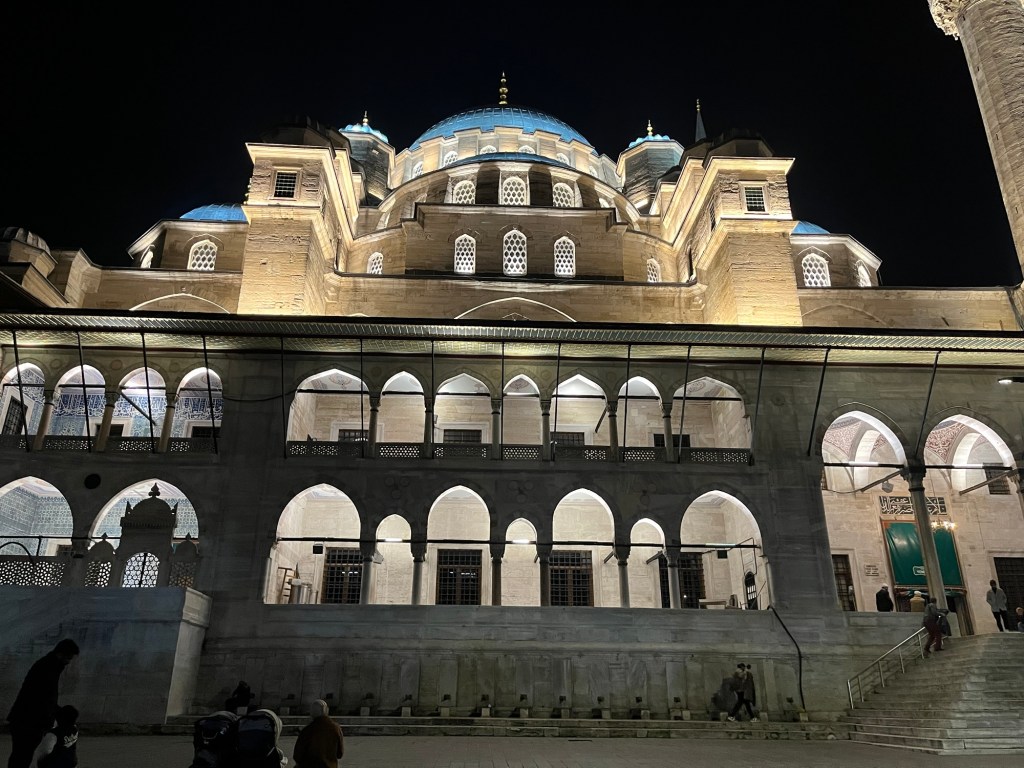
In the afternoon, we head to the historic water reservoir known as the ‘sunken palace’ next to the Hagia Sophia and the blue mosque, the basilica cistern. The dimensions of the underground complex alone are impressive: the water was transported from 19 kilometres away via aqueducts into the complex built in the 6th century – 140 metres long and 70 metres wide. A magical place that was worth the 25 euro entrance fee per person.
However, we don’t feel like paying another 100 euros for entry to the Hagia Sophia and prefer to eat grilled corn and sesame rings with cream cheese and hang out in the large square before everyone is allowed to rest at home. The children have noodle soups, relax on the equipment, we practise skat on the balcony and treat ourselves to an after-work beer with a view of the city. The battery-powered fairy lights make Tara and Morpheus happy to go to sleep and remind them of home.
Tomorrow is Inyan’s birthday, we have to check out at midday, and at around 21:35 in the evening we fly on to Oman, just under 5 hours away.
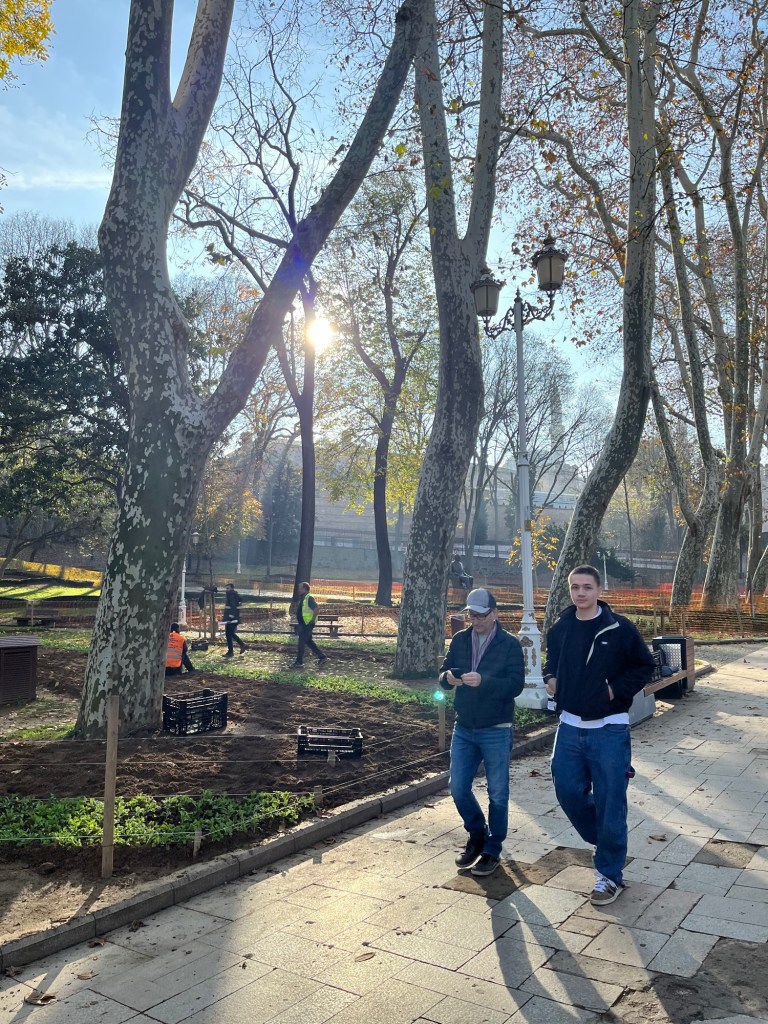
Die Sonne scheint, die Kinderschuhe hat der Nikolaus geschmückt, das Hotel lädt uns als Wiedergutmachung zum Frühstück ein, draußen begleiten uns auf Schritt und Tritt die Katzen und die erste Lektion unserer Weltreiseschule führt uns in den Gülhane Park.
Die Kinder üben auf den Schildern die englischen Texte vorzulesen und lernen dabei, dass ein gewisser Atatürk hier eine große Rolle spielt und das deutsche Alphabet mit seinen Umlauten 1929 als offizielle Schrift eingeführt hat.
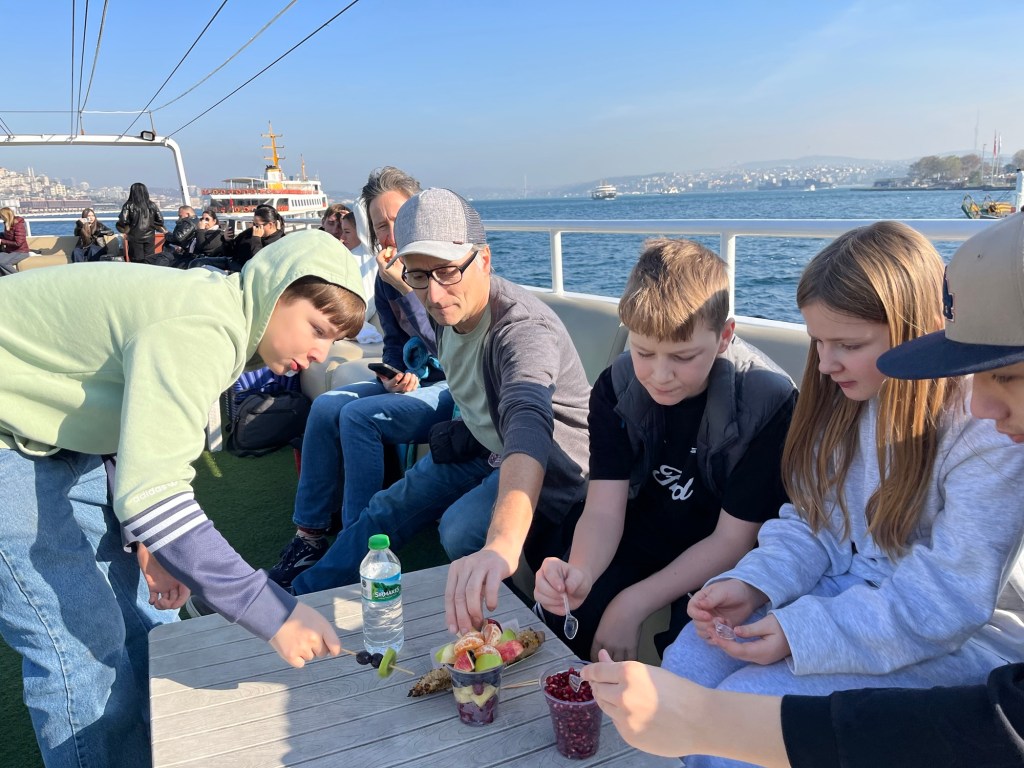
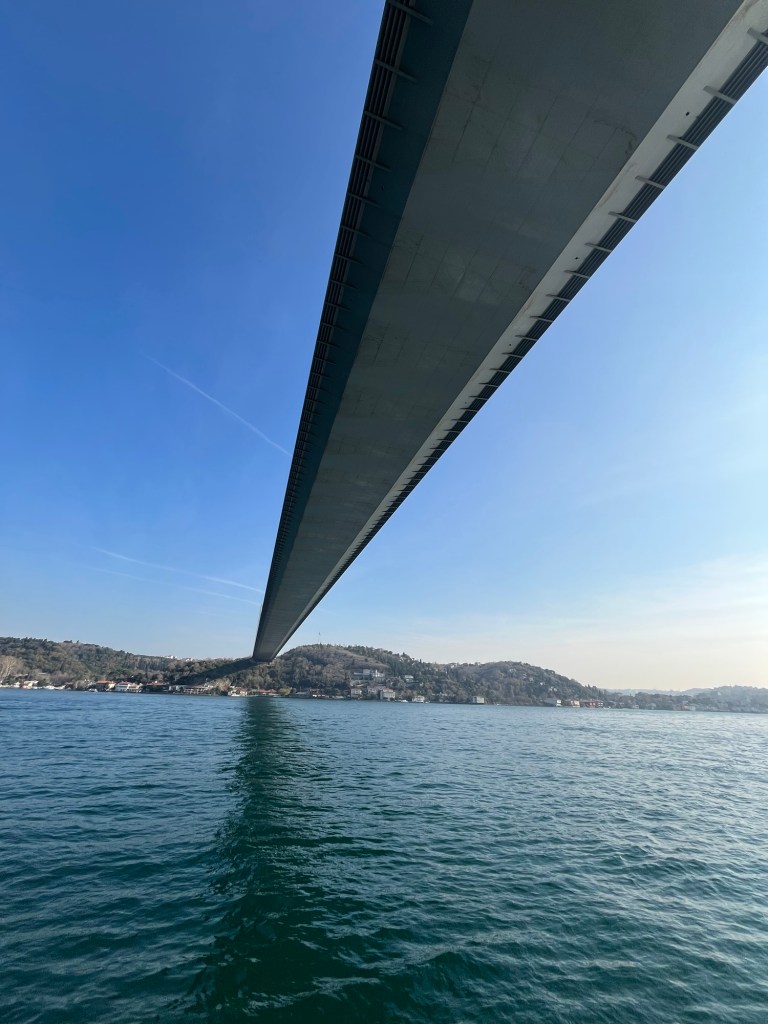
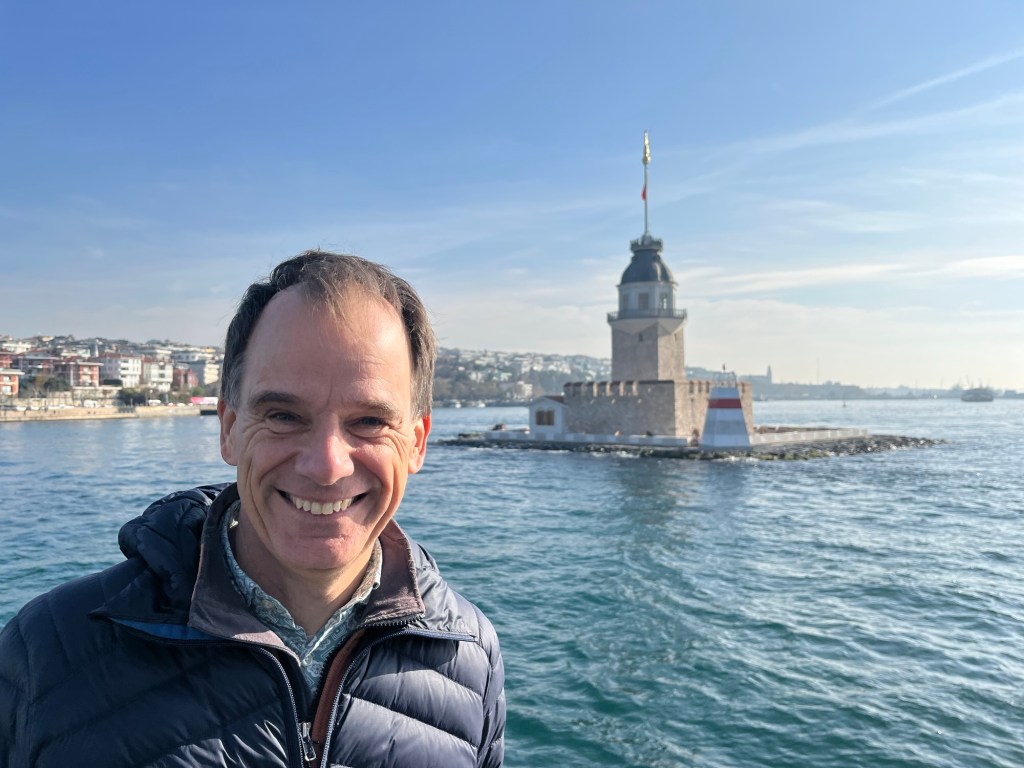
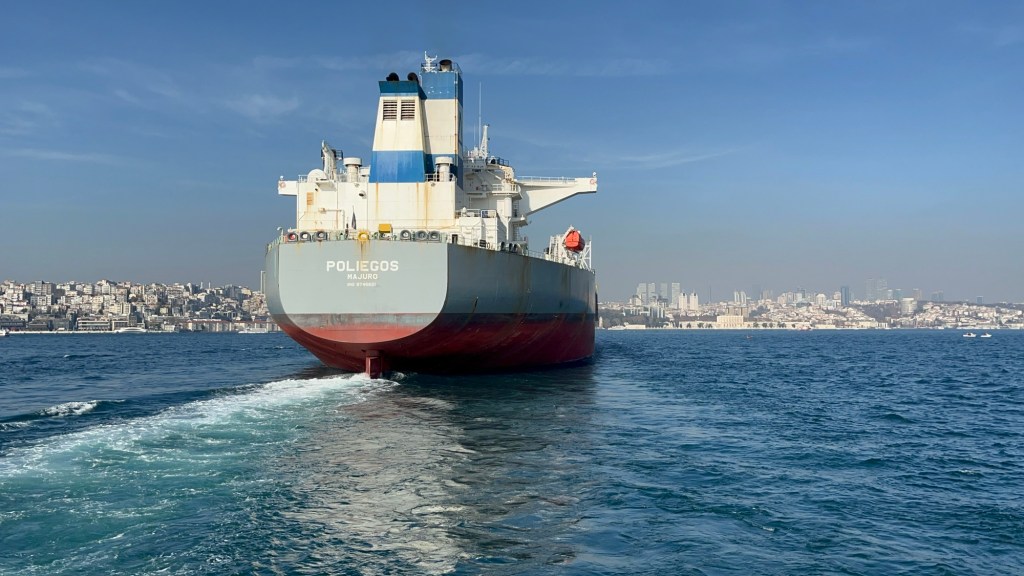
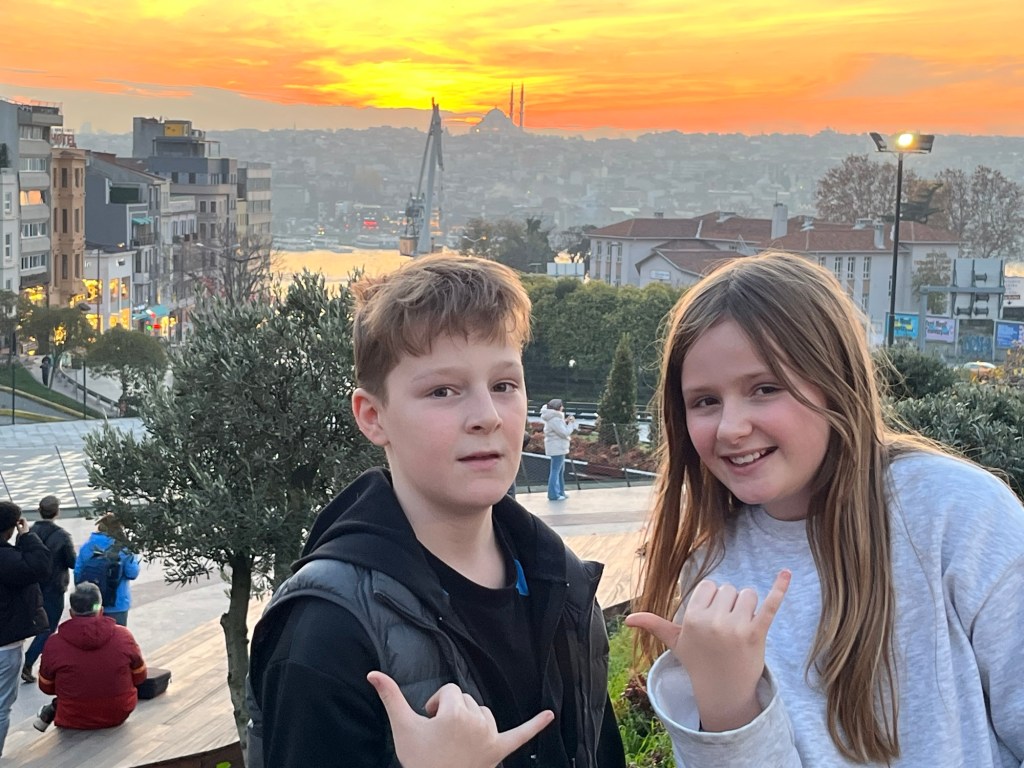
In den Bäumen entdeckt Morpheus grüne Vögel, die wie kleine Papageien aussehen, und mit seinem Ball gibt es immer etwas zu spielen. Am Meer angekommen laden uns die Fähren zu einer Bootstour unter den beiden Hängebrücken durch den Bosporus in Richtung schwarzes Meer, hinauf auf der europäischen Seite und auf der asiatischen Seite zurück. Mir zuliebe dreht der Kapitän zwei Extrarunden am Leander-Turm, was mich hoch erfreut- oder musste er wegen eines Tankers warten?
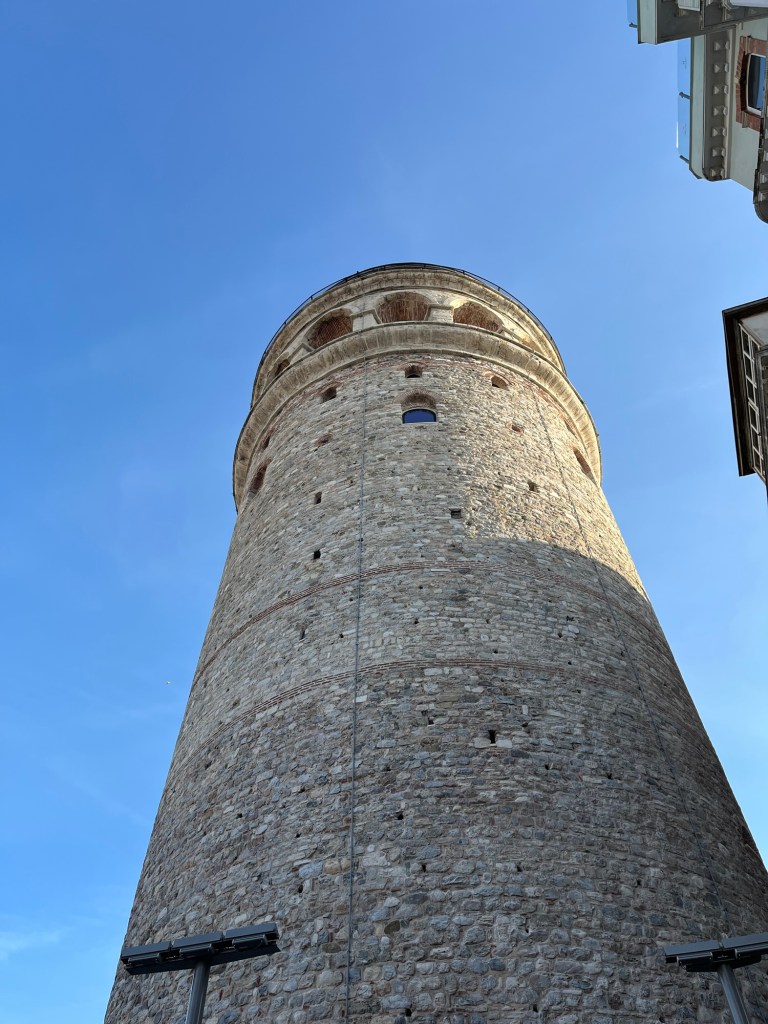
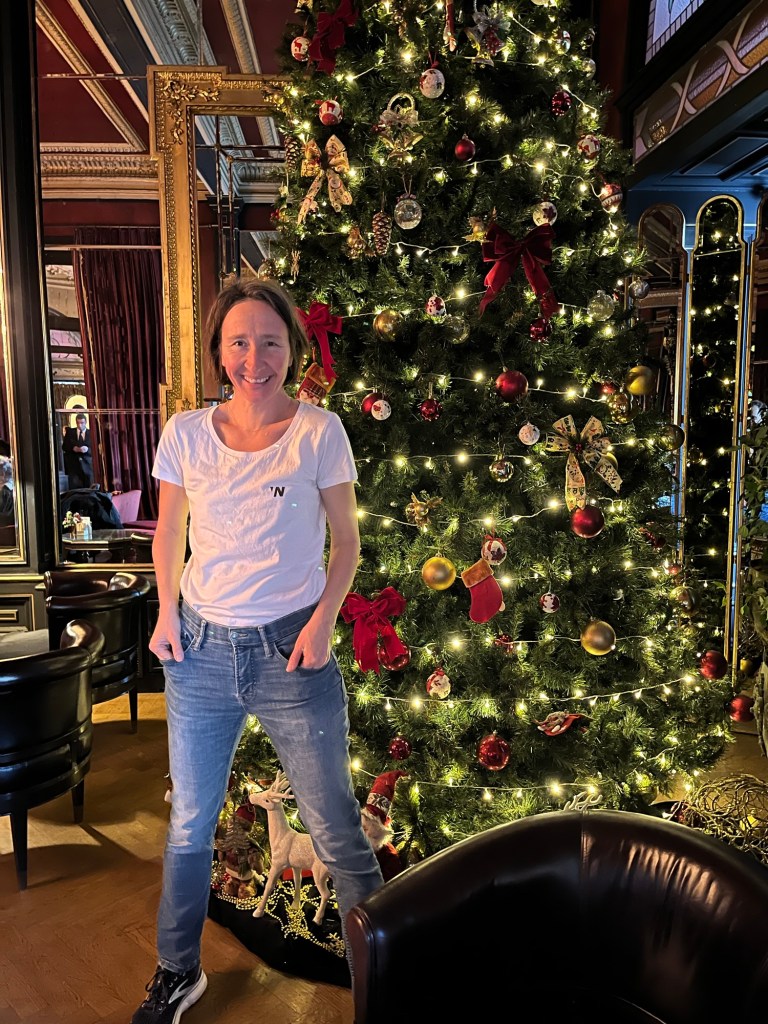
Auch wenn es zur Landeskultur gehört, bereits Kleinkindern, fünf Tassen Tee zu verabreichen, wie uns der Kellner gestern begeistert schilderte, verzichten wir darauf und lassen die Kinder lieber Obst, gegrillte Maiskolben und Kastanien essen. Dafür gibt es für so viel großartigen Einsatz einen Burger im Schnellimbiss. Auf der Galata- Brücke sieht man hunderte von Anglern ihre kleinen Fische fangen und beim Aufstieg zum Galata Turm gibt es einen Obstsaft. Der Tatortreiniger reinigt dort gerade die Spuren eines tragischen Sturzes, und so ziehen wir weiter in das prächtige Pera Palace Hotel und trinken dort einen Nachmittags Tee , spielen Rommee und genießen das Ambiente in den Räumen, in denen schon Agatha Christie den Mord im Orientexpress schrieb.
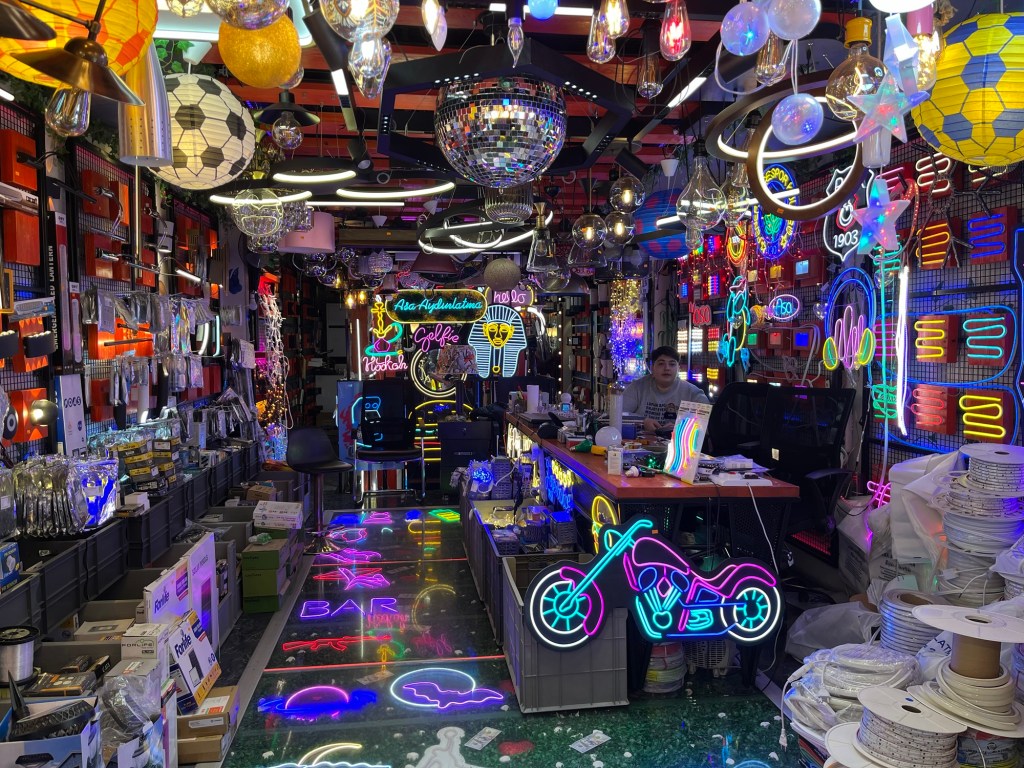
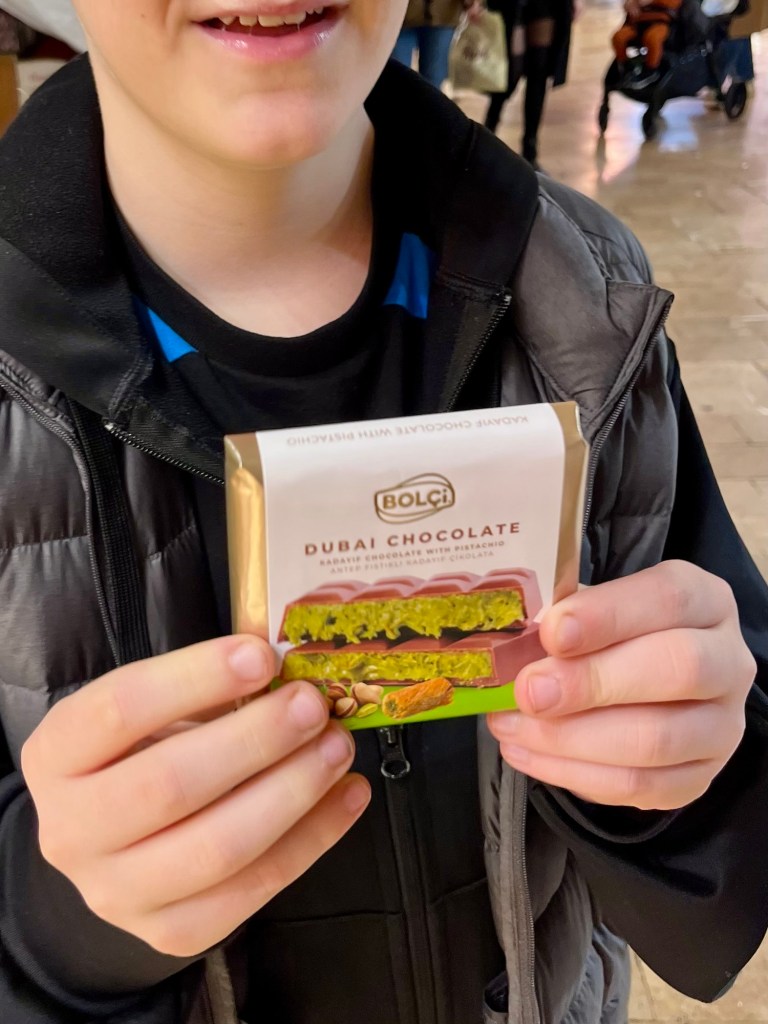
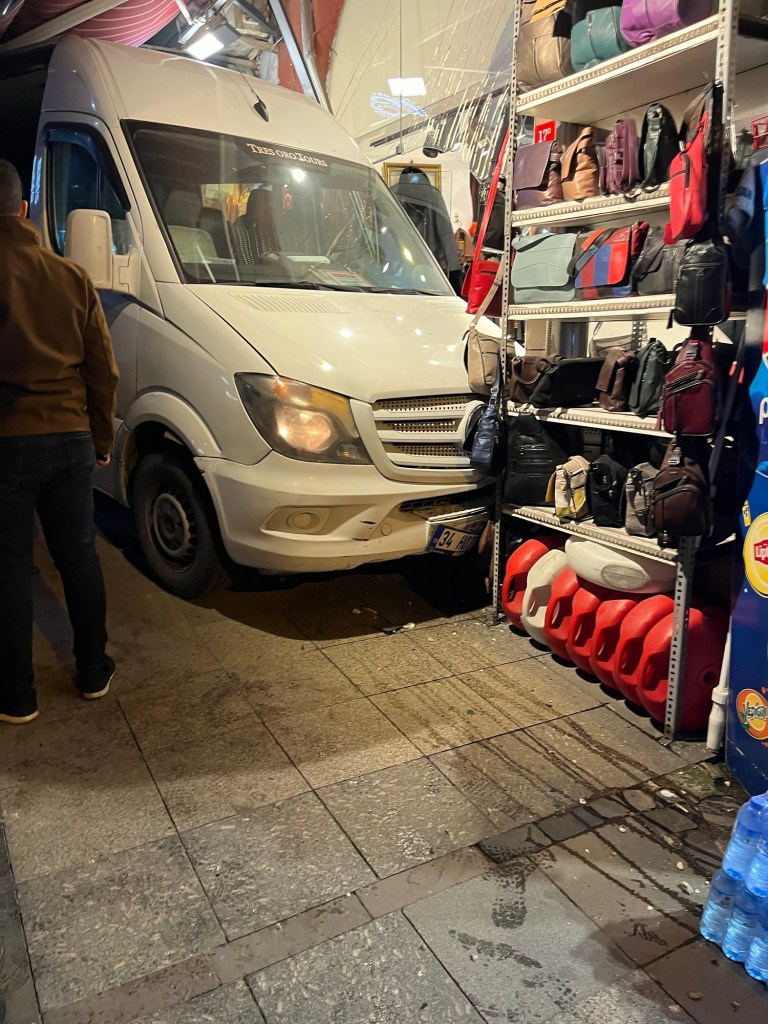
In den Bazars der Unterführungen finden wir die ersten Wichtel Geschenke und Tara ihre heiß begehrte Handtasche, während Morpheus endlich eine Dubai Schokolade genießen darf. Die Kinder sind erstaunt, was man an einem Tag alles erlebt, als sie noch einen vom Weg abgekommen Kleinbus im Schaufenster entdecken.
Erschöpft kehren wir voller Erlebnisse abends ins Hotel zurück.
St. Nicholas comes from Turkey
The sun is shining, Santa Claus has decorated the children’s shoes, the hotel invites us to breakfast to make amends, outside the cats accompany us at every turn and the first lesson of our world travel school takes us to Gülhane Park. The children practise reading out the English texts on the signs and learn that a certain Atatürk played a major role here and introduced the German alphabet with its umlauts as the official script in 1929.
Morpheus discovers green birds in the trees that look like little parrots, and there is always something to play with his ball. Once we reach the sea, the ferries take us on a boat trip under the two suspension bridges across the Bosphorus towards the Black Sea, up the European side and back down the Asian side. For my sake, the captain does two extra laps of the Leander Tower, which delights me – or did he have to wait because of a tanker?
Even though it is part of the local culture to serve five cups of tea to small children, as the waiter enthusiastically told us yesterday, we refrain from doing so and prefer to let the children eat fruit, grilled corn on the cob and chestnuts. For all their hard work, we get a burger at the fast food restaurant and see hundreds of anglers catching their little fish on the Galata Bridge and a fruit juice on the way up to the Galata Tower. The crime scene cleaner is cleaning up the traces of a tragic fall, and so we move on to the magnificent Pera Palace Hotel for an afternoon tea, a game of Rommee and to enjoy the ambience in the rooms where Agatha Christie wrote Murder on the Orient Express.
In the bazaars of the underpasses, we find the first gnome gifts and Tara her coveted handbag, while Morpheus finally gets to enjoy a Dubai chocolate. The children are amazed at what you can experience in one day when they discover a minibus in the shop window.
Exhausted, we return to the hotel in the evening, full of experiences.
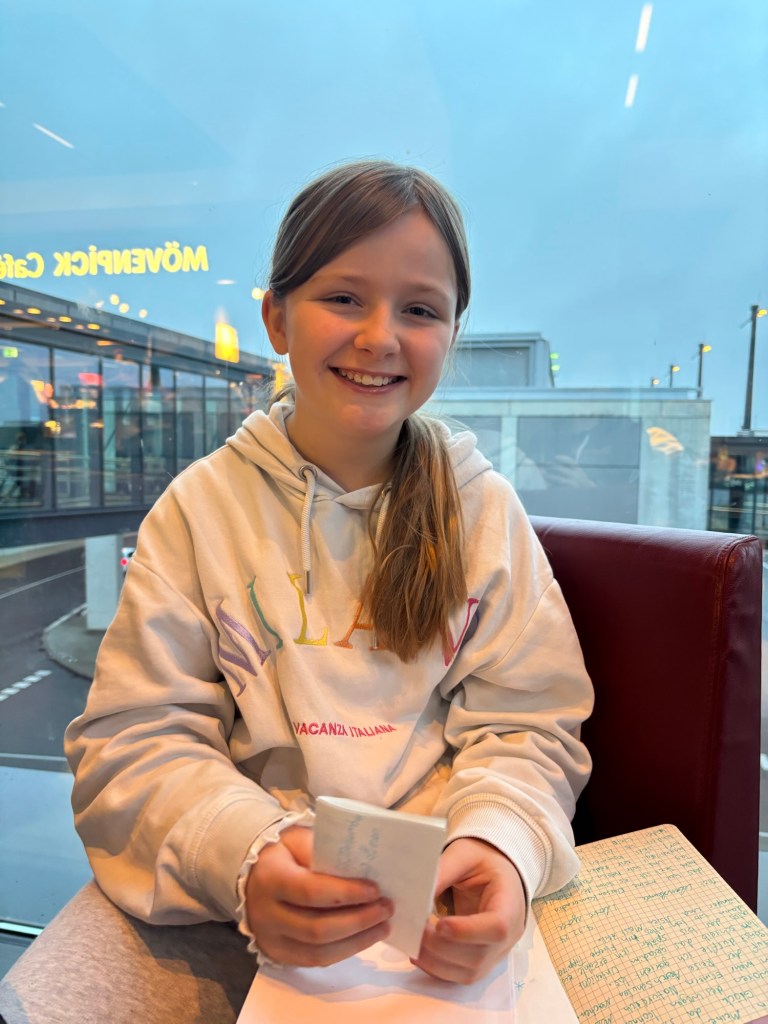
Um vier wachen wir auf, die Straßenbahn bringt uns um 6 zum Alexanderplatz. Am Flughafen gibt es im Mövenpick Café eine Stärkung. Wir werden wild über den Flieger verteilt. Und ich komme beim Warten und Fliegen dazu die Kafka Biografie zu lesen, von meinem Lieblingsbiografen Rüdiger Safranski zum 100. Todestag 2024. Ein Vorschlag auf dem neu gekauften Kindle- E-Reader. Eine merkwürdige Faszination habe ich für diesen früh an Tuberkulose gestobenen Autor.
Wo ich doch meist leicht und beschenkt durchs Leben schreite, kenne ich doch wie wohl wir alle diese Albträume der Verwirrungen, Bedrohungen, Ängste und die Versuche mit Ehrgeiz eine Verbindung herzustellen- mit der Welt da draußen. Mit 17, 18, da hatten seine Werk eine enorme tröstende Kraft auf mich ausgeübt, die ich aus der Ferne des erfüllten Lebens jetzt besser verstehen kann.
Es nicht zu wissen wie es geht, das Gefühl kannte ich so genau, und den Reflex des Rückzugs aus innerer Verunsicherung. Als das Mädchen in der 6. oder 7. Klasse in das ich offensichtlich verliebt war mich wagte zu fragen ob ich mit ihr gehen wollte antwortete ich, völlig überraschend und überfordert: „Das kannst du dir denken!“Ich meinte ja und hatte Angst, sie wollte mich auf den Arm nehmen. Sie verstand nein und es wurde nie etwas zwischen uns. Ich beschwichtige mich- zum Glück hatte ich mir die Blamage und peinliche Bloßstellung erspart nicht zu wissen was man tun sollte oder wissen müsste wenn man mit „jemandem geht“.
Ich sehe Parallelen- ohne das (Tagebuch)Schreiben wäre mein Leben nicht zu bewältigen, nicht zu verstehen, wäre es auf Treibsand gebaut. Mit dem Schreiben habe ich mir das Fundament erstellen können auf dem ich jetzt lebe- ich bin selbst am meisten erstaunt welche magische Kraft das Wort auf mich ausübt.
Ich habe mich aus Verstandesgründen für eine Profession entschieden, die immer eine Herausforderung war- und ich beschloss gleich im ersten Semester nur die zu meinen Freunde zu machen, die sich wie ich weigerten ein Wort über diese Sache freiwillig zu verlieren.
Kafka begründete bei mir diese Einstellung gegen alles zu sein, was da draußen erwartet wurde- weil es eine andere innere Wahrheit gab, der ich folgte.
Etwa auf der Abifahrt nach Prag. Ich verbrachte meine Zeit allein, auf der Suche nach Kafkas Welt. Ich reiste nachts im Regen mit der Straßenbahn durch das trübe Ostblock-Prag der 80er Jahre, und stieg in heruntergekommenen Treppenhäusern bis zum Dachgeschoss- auf den Spuren des Prozesses. Verirrungen, Verwirrung, mir war nach allein sein.
Da einmal durch gegangen zu sein hilft bis heute, dass ich mit Herausforderungen gut umgehen kann und auch im Dunklen immer eine Wahrheit sehe. Als ich mit 23 meine eigene Tuberkulose bekam, fühlte ich mich auf eine Weise erlöst, aufgenommen in den Club der schwindsüchtigen Poeten, wie Schiller, Novalis und Kafka. Freigestellt von den unerträglichen Verpflichtungen von Arbeit, Familie und gesellschaftlichen Aufstieg. Wenigstens für eine Weile. Aber ich erlaubte mir diese Perspektive mein Leben lang.
Auf eine merkwürdige Weise folge ich auch den Spuren Kafkas, in Spindlermühle stand ich oft auf der Holzbrücke, wo Kafka das Schloss imaginierte, in Berlin-Steglitz fuhr ich täglich durch den Park, durch den er in den späten Jahren spazieren ging. Seine erste Verlobte Felice Bauer wohnte in der Immanuelkirchstraẞe in Berlin, wie ich auch, bis heute. Die AUVA, die Arbeiter-Versicherungsanstalt wo Kafka bis zu seinem Tod mit 41 arbeitete, existiert weiter, ich habe sie in Wien als Berater besucht, mein erster Arbeitgeber war die BG, das deutsche Pendant, und ja ich habe jahrelang für Krankenversicherungen gearbeitet, und kenne das Schicksal des beruflich Reisenden, über das er sich beklagt.
Im Flieger las ich die Biografie zu Ende, was für ein Luxus. Ich bin wieder außerhalb der Routinen des Alltags, was für eine Freude.
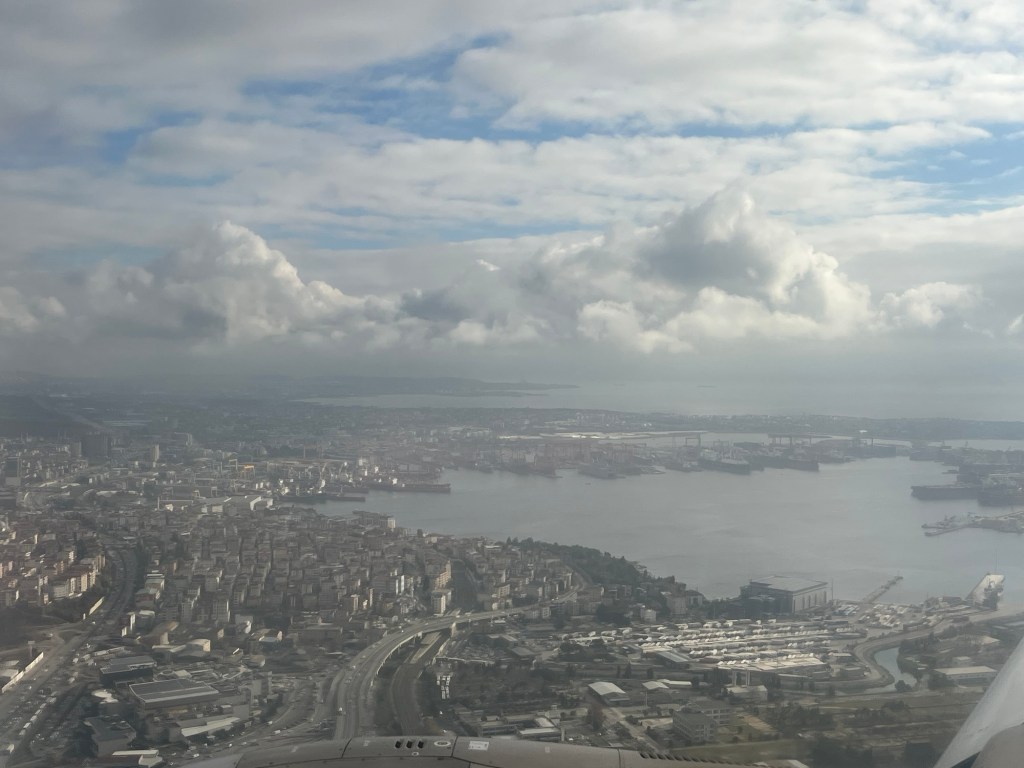
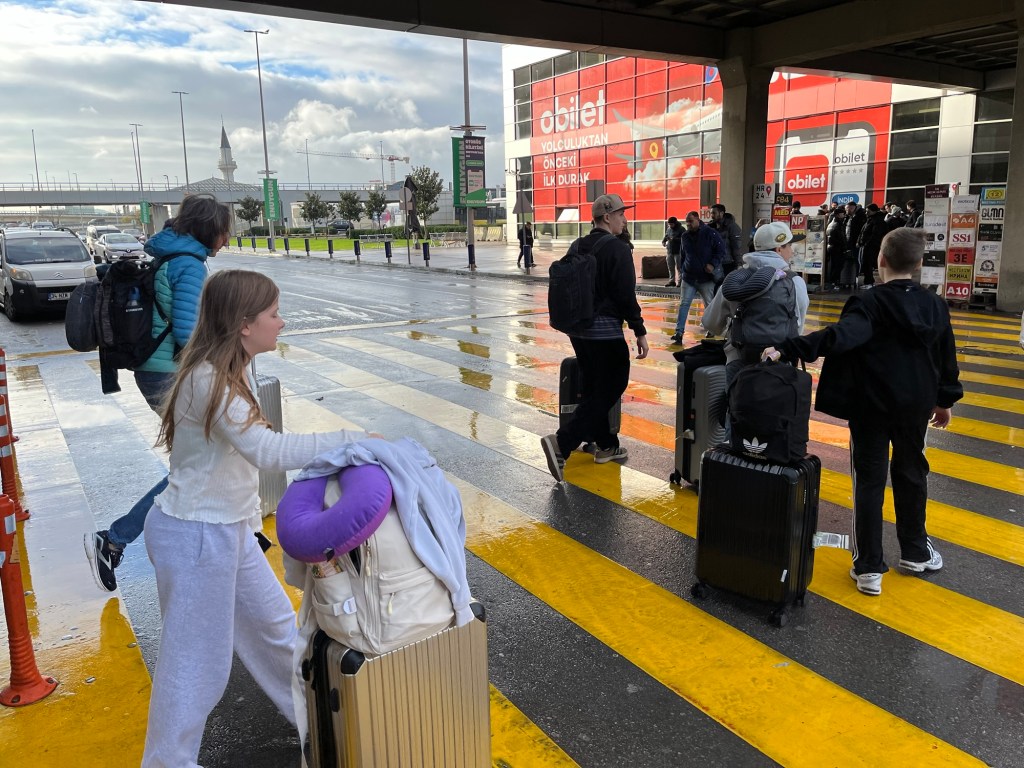
Istanbul ist groß und chaotisch, die Sonne scheint und empfängt uns strahlend und auf der Bosporusbrücke nach Europa zurück sind wir alle erstaunt vom Anblick von Meer, Stadt und Ambiente.
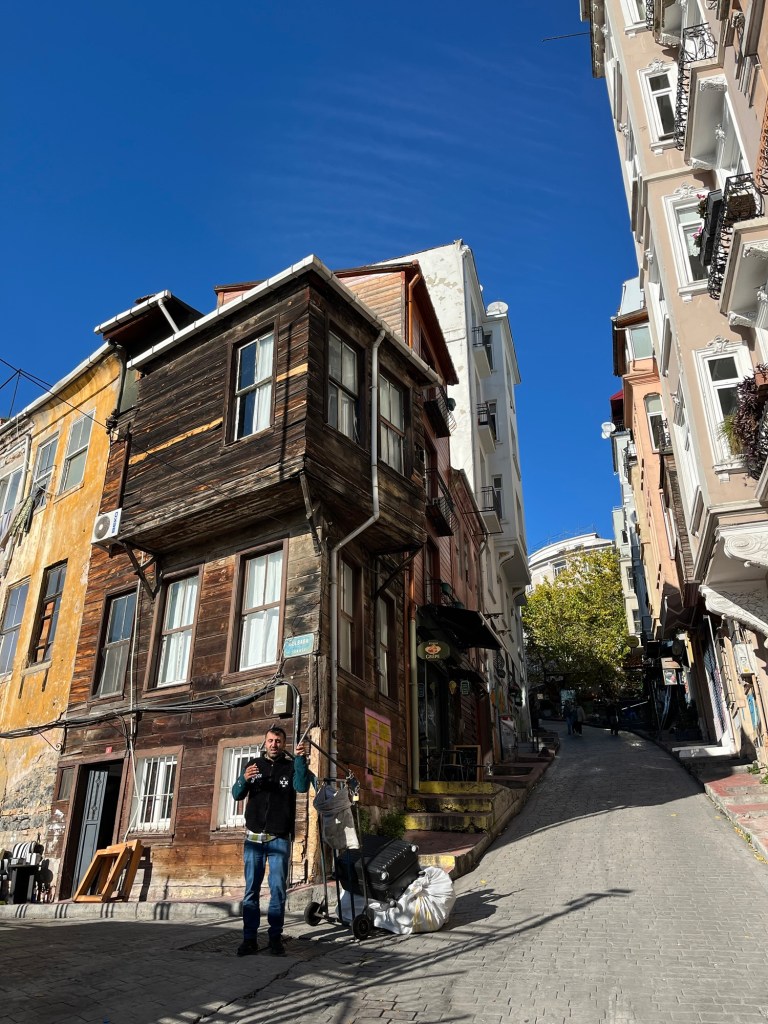
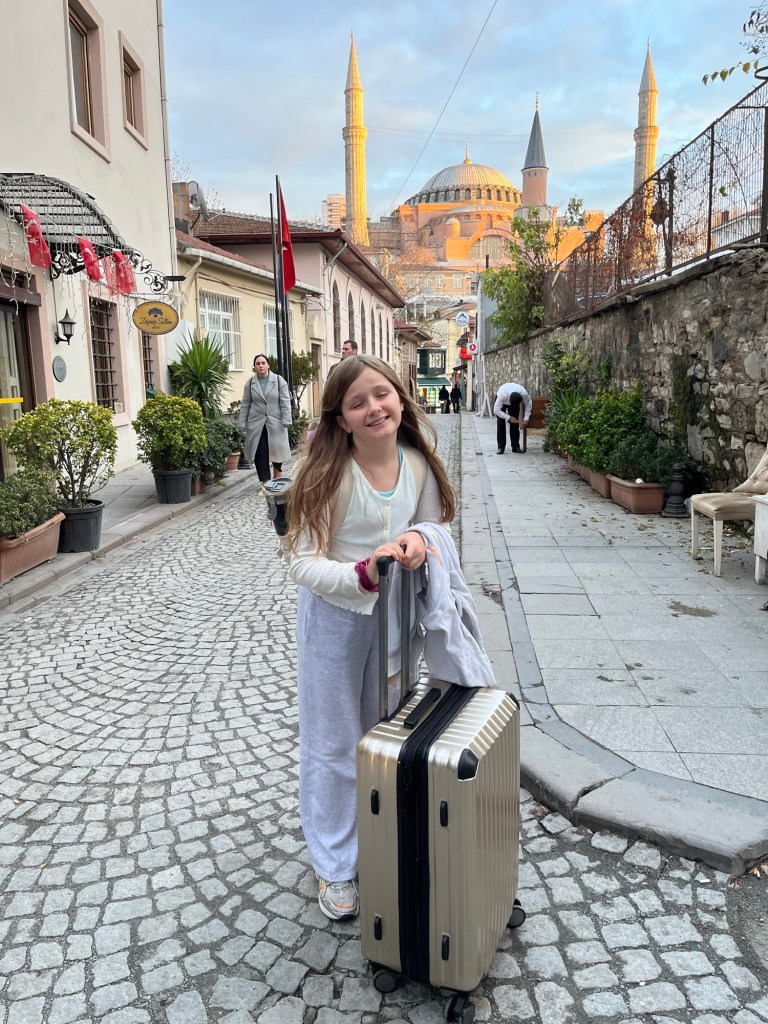
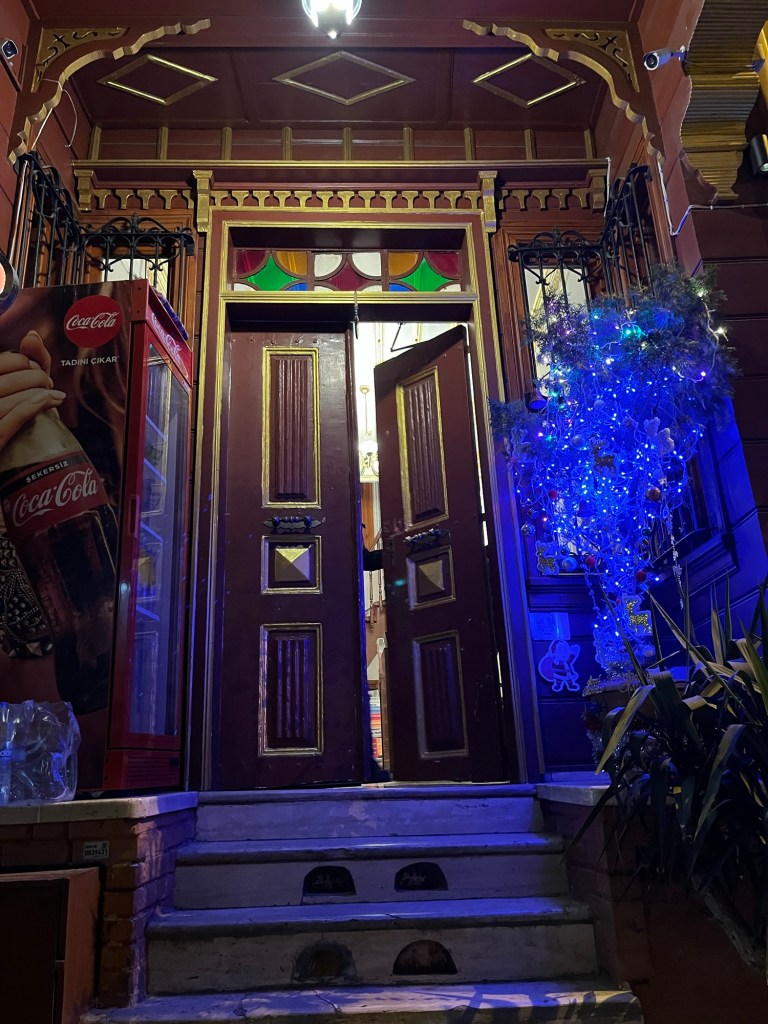
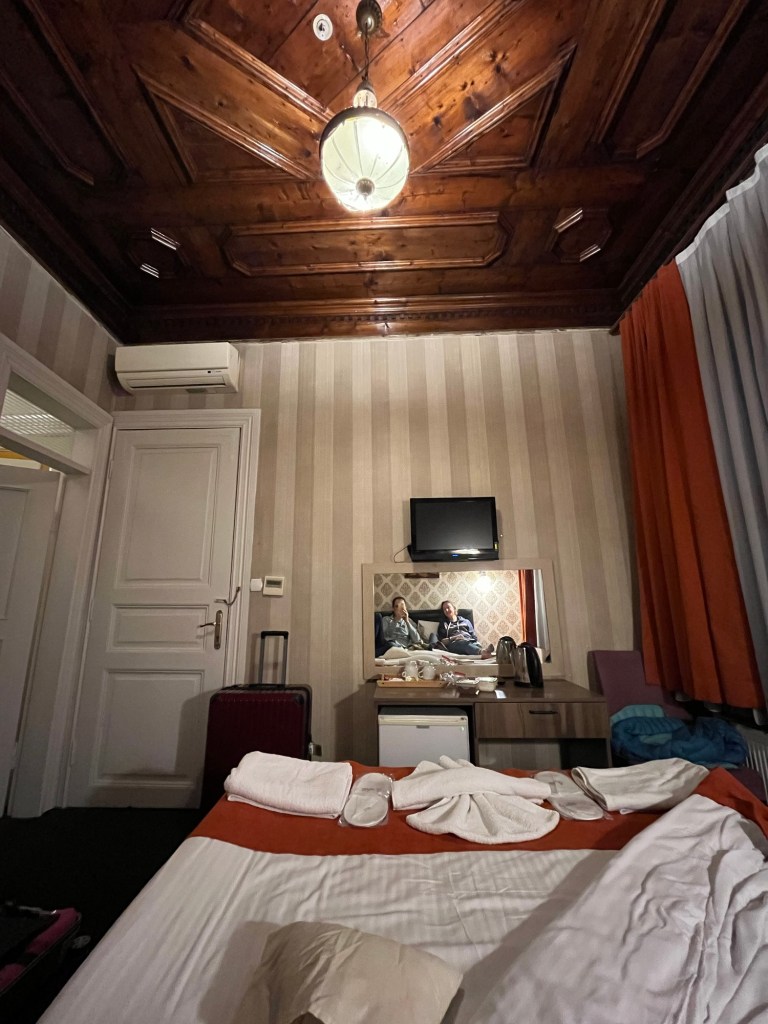
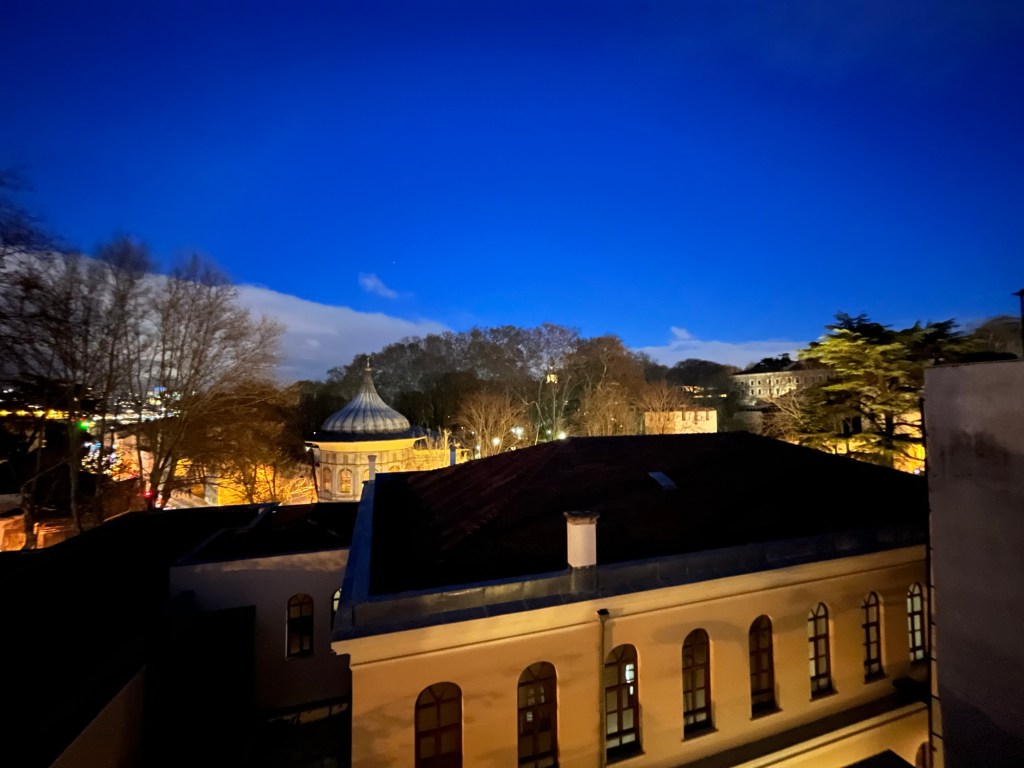
In den engen Gassen der Altstadt gelegen, mit Blick auf das Tokapi Serail ist unser Hotel irgendwie nicht verfügbar und wir tragen die Koffer über Steintreppen und historische Stiegen in ein Ausweichquartier , das mir sofort gefällt- es ist offensichtlich alt und man spürt es, aber es hat Charme und wir sind angekommen.
The first day
We wake up at four, the streetcar takes us to Alexanderplatz at 6. At the airport we have a snack in the Mövenpick Café. We are spread wildly across the plane. And while waiting and flying, I get to read the biography of Kafka by my favorite biographer Rüdiger Safranski on the 100th anniversary of his death in 2024. A suggestion on the newly purchased Kindle e-reader. I have a strange fascination for this author who died of tuberculosis at an early age.
Although I usually walk through life light and blessed, I know, as we all do, these nightmares of confusion, threats, fears and attempts to connect with ambition – with the world out there. At 17, 18, his work had an enormous comforting power on me, which I can now understand better from the distance of a fulfilled life. Not knowing how to do it, I knew the feeling so well, and the reflex of withdrawal out of inner insecurity.
When the girl I was obviously in love with in 6th or 7th grade dared to ask me if I wanted to go with her, I replied, completely surprised and overwhelmed: „You can guess that!“ I meant yes and was afraid she was pulling my leg. She understood no and it never became anything between us. I reassured myself – luckily I had spared myself the embarrassment and embarrassing exposure of not knowing what to do or need to know when „dating someone“.
I see parallels – without (diary) writing, my life would be unmanageable, incomprehensible, built on quicksand. Writing has given me the foundation on which I now live – I am amazed at the magical power the word has on me.
I chose a profession that was always a challenge for reasons of sanity – and I decided in my first semester to only make friends with those who, like me, refused to say a word about it voluntarily.
Kafka established this attitude in me of being against everything that was expected out there – because there was another inner truth that I followed.
For example, on the Abitur trip to Prague. I spent my time alone, searching for Kafka’s world. I traveled by streetcar at night in the rain through the gloomy Eastern Bloc Prague of the 80s, and climbed to the top floor in run-down stairwells – on the trail of the trial. Lost, confused, I felt like being alone.
Having gone through it once still helps me today to deal with challenges well and to always see a truth even in the dark. When I got my own tuberculosis at 23, I felt redeemed in a way, accepted into the club of consumptive poets like Schiller, Novalis and Kafka. Released from the unbearable obligations of work, family and social advancement.At least for a while. But I allowed myself this perspective all my life.
In a strange way, I also follow in Kafka’s footsteps; in Spindleruv Mlyn I often stood on the wooden bridge where Kafka imagined the castle, and in Berlin-Steglitz I drove daily through the park where he used to walk in his later years. His first fiancée Felice Bauer lived on Immanuelkirchstraẞe in Berlin, as I do to this day. The AUVA, the workers‘ insurance institution where Kafka worked until his death at 41, still exists, I visited it in Vienna as a consultant, my first employer was the BG, the German equivalent, and yes I worked for health insurance companies for years, and know the fate of the professional traveler he complains about.
I finished reading the biography on the plane, what a luxury. I’m out of the routines of everyday life again, what a pleasure.
Istanbul is big and chaotic, the sun shines and welcomes us brightly and on the Bosphorus Bridge back to Europe we are all amazed by the sight of the sea, the city and the ambience.
Located in the narrow streets of the old town, with a view of the Tokapi Seraglio, our hotel is somehow unavailable and we carry our suitcases up stone steps and historical staircases to an alternative accommodation that I immediately like – it is obviously old and you can feel it, but it has charm and we have arrived.
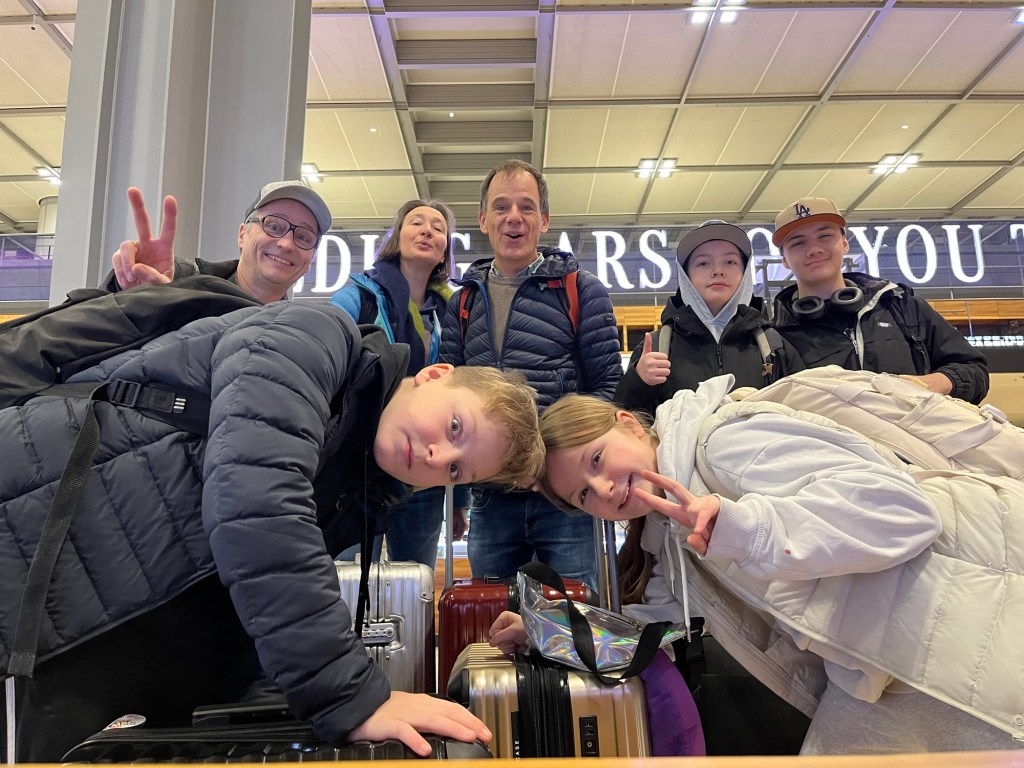
Morgen früh brechen wir auf. Sieben Jahre seit unserem letzten Start geht es wieder los. Noch einmal um die ganze Welt. Und dieses Mal haben wir Freunde dabei, die das Abenteuer mit uns gemeinsam erleben wollen. Den mit Freunden zu Reisen ist am allerschönsten. Andreas und seine beiden Söhne Yuki (15) und Inyan (12) werden uns die ganze Reise begleiten. Sie haben es auch geschafft, Arbeit und Schule und den Alltag mal in Berlin hinter sich zu lassen.
Wir starten also zu siebt morgen um 9:40 Uhr vom Flughafen BER nach Istanbul. Wir, Nadine, (47), Leander (56), Morpheus (12) und Tara (10) sind älter, aber nicht vernünftiger geworden und wollen es noch mal wissen. Unser Ältester Lysander (18) hat heute mit die Wohnung verlassen, wird zwei Wochen bei meinem Bruder wohnen, bevor er selbst nach Indien fliegt und im Februar dann für drei Monate zu einem Praktikum nach Sri Lanka weiterreist, wo er Kinder unterrichten wird. Und unser zweiter Sohn Velis, (16), beendet am 30 Dezember seinen 10 monatigen Aufenthalt mit YFU in Hekinan bei Nagoya, Japan, um wieder zur Familie zu kommen. So können wir Sylvester all zusammen feiern. Sogar meine Schwester mit ihren Kindern und ihrem Mann haben sich für die Feiertage in Indien angekündigt, wir werden sie in Mumbai treffen. Und mein Bruder will im Februar nach Goa kommen, wie auch unsere Freunde Katrin, Micha und ihr Sohn Noah im Januar uns besuchen werden. Auch unsere Freunde Solveig und Knut haben sich angekündigt. Es sind großartige Aussichten.
Die Koffer sind gepackt, die Wohnung ist ausgeräumt, wir packen noch die letzten Sachen in Kisten und bringen sie nachher in den Keller. Schon morgen zieht Emiliano aus Chile bei uns ein und gründet die WG, die dan von Lisa aus Konstanz, Xiaolin aus China und Fabian aus Münster verstärkt wird. Das war die größte Arbeit der letzten Tage, über die Webseite WG Gesucht noch eine WG zusammenzustellen und die Kinderzimmer vorzubereiten. Gestern morgen gab es die letzte Zusage, heute haben wir den ersten Schlüssel übergeben.
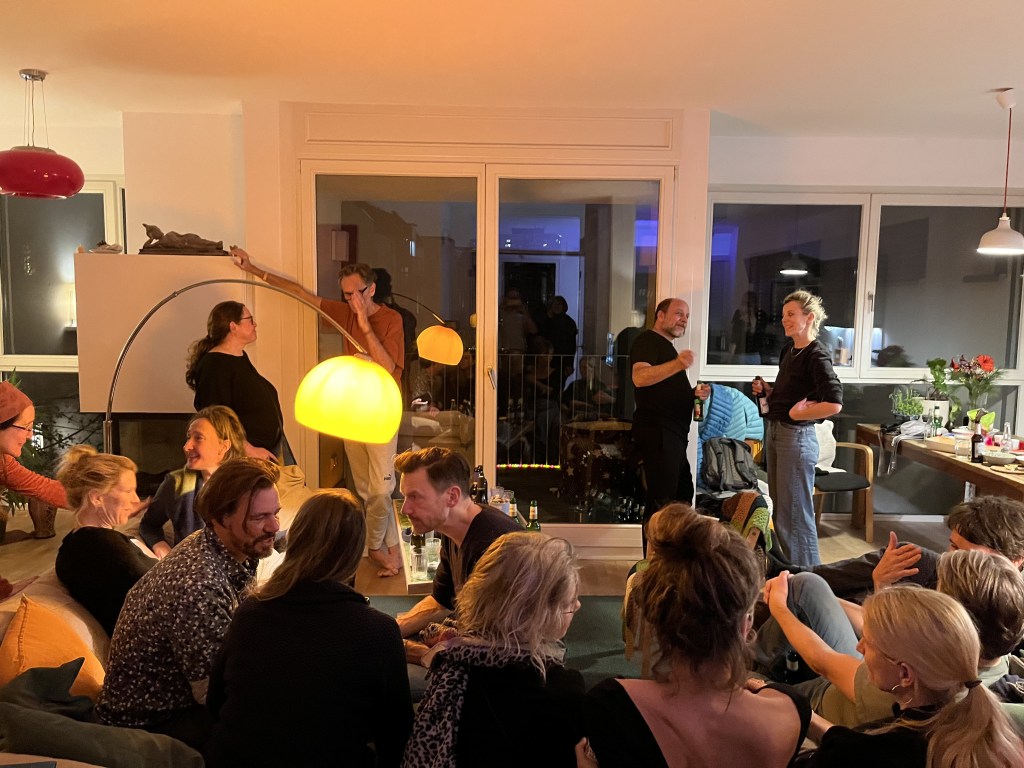
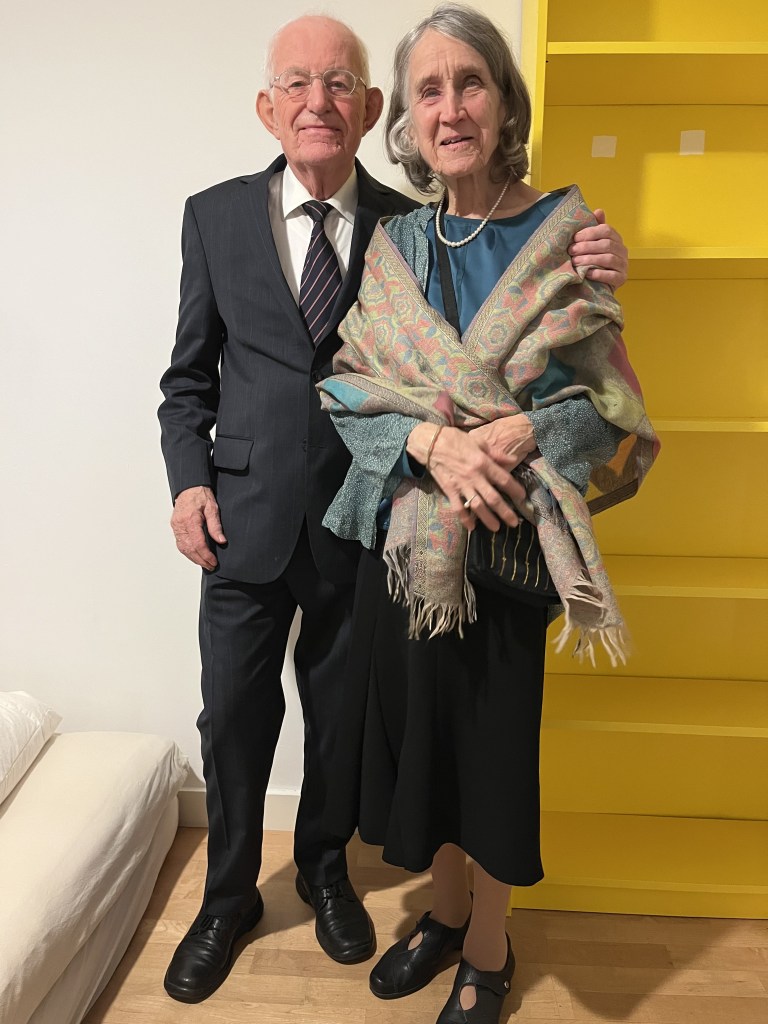
Zuvor gab es aber gestern noch die große Abschiedsparty. Meine Eltern ließen es sich mit 86 und 87 nicht nehmen, noch aus Ulm anzureisen, meine Schwiegermama kam aus Zwickau, und wir luden nur spontan zu Bier und Salzstangen ein. Ein lieber Nachbar bot an, den DJ zu machen, und bis nach Mitternacht war eine richtig coole Party am Gange – eine große Freude Freunde und Familie noch einmal zu verabschieden, während die Enkel mit Oma und Opa in der Zauberflöte in der Staatsoper noch Kultur genießen durften.
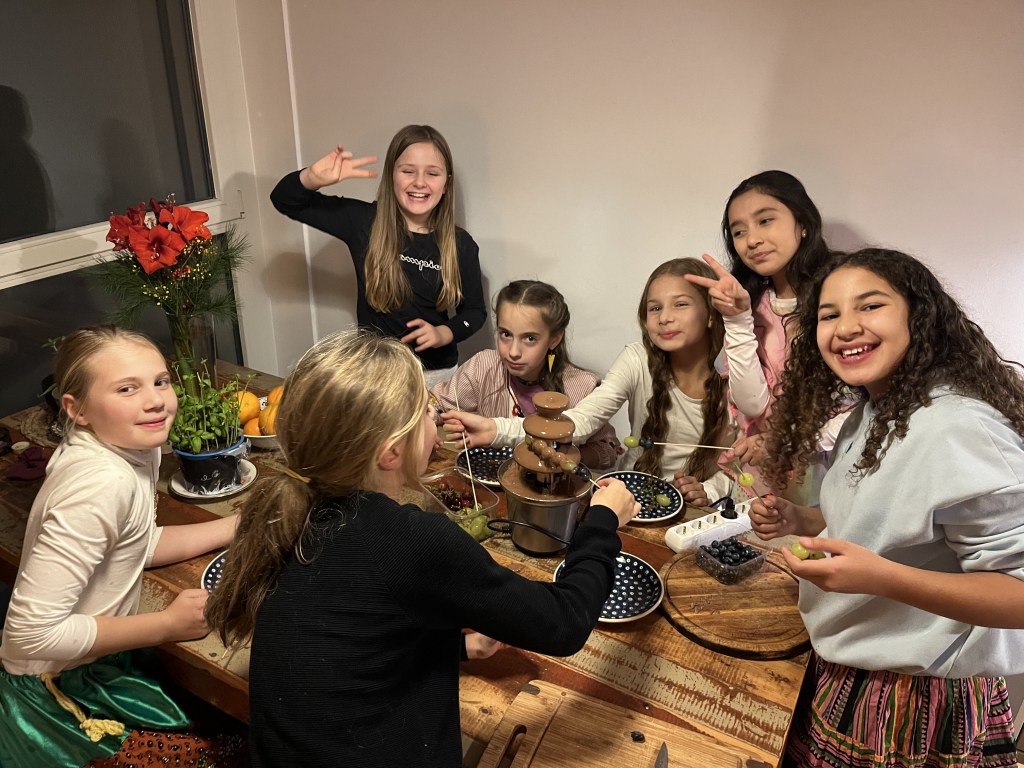
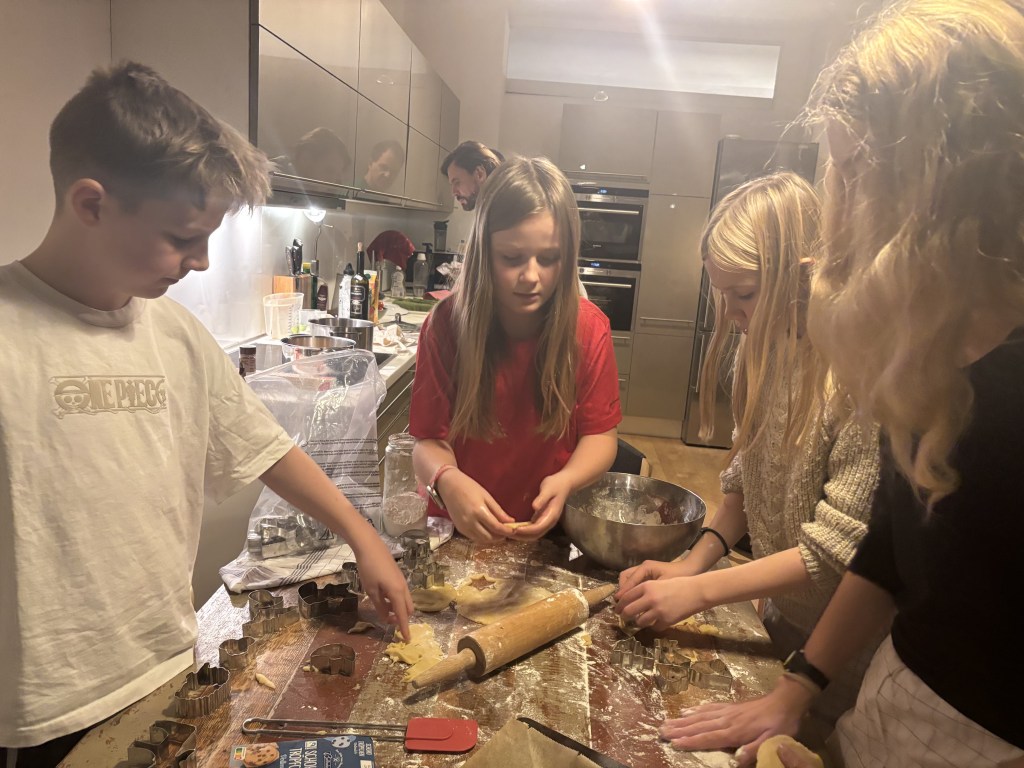
Tara und Morpheus hatten auch noch mal ihre Freunde eingeladen, es gab Schokoladenbrunnen bei Tara und eine Übernachtungsparty von Morpheus. Und für die Klasse Schokomuffins, Plätzchen für die Adventszeit und von den Eltern ein Abschied auf dem Weihnachtsbasar der Grundschule. Wir sind dankbar für so viel freundliche Anteilnahme und Unterstützung, auch von den Lehrern.
Beim Blick auf die Waage war dann heute noch mal aussortieren angesagt. Pegasus erlaubt nur 20 Kg pro Koffer, und so musste noch mal Abschied genommen werden. Nur eine Hose, nur eine Fleecejacke, weniger Bücher und Krimskrams – am Ende hat es gepasst. In den meisten Ländern wird es eh warm sein, und für den Rest hilft die leichte Daunenjacke.
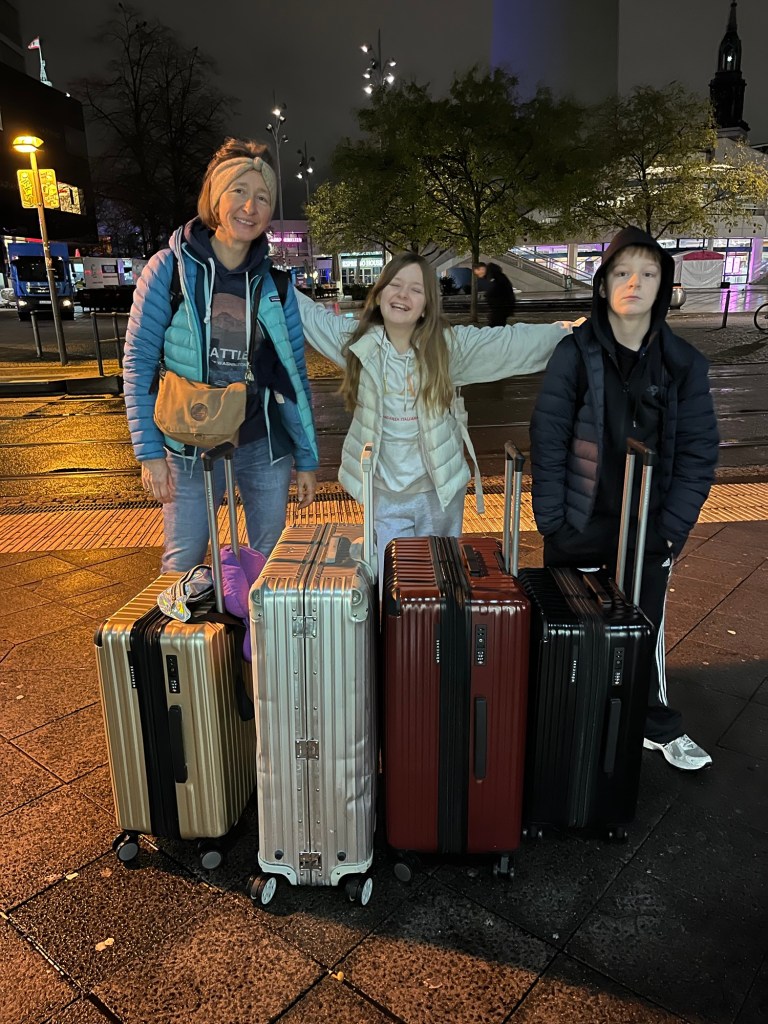
Aber Volleyball und Frisbee, Jonglierbälle und Isomatte müssen mit, wie auch Schlafsäcke und die Reiseapotheke, die Geschenke für unsere indische Vermieter-Familie (der 90jährige Michael hatte sich eine Stirnlampe und Duck-Tape gewünscht). Dieses Mal reisen wir im neuen Stil mit Rollkoffer, zwei große für die Erwachsenen, zwei kleine für die Kinder. Und Nadine bekam als großartige Gabe das Statussymbol der Reisenden von unserem Freund Knut, einen verbeulten Rimova-Koffer in XL.
Hatten wir das letzte Mal einen Trolley dabei, um darauf Sack und Pack zu transportieren, und große Reiserucksäcke, sind die Kinder jetzt groß genug ihren eigenen Koffer zu ziehen und dazu einen kleinen Rucksack als Daypack. Den Trolley haben wir leider verloren. Und Rollen am Koffer sind einfach sehr praktisch. Die Zeiten ändern sich.
Es fällt schwer, nicht den Überblick zu verlieren. So viele Reservierungen und Tickets, Buchungen und Vouchers. Wir hatten schon einige Unruhe im Vorfeld. Flüge, die doppelt gebucht wurden und sich nicht stornieren ließen, Leihwägen, die nie bestätigt wurden und jetzt kurzfristig neu gebucht werden mussten. Für den Oman haben wir dafür etwa jetzt einen Toyota Hilux für die 9 Tage gemietet, der soll uns sicher durch die Berge und Wüste bringen.
Die Nächte waren auch eher unruhig. Immer wieder wach ich auf, mal schon um Mitternacht, mal um 2 oder 3 Uhr. Träume bunte und wilde, aber auch teilweise anstrengende Träume. Oder mit fällt irgend ein To-do ein, das ich noch ganz vergessen hatte. Manchmal auch ist die Vorbereitung voller Hindernisse. Der frisch angemietete Storage-Room in Lichtenberg wird von mir ein zweites Mal gefüllt, als ich merke das eine Matratze, die an die Wand gelehnt war sich mit Wasser vollgesogen hat. Und dazu mehrere Kisten. Kleidung und Papiere sind feucht. Wie gut, dass mir das noch aufgefallen ist – nach 5 Monaten hätten wir eine verschimmelten Haufen vorgefunden. So packe ich alles noch mal um, in einen hoffentlich trockenen neuen Raum, der nicht außen liegt.
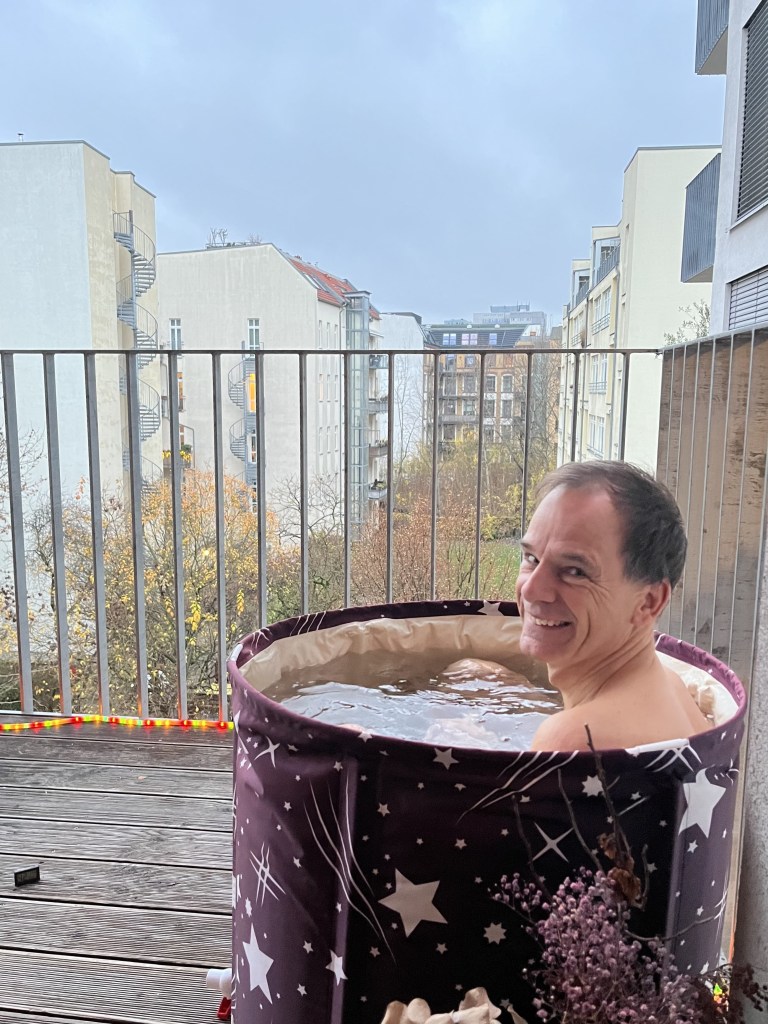
Aber jetzt sieht es so aus, als hätten wir alles noch hinbekommen. Wir biegen auf die Zielgerade ein, die Startbahn kommt näher. Kurs ist Richtung Osten, Byzanz, Konstantinopel oder einfach Istanbul. Unser erstes Ziel wartet. Der Wettergott ist uns gnädig, es ist Sonnenschein und 12-16 Grad für die nächsten 4 Tage angekündigt. Da habe ich den letzten Morgen im Bottich bei 3 Grad Wassertemperatur noch mal so richtig genossen.
Goodby Berlin
Departure to Istanbul
We set off tomorrow morning. Seven years since our last start, we’re off again. Once again around the world. And this time we have friends with us who want to experience the adventure with us. Because travelling with friends is the best thing of all. Andreas and his two sons Yuki (15) and Inyan (12) will be travelling with us the whole way. They have also managed to leave work, school and everyday life behind them in Berlin.
So the seven of us will be leaving BER airport for Istanbul tomorrow at 9.40 am. We, Nadine (47), Leander (56), Morpheus (12) and Tara (10) are older, but not more sensible, and want to try again. Our eldest, Lysander (18), left the flat today and will be staying with my brother for a fortnight before flying to India himself and then travelling on to Sri Lanka in February for a three-month internship where he will be teaching children. And our second son Velis, (16), will end his 10-month stay with YFU in Hekinan near Nagoya, Japan, on 30 December to rejoin his family. So we can celebrate New Year’s Eve all together. Even my sister with her children and her husband have announced that they will be in India for the holidays, we will meet them in Mumbai. And my brother wants to come to Goa in February, just as our friends Katrin, Micha and their son Noah will visit us in January. These are great prospects.
The suitcases are packed, the flat has been cleared out, we’re packing the last few things into boxes and will move them into the cellar later. Tomorrow Emiliano from Chile will move in with us and found the flat share, which will then be joined by Lisa from Constance, Xiaolin from China and Fabian from Münster. That was the biggest job of the last few days, putting together a flat share via the WG Gesucht website and preparing the children’s rooms. Yesterday morning we received the final confirmation and today we handed over the first keys.
But before that, there was a big farewell party yesterday. At 86 and 87, my parents couldn’t resist travelling from Ulm, my mother-in-law came from Zwickau, and we just spontaneously invited them over for beer and pretzel sticks. A dear neighbour offered to do the DJ and a really cool party went on until after midnight – a great pleasure to say goodbye to friends and family once again, while the grandchildren were able to enjoy culture with Grandma and Grandpa at the Magic Flute in the State Opera.
Tara and Morpheus had also invited their friends round again, there were chocolate fountains at Tara’s and a sleepover party for Morpheus. And for the class, chocolate muffins and a farewell from the parents at the primary school Christmas bazaar. We are grateful for so much kind sympathy and support, including from the teachers.
Looking at the scales, we had to sort out again today. Pegasus only allows 20kg per suitcase, so we had to say goodbye again. Just one pair of trousers, just one fleece jacket, fewer books and bits and bobs – in the end it was enough. It will be warm in most countries anyway, and the light down jacket helps for the rest.
But the volleyball and frisbee, juggling balls and sleeping mat have to go, as well as sleeping bags and the first-aid kit, the presents for our Indian landlord family (90-year-old Michael had asked for a head torch and duck tape). This time we are travelling in the new style with wheeled suitcases, two large ones for the adults and two small ones for the children. And Nadine received a great gift from our friend Knut, a dented Rimova suitcase in XL, the status symbol of travellers.
Last time we had a trolley with us to carry bags and packs and large travel rucksacks, but now the children are big enough to pull their own suitcases and a small rucksack as a daypack. Unfortunately, we lost the trolley. And wheels on the suitcase are simply very practical. Times are changing.
It’s hard not to lose track of everything. So many reservations and tickets, bookings and vouchers. We’ve already had a few upsets in the run-up. Flights that were booked twice and couldn’t be cancelled, rental cars that were never confirmed and now had to be rebooked at short notice. We have now rented a Toyota Hilux for the 9 days in Oman, which should take us safely through the mountains and desert.
The nights were also rather restless. I kept waking up, sometimes at midnight, sometimes at 2 or 3 am. I dream colourful and wild, but also sometimes exhausting dreams. Or I remember some to-do that I had completely forgotten about. Sometimes the preparation is also full of obstacles. I fill the newly rented storage room in Lichtenberg a second time when I realise that a mattress leaning against the wall has soaked up water. And several boxes too.
Clothes and papers are damp. It’s a good thing I noticed this – after 5 months we would have found a mouldy pile. So I repack everything again, hopefully into a dry new room that isn’t outside.
But now it looks like we’ve got everything sorted. We turn onto the home straight, the runway is getting closer. We are heading east, towards Byzantium, Constantinople or simply Istanbul. Our first destination awaits. The weather gods have been kind to us, with sunshine and 12-16 degrees forecast for the next four days. I really enjoyed my last morning in the tub when the water temperature was 3 degrees.








 our travel space